
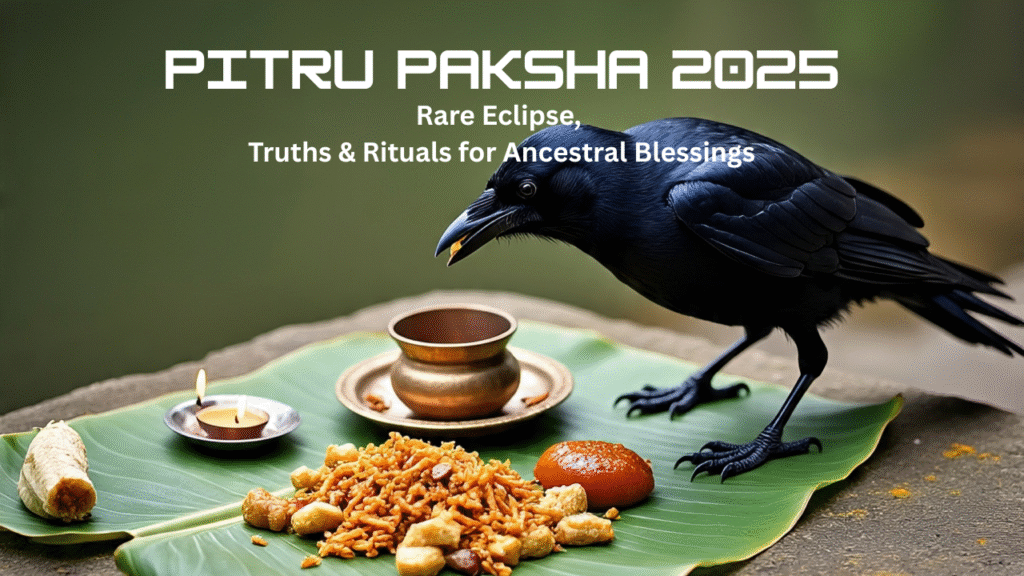
What is Pitru Paksha & Why It Matters
Why 2025’s Eclipses Are Special
- Pitru Paksha (also Pitrŭ-Paksh, Shraddha Paksha) is the 15-16 lunar day period in the Hindu calendar when Hindus honour their ancestors (Pitru) by rituals like Shraddha, Tarpan, Pind Daan etc.
- In 2025, Pitru Paksha begins on 7 September (on Purnima) and ends on 21 September (Mahalaya Amavasya / Sarvapitrī Amavasya) when ancestors are believed to return to their loka.
- What makes 2025 especially rare is that it starts with a total lunar eclipse (Chandra Grahan) on 7-8 September and ends with a solar eclipse (partial) on 21 September. Having both eclipses framing Pitru Paksha is considered uncommon.
- The lunar eclipse on 7 Sept is especially long (≈ 82 minutes) and is visible across large parts of Asia, Africa, Europe and Australia.
- The solar eclipse on 21 Sept is partial, visible mostly in the Southern Hemisphere (South Pacific, eastern Australia, New Zealand, parts of Antarctica). It is not visible from India.
So, Pitru Paksha 2025 is special because of this double eclipse book-ending: a lunar eclipse at the start, a solar eclipse at the end. Many believe this enhances the spiritual potency of this Pitru Paksha.
Ancient / Scriptural Foundations: What the Vedas, Puranas, Upanishads Say
These are the sources and stories that give Pitru Paksha and associated rituals meaning.
- Garuda Purana & Mahabharata
- The Garuda Purana describes how performing Shraddha at the proper time helps departed ancestors attain moksha (liberation) or peace.
- Mahabharata refers to Pitru Paksha and rituals for ancestors; scriptures say one must perform Shraddha, Tarpan, etc., for the peace of souls.
- The Garuda Purana describes how performing Shraddha at the proper time helps departed ancestors attain moksha (liberation) or peace.
- Vedic Astrology / Hindu Calendar Principles
- The Hindu lunar calendar (and notions of paksha / tithi) are tied with lunar phases. Shraddha is to be done in sync with death anniversaries and lunar dates.
- The idea of Pitru Rin (debt to ancestors) is old, found in smritis and Puranas: fulfilling dharma to ancestors is one of the debts humans are born with.
- The Hindu lunar calendar (and notions of paksha / tithi) are tied with lunar phases. Shraddha is to be done in sync with death anniversaries and lunar dates.
- Mythological Stories
- One popular story is of Shraddha of King Bali, or the story of the crow carrying rice offering, expressing gratitude and love to our forebearers. (Many variants across regions.)
- Another is of Markandeya or sages who performed Shraddha to relieve ancestors from suffering. These stories emphasize that offerings, remembrance, help the departed.
- One popular story is of Shraddha of King Bali, or the story of the crow carrying rice offering, expressing gratitude and love to our forebearers. (Many variants across regions.)
- Rules & Restrictions in Scriptures
- Sutak period (before and during eclipses) has scriptural mention: restricting certain activities, purification, etc. (though with regional and textual variations).
- Scriptures say auspicious works (vivah, housewarming etc.) are to be avoided during inauspicious tithis. Pitru Paksha and particularly eclipse times are included.
- Sutak period (before and during eclipses) has scriptural mention: restricting certain activities, purification, etc. (though with regional and textual variations).
Scientific & Astronomical Explanations: What Really Happens in the Sky
Here are the science facts behind eclipses and lunar/solar timing, and how they map onto Pitru Paksha 2025.
- What is a lunar eclipse?
- Happens when Earth comes between Sun and Moon; Earth’s shadow covers the Moon. If full coverage → total lunar eclipse. The reddish colour (“Blood Moon”) comes from sunlight refracting through Earth’s atmosphere and scattering away blue light.
- Happens when Earth comes between Sun and Moon; Earth’s shadow covers the Moon. If full coverage → total lunar eclipse. The reddish colour (“Blood Moon”) comes from sunlight refracting through Earth’s atmosphere and scattering away blue light.
- What is a solar eclipse?
- Occurs when Moon comes between Sun and Earth; part or full Sun is obscured for some areas on Earth. Partial eclipse is when only part of Sun is covered. Visibility depends on location.
- Occurs when Moon comes between Sun and Earth; part or full Sun is obscured for some areas on Earth. Partial eclipse is when only part of Sun is covered. Visibility depends on location.
- Why Eclipses are rare events
- Because orbits of Earth & Moon are inclined; perfect alignment required. Eclipse seasons happen a few times per year, but to have a lunar eclipse and a solar eclipse exactly framing a special period like Pitru Paksha is unusual.
- Because orbits of Earth & Moon are inclined; perfect alignment required. Eclipse seasons happen a few times per year, but to have a lunar eclipse and a solar eclipse exactly framing a special period like Pitru Paksha is unusual.
- Calendar & Lunar Phases, Paksha, Tithi
- Pitru Paksha begins after Purnima (full moon) and leads into Krishna Paksha (waning moon) ending at Amavasya (new moon). The lunar phases are precise in astronomy.
- Eclipses occur only near new moon (solar eclipse) or full moon (lunar eclipse) and near lunar nodes, which is why these alignments are linked to lunar phases.
- Pitru Paksha begins after Purnima (full moon) and leads into Krishna Paksha (waning moon) ending at Amavasya (new moon). The lunar phases are precise in astronomy.
Myths, Truths, Common Beliefs: Separating Fact from Tradition
| Belief / Myth | Traditional View | Scientific or Critical View |
| Ancestors visit Earth during Pitru Paksha; offerings reach them via crows etc. | Yes; offerings of food (anna), water, Tarpan etc. are made, crows are fed as they are believed to be messengers. | Symbolic: The crow tradition may be cultural, representing remembrance. No physical proof of ancestors’ souls receiving food, but belief gives emotional comfort and social cohesion. |
| Eclipses are highly inauspicious; all rituals must stop. | Many texts & customs say during Sutak period certain prohibitions: no cooking, no puja, no starting new ventures etc. | Scientifically, eclipses are purely astronomical. There is no evidence of physical negative impact from the eclipse itself. But psychological, social effects (fear, awe) are real. |
| Doing Shraddha during eclipse (if allowed) gives extra merit. | Some astrologers believe offerings, charity etc during eclipse times multiply merit for ancestors and descendants. | These views are faith‐based, not scientifically provable, but they serve to encourage ritual, mindfulness, social responsibilities like charity. |
What Rituals Are Done, Why, and Their Effects
Here’s what people do, why they believe so, and what effects or benefits are said to come from the rituals.
- Shraddha
- Offer cooked food (rice, kheer, puri etc) to Brahmins, crows, sometimes directly to ancestors via water or via fire.
- Believed effect: Peace for ancestors, blessings for descendants, reduction of Pitru-dosha (ancestral debt or wrongs).
- Offer cooked food (rice, kheer, puri etc) to Brahmins, crows, sometimes directly to ancestors via water or via fire.
- Tarpan
- Pour water mixed with black sesame seeds, barley, kusha grass, while chanting specific mantras. Done by the banks of river, pond etc.
- Believed effect: Quenching the thirst/needs of beings in subtle realms; cleansing, purification.
- Pour water mixed with black sesame seeds, barley, kusha grass, while chanting specific mantras. Done by the banks of river, pond etc.
- Pind Daan
- Offering of rice/bread balls (pinda) to represent body, symbolizing letting go of attachment and helping the departed soul.
- Offering of rice/bread balls (pinda) to represent body, symbolizing letting go of attachment and helping the departed soul.
- Daan / Charity
- Feeding the needy, donating to Brahmins, helping animals, etc. A way to do good karma in name of ancestors.
- Feeding the needy, donating to Brahmins, helping animals, etc. A way to do good karma in name of ancestors.
- Do’s and Don’ts
- Special in 2025
Effects people believe in:
- Spiritual peace for ancestors; less karmic interference from ancestors in living persons.
- Mental peace & emotional closure for people remembering their loved ones.
- Social bonds (family coming together, charity, community).
- A sense of being aligned with cosmic order; humility before nature.
Why 2025’s Double Eclipse Frame Adds Significance
- Because the start (lunar eclipse) happens on the first day of Pitru Paksha: strengthens the sense of cosmic entering; opening of ancestral memory with full moon → darkness.
- Ending with solar eclipse on Mahalaya Amavasya: new moon, eclipse, symbolic of transition, renewal, letting go, closure.
- Astrologers suggest that performing Shraddha/offerings around such rare alignments may amplify the ritual’s effects.
Myths vs What We Know
- Myth: Eclipses are evil, harmful, everything stops.
→ Truth: Certain restrictions are cultural; health caution is sensible (e.g. avoid going out in strong sun during solar eclipse, avoid food contamination etc.). But scientifically, eclipse is a neutral event. - Myth: Ancestors suffer unless ritual is done exactly by complex rules.
→ Truth: In many texts, intent (Shraddha done with faith), charity, remembrance are considered more important than perfection. - Myth: Modern science discredits everything.
→ Truth: Science explains celestial mechanics; but religion/rituals serve psychological, social, moral functions. Both can coexist.
Conclusion
Pitru Paksha 2025 is not just another observance; it is shaped by a rare cosmic alignment — starting with a total lunar eclipse and ending with a partial solar eclipse. This dual eclipse framing amplifies symbolic weight, offering a chance for deeper reflection, ritual potency, and collective remembrance. Ancient scriptures like the Garuda Purana and Mahabharata reinforce that rituals like Shraddha, Tarpan, Pind Daan are not just ritualistic formalities, but mean to assist ancestors’ peace and emotional‐spiritual wellbeing of the living.
Why Mindful MummaNest is sharing this: Because we believe you (and your family) deserve complete, reliable information — not only the rituals, but the science, myths, context, and stories. We want you to be empowered, mindful, and aware of what is happening around you — in the skies, in the calendar, and in your own heart.
“Our Mumms Are Not Alone”
All housewives, mothers, caregivers — you are not alone. Mindful MummaNest is here as your real friend. We don’t just suggest; we celebrate your successes. We guide you with skills, knowledge, rituals, news, grooming, earning ideas. Stay connected with us so we can help, support, and celebrate you too.
Best Sources & Tools for Pitru Paksha 2025
We have carefully combined ancient wisdom, modern astronomy, and practical tools so you get everything in one place — trusted, research-backed, and easy to use.
- Garuda Purana & Mahabharata – describe Shraddha, Tarpan, Pitru Rin (ancestral debt) and why they matter.
- Times of India – Pitru Paksha 2025 Dates & Significance – confirmed dates, dos & don’ts.
- Hindustan Times – Weekly Panchang & Grahan – for eclipse & planetary transit details.
- India Today – Lunar Eclipse 2025 Coverage – scientific facts & visibility zones.
- NASA Eclipse Portal – authentic global timings and eclipse maps.
- MyJar Blog – Pitru Paksha Traditions – easy-to-understand tradition guide.
Practical Tools to Stay Aligned
- Drik Panchang App / Website – accurate tithi, muhurat, and city-specific timings for Shraddha.
- NASA Eclipse Visualization Tool – see live path & timing of September 2025 eclipses.
- Google Sky Map / Stellarium App – observe Moon & Sun positions during Pitru Paksha nights.
- YouTube Explainers
- Mindful MummaNest Blog Library – your digital friend for festival guides, earning tips, and mindful living updates.