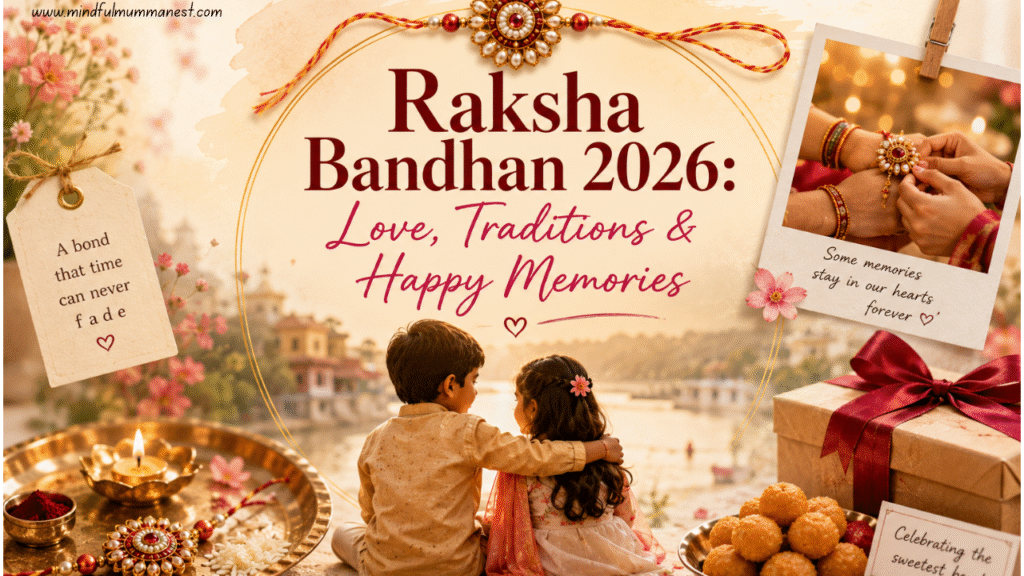
Raksha Bandhan Across India: One Festival, Many Traditions
When Is Raksha Bandhan 2026?
Raksha Bandhan 2026: A Festival That Takes Me Back to Childhood
There are some festivals that feel less like a festival and more like childhood, and Raksha Bandhan is one of them for me. I still remember the excitement, everyone gathering together, silly fights, laughter, gifts, photographs, games and outings. Somehow, on this one day, we all became little children again.
Even today, life has changed with work, family, responsibilities and the dream to earn money, but Rakhi brings back those old jokes, memories and promises.
- Childhood memories, sibling love and family time
- Rakhi traditions, stories, Bhadra and Muhurat
- How different parts of India celebrate
- Simple ways to celebrate without spending too much
- Meaningful Rakhi gifts
- Small opportunities to learn skills and earn money
At Mindful Mumma Nest, we care about keeping you updated with the festivals, lifestyle, traditions, opportunities and everyday knowledge that matter to you. I want you to understand why we celebrate, not just follow a tradition because everyone else does.
So today, let’s talk about Raksha Bandhan 2026—its stories, rituals, meaning, memories and how this beautiful festival can also inspire us to learn, grow and earn money while staying connected to the people we love.
Raksha Bandhan 2026: When Is It and What Is the Muhurat?
First, let’s clear the biggest confusion.
Raksha Bandhan 2026 will be celebrated on Friday, August 28, 2026, in India.
The confusion comes because Shravana Purnima begins on August 27 at 9:08 AM and ends on August 28 at 9:48 AM. The festival is observed on August 28 because of the way the Purnima day and sunrise are considered for the festival.
For Delhi and nearby North Indian locations, the available Panchang timings show the Rakhi ceremony beginning around 5:57 AM on August 28 and continuing until 9:48 AM, with Bhadra already over before sunrise.
Local Panchang timings can differ slightly by location, so if your family follows a particular Panchang or family tradition, check that local timing before the ritual.
What About Bhadra?
This is the part many families ask about.
Bhadra is a period associated with Vishti Karana in the Hindu Panchang. Traditional practice generally avoids starting important auspicious ceremonies during Bhadra. Raksha Bandhan is one of the festivals where this timing is especially discussed.
In 2026, the good news is that for the main North Indian locations checked, Bhadra ends before sunrise on August 28.
So there is no need to panic.
You don’t have to rush.
You don’t have to tie Rakhi just because everyone else on social media has started posting.
Wait for your family’s appropriate Muhurat.
Then celebrate peacefully.
Why Do People Avoid Rakhi During Bhadra?
The traditional explanation is simple.
Bhadra is considered unsuitable for auspicious ceremonies.
There are also traditional stories connecting Bhadra with difficult or destructive energy, which is why people prefer to wait until it passes.
I always feel that understanding the reason behind a tradition makes it more meaningful.
We don’t have to be frightened by every belief.
We can understand it.
Respect it.
And follow it according to our family’s tradition.
How Do We Celebrate Raksha Bandhan?
Honestly, we don’t need a huge celebration.
That is one thing I want to remind you.
You don’t need an expensive decoration.
You don’t need a designer Rakhi.
You don’t need a huge gift.
You don’t need a restaurant booking.
The heart of Raksha Bandhan is very simple.
A sister or sibling ties the sacred thread.
Prayers are offered.
Blessings are exchanged.
Sweets are shared.
Gifts are exchanged.
And the family spends time together.
Traditional Raksha Bandhan rituals commonly include preparing a puja thali with Rakhi, roli, rice and sweets, applying tilak, tying the Rakhi and exchanging gifts.
A Simple Rakhi Thali
You can keep:
- Rakhi
- Roli or kumkum
- Unbroken rice grains
- Diya
- Sweets
- Flowers
- A small amount of water
- Your family’s traditional puja items
You don’t need twenty things.
Keep it simple.
Keep it clean.
Keep your heart happy.
A Simple Raksha Bandhan Mantra
One traditional Sanskrit Raksha Sutra mantra often recited is:
“येन बद्धो बली राजा दानवेन्द्रो महाबलः।
तेन त्वामभिबध्नामि रक्षे मा चल मा चल॥”
A simple meaning is:
The sacred thread with which the mighty King Bali was bound is being tied to you; may this protection remain firm.
If your family follows another mantra or traditional prayer, you can continue with that.
There is no need to turn a beautiful family festival into a stressful examination.
After Tying Rakhi
You can:
- Offer sweets.
- Take blessings from elders.
- Exchange gifts.
- Touch elders’ feet according to family custom.
- Take family photographs.
- Eat together.
- Call siblings who cannot come home.
- Share old photographs.
- Play childhood games.
- Go for an outing.
- Simply sit together and talk.
That last one is my favourite.
Sometimes the best Rakhi gift is time.
The Many Stories Behind Raksha Bandhan
This is where Raksha Bandhan becomes fascinating.
There isn’t only one story.
Different scriptures, traditions and later cultural narratives connect the sacred thread with protection, duty, affection and relationships.
And we should remember one thing.
A popular Rakhi story is not automatically a historically verified event.
Some are scriptural narratives.
Some come from later traditions.
Some are popular legends.
Some have become part of India’s cultural memory.
That doesn’t make them meaningless.
It simply means we should tell them honestly.
1. Indra and Sachi: The Sacred Protection Thread
One of the oldest commonly cited Raksha Bandhan narratives is connected with Indra, Sachi/Indrani and Brihaspati.
The story appears in traditions associated with the Bhavishya Purana.
The devas were facing a difficult battle with the asuras. Indra was worried. Sachi sought divine help, and a sacred protective thread empowered through prayer was associated with protection for Indra.
The devas eventually won.
The story connects the sacred thread with protection, faith and courage, rather than only the brother-sister relationship.
And I love this because it reminds us that Raksha is a much bigger word than “brother protects sister.”
It can mean:
I stand beside you.
2. Krishna and Draupadi: A Small Gesture, A Lifelong Promise
This is probably the story many of us have heard since childhood.
In the popular retelling, Krishna injured his finger and Draupadi immediately tore a piece of cloth from her saree and tied it around his finger.
It was a small act.
She didn’t ask for anything.
She simply saw someone she loved bleeding and helped.
Later, Krishna’s protection of Draupadi is connected in popular tradition with that bond.
The story is deeply loved, but it is worth remembering that versions of this story vary, and the exact connection to Raksha Bandhan is part of later tradition rather than a simple one-line statement from the Mahabharata itself.
That makes the lesson even more beautiful for me.
A relationship is built through small acts.
Not only through big promises.
3. Yama and Yamuna: When a Sister Welcomes Her Brother
Another beautiful traditional story is about Yama and Yamuna.
Yamuna wanted her brother to visit her. In the popular account, after a long separation, Yama finally visited her.
She welcomed him.
She prepared food.
She tied the sacred thread.
Yama was touched by her affection and blessed her.
This story is associated with love, reunion, hospitality and the wish for a long and blessed life.
And isn’t this exactly what many of us still do?
We wait for our siblings.
We prepare their favourite food.
We complain that they came late.
Then we hug them anyway.
That is Rakhi.
4. Lakshmi and King Bali: When Rakhi Became a Bond of Trust
Another important story connects Goddess Lakshmi, Lord Vishnu and King Bali.
In the traditional account, Vishnu had promised to protect Bali and stayed with him. Lakshmi wanted Vishnu to return to Vaikuntha.
She approached Bali, tied a sacred thread and revealed her identity and wish.
Bali accepted the relationship and allowed Vishnu to return.
This tradition is also connected with the name Baleva in some contexts.
Again, the meaning is not simply “a brother must give a gift.”
It is about trust, relationship and keeping one’s word.
5. Other Stories You May Have Heard
There are many more stories attached to Raksha Bandhan.
Some popular traditions mention Kunti and Abhimanyu.
Some connect the festival with Santoshi Mata, Shubh and Labh.
There are also historical stories involving Rani Karnavati and Humayun, and popular accounts about Roxana and Porus.
But here I want to be careful.
These stories belong to different layers of Indian tradition and historical memory, and they should not all be presented as equally documented historical facts.
That distinction matters.
We can respect our stories without changing legends into history.
And that is exactly how I want to share knowledge with you.
With love.
But also with honesty.
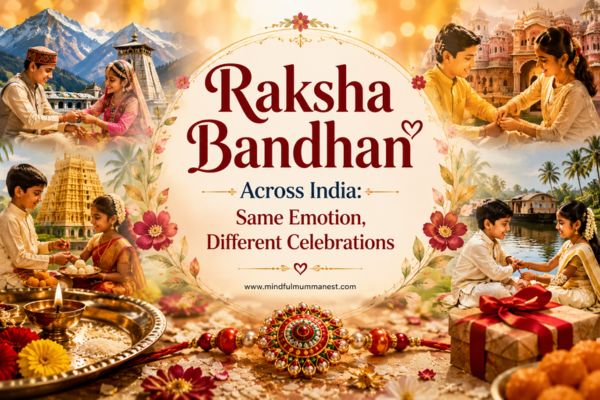
Raksha Bandhan Across India: Same Emotion, Different Celebrations
This is one of the things I love most about India.
One festival.
So many expressions.
In different regions, Shravan Purnima carries different names and customs.
Maharashtra
In Maharashtra, the day is strongly associated with Narali Purnima, especially among coastal communities. Coconut offerings to the sea are an important part of the festival traditions, alongside Rakhi celebrations.
Rajasthan
Some communities have traditions involving tying threads to trees and connecting the festival with protection of nature. In some places, brothers are ceremonially honoured as “raja.”
Uttarakhand
Raksha Bandhan can also involve Raksha Sutra rituals connected with priests and religious ceremonies.
The sacred thread becomes a wider symbol of protection and blessing.
Uttar Pradesh
In many places, people also use Raksha Bandhan as an opportunity to thank those who protect society, including soldiers and police personnel.
Odisha and Other Regions
Shravana Purnima is connected with other regional observances too, showing how one lunar day can hold several layers of religious and cultural meaning.
This is what makes India beautiful.
We don’t always celebrate the same day in exactly the same way.
But the feeling travels.
What Does Science Say About Raksha Bandhan?
Now let’s step outside mythology for a moment.
Because I love when tradition and curiosity sit together.
Raksha Bandhan falls around the full moon of Shravana.
A full moon happens when the Earth is positioned between the Sun and Moon so that the Moon’s Earth-facing side is fully illuminated.
The Moon does not produce its own light.
It reflects sunlight.
The Earth rotates on its axis.
The Moon orbits Earth.
And Earth orbits the Sun.
So while we are sitting at home tying Rakhi, there is a huge movement happening above us that we don’t even notice.
I find that beautiful.
Our festivals were developed around natural cycles long before we had smartphones telling us the date.
And there is another interesting 2026 detail.
A deep partial lunar eclipse also occurs on August 28, 2026, but it will not be visible from India. Current reporting therefore notes that the eclipse does not prevent Raksha Bandhan rituals in India; traditional Sutak practices are generally tied to an eclipse being visible at the location.
So don’t let social-media messages frighten you.
Check reliable information.
Check your local Panchang if your family follows it.
And then celebrate peacefully.
Raksha Bandhan, Childhood and My Siblings
This is the part where I don’t need any book.
I have my own memories.
My siblings and I didn’t need an expensive plan.
We simply needed everyone together.
The house became noisy.
Someone was laughing.
Someone was teasing someone else.
Someone was asking when the gift would be opened.
Someone was taking photographs.
And somehow we all became children again.
We still love gifts.
We still love food.
We still like going out.
We still take photographs.
We still tease each other.
Maybe the only thing that changed is that our childhood clothes became adult clothes and our responsibilities became much bigger.
But the feeling didn’t change.
And I don’t want it to.
Because in today’s world, we are constantly being told to grow up.
Work harder.
Earn money.
Build your career.
Buy something.
Invest.
Save.
Improve.
Compete.
Sometimes Raksha Bandhan simply says:
Come home.
That is enough.
Raksha Bandhan Gifts: Don’t Buy the Price, Buy the Feeling
I have seen how gifting has changed.
Earlier, a simple gift could make us extremely happy.
Today we have endless choices.
Jewellery.
Perfume.
Clothes.
Gadgets.
Wallets.
Books.
Beauty products.
Gift hampers.
Experiences.
And there is nothing wrong with that.
But please don’t turn Rakhi into a competition.
Recent 2026 gifting coverage is also emphasising personalised and meaningful gifts over simply expensive ones.
5 Gift Ideas for a Sister
- A personalised piece of jewellery — something she can actually wear.
- A handbag or useful everyday accessory — practical and beautiful.
- A book with a handwritten note — especially if she loves reading.
- A self-care or skincare gift — chosen according to her preferences.
- A memory gift — photo book, framed photograph or a handwritten childhood letter.
5 Gift Ideas for a Brother
- A good wallet — useful every day.
- A watch or smart accessory — practical and memorable.
- A grooming kit — if he enjoys personal care.
- A book or journal — especially for someone who likes learning.
- A personalised gift — something carrying his name, initials or an inside joke between you.
And remember something.
A handwritten letter can beat a ₹5,000 gift.
Because money buys things.
Memory creates relationships.
Raksha Bandhan and a Small Opportunity to Earn Money
Now you know I could not finish this article without talking about this.
Because if we are discussing lifestyle, we should also discuss financial confidence.
Festivals create demand.
People need gifts.
People need decorations.
People order sweets.
People buy clothes.
People search for ideas.
People need social media posts.
People look for personalized products.
People want photographs.
People want handmade items.
And behind every need, there can be a small skill.
This does not mean you should turn every family celebration into a business.
It means you can learn to notice opportunities.
Rakhi Gift Content Creator
You can create Rakhi gift recommendation content on Instagram, Pinterest, a blog or YouTube.
You can learn affiliate marketing and potentially earn money when eligible purchases happen through your properly disclosed affiliate links.
If you want to understand how collaborations work, read my Partnership with Influencers: How It Can Help You Earn Money.
Pinterest Rakhi Ideas
Create useful Pinterest content around:
- Rakhi gift ideas.
- Rakhi decoration.
- Rakhi thali ideas.
- Rakhi outfit ideas.
- Brother-sister photography.
- Rakhi return gifts.
- Handmade Rakhi ideas.
Pinterest can become a traffic source when you learn how to create useful visual content consistently.
If you want to explore this path, I have already shared Pinterest Earn Money Ways: Ideas You Can Start Learning.
Handmade Rakhi or Gift Hampers
If you are creative, you can learn to make:
- Handmade rakhis.
- Gift hampers.
- Personalised cards.
- Photo frames.
- Chocolate boxes.
- Small festive decorations.
- Plantable or eco-friendly Rakhi products.
Start small.
Show your work.
Take orders only when you can manage them.
Don’t buy huge stock just because a festival is coming.
AI Skills for Festive Content
This is another modern opportunity.
You can learn how to use AI tools responsibly for:
- Content ideas.
- Product descriptions.
- Social media captions.
- Festival calendars.
- Design brainstorming.
- Customer communication drafts.
- Basic content planning.
I have already talked about this in AI Skills to Learn and Earn Money: Skills for the New Digital World.
Remember:
AI is a tool.
Your judgement, creativity and human understanding are still yours.
Simple Living Can Also Help You Earn Money
This may sound strange, but it connects directly with our lifestyle philosophy.
When we stop buying everything simply because a festival is coming, we can use that saved money more thoughtfully.
We can learn.
We can invest in a useful skill.
We can create something.
We can start small.
I wrote about this connection in 5 Ways to Live a Simple Life and Earn Money.
If You Love Spiritual Content
There is also a growing interest in spiritual and devotional content.
If you genuinely know the subject and share it respectfully, you can explore content creation around:
- Festival traditions.
- Puja information.
- Mantras.
- Cultural history.
- Temple stories.
- Devotional crafts.
- Festival calendars.
You can read my Divine Remedies and Ways to Earn Money article for another perspective.
But please don’t make false promises.
Don’t tell people a ritual will guarantee wealth.
Don’t exploit someone’s faith.
And never promise guaranteed income.
That is not the kind of earning journey I want for us.
7 Simple Steps to Turn a Festival Interest Into a Small Skill
If Raksha Bandhan makes you think, “Maybe I can do something too,” start here.
- Choose one skill.
- Learn it from a reliable platform.
- Practice with Rakhi-related content.
- Create 5–10 examples.
- Share them honestly.
- Learn what people actually respond to.
- Improve before spending big money.
- Keep records of your expenses.
- Never promise guaranteed earnings.
- Keep your family celebration separate from business pressure.
You can learn digital skills through platforms such as Canva Design School, Google Skillshop, Meta Blueprint, YouTube tutorials and other reputable learning resources.
And please remember:
The first goal is not a huge income.
The first goal is useful skill + real practice + first opportunity.
Raksha Bandhan Is Also About Giving Protection Back
There is something I want us to think about this year.
We often say:
Brother protects sister.
But life today is different.
Sisters protect brothers too.
Brothers support sisters.
Siblings support each other’s careers.
Siblings help each other financially.
They listen.
They stand beside one another during difficult decisions.
They encourage each other to learn.
They tell each other when something is wrong.
They celebrate each other’s achievements.
So perhaps the modern meaning of Raksha Bandhan is:
I will not leave you alone when life becomes difficult.
That feels much closer to the real bond.
What Should We Do on Raksha Bandhan 2026?
Nothing complicated.
Wake up.
Take a bath.
Wear something you feel good in.
Prepare your thali.
Offer your prayers according to your family tradition.
Wait until the appropriate local Muhurat.
Apply tilak.
Tie the Rakhi.
Say your prayer.
Exchange sweets.
Exchange gifts.
Take photographs.
Eat together.
Call the sibling who cannot come.
Visit someone who needs love.
And then forget the phone for a little while.
Play a game.
Tell an old story.
Look at childhood photographs.
Laugh.
Because one day these ordinary moments will become memories.
Guest Corner: With Gratitude
I am grateful to the Vedas and the wider Vedic tradition for giving India a way of looking at life through nature, time, duty and sacred relationships; to the Bhavishya Purana for the traditional Indra-Sachi Raksha Sutra narrative; to the Mahabharata tradition for the stories of Krishna and Draupadi and the many ways protection, duty and relationships appear in the epic; to the Vishnu Purana tradition and later retellings for the Lakshmi-Bali-Vishnu story; to the traditional stories of Yama and Yamuna for reminding us about reunion and sibling affection; to the countless regional traditions of Maharashtra, Rajasthan, Uttar Pradesh, Uttarakhand, Odisha and other parts of India for showing us that one festival can carry many beautiful forms; and to every grandmother, mother, father, brother, sister, teacher, priest, storyteller and family member who has carried these traditions from one generation to another.
I am also grateful to the writers, researchers, Panchang makers and cultural historians whose work helps us understand our festivals with more care.
And most of all, I am grateful to my siblings.
For the childhood memories.
The fights.
The laughter.
The gifts.
The photographs.
The teasing.
Growing up.
And the strange magic of becoming children again whenever we are together.
Final Thoughts: What Raksha Bandhan Really Gave Me
After learning all these stories, I feel Raksha Bandhan is much more than a sacred thread. It carries love, memories, prayers, family, promises and childhood. This year, when you tie Rakhi, don’t think only about the gift you receive—think about the love and support you give.
- Your time
- Your trust
- Your blessings
- Your presence
- Your encouragement
- Your belief in each other’s dreams
Maybe your sibling wants to learn a skill, start a blog, become financially independent or earn money. Tell them, “Go ahead, I believe in you.” Sometimes the best Rakhi gift is not inside a box—it is the courage to begin.
At Mindful Mumma Nest, I believe we can love our traditions, support our families, build our dreams and earn money without forgetting what truly matters.
I am proud of our beautiful traditions that give us memories, reasons to smile, celebrate and come closer to the people we love. We can honour them, build our dreams, learn, grow and earn money without losing our relationships.
So from my family to yours, Happy Raksha Bandhan 2026. May this sacred bond always stay strong, and may every brother and sister always have someone to say, “Don’t worry, I am here.”
Frequently Asked Questions
1. When is Raksha Bandhan 2026?
It will be celebrated on Friday, August 28, 2026.
2. When can I tie Rakhi?
For Delhi and nearby North Indian locations, the Rakhi ceremony is in the morning after Bhadra, with timings varying by location.
3. Why is Bhadra avoided?
Traditional Panchang practice considers Bhadra unsuitable for auspicious ceremonies such as Rakhi tying.
4. What should be kept in a Rakhi thali?
Rakhi, roli, rice, diya, sweets and your family’s customary puja items are enough.
5. What is the main meaning of Raksha Bandhan?
It celebrates love, protection, trust, blessings and the sibling bond.
6. Can Raksha Bandhan help me earn money?
The festival can inspire small opportunities in content, crafts, gifting, affiliate marketing and digital skills.
Sources & Tools
1. Drik Panchang
For 2026 Raksha Bandhan date, Purnima, Bhadra and local Muhurat information.
2. Times of India
For current 2026 festival updates, traditions and mythology research.
3. WHO & ILO
For the health context around working hours mentioned in our broader lifestyle philosophy.
4. International Labour Organization
For work, time and modern working-life context.
5. Indian cultural and regional references
For understanding how Raksha Bandhan and Shravana Purnima are observed differently across India.
6. Panchang and astronomy references
For understanding the relationship between Purnima, lunar cycles and the 2026 eclipse information.
One Last Thing From Me
Rakhi doesn’t have to be perfect; just be with your people—a call, an old photo and a little laughter can be enough.
Take one small step toward your dreams, skills and earn money journey, but never forget those who stood beside you along the way.
Stay connected, keep learning, keep earning—and never forget to celebrate the people you love.
Happy Raksha Bandhan from Mindful Mumma Nest.