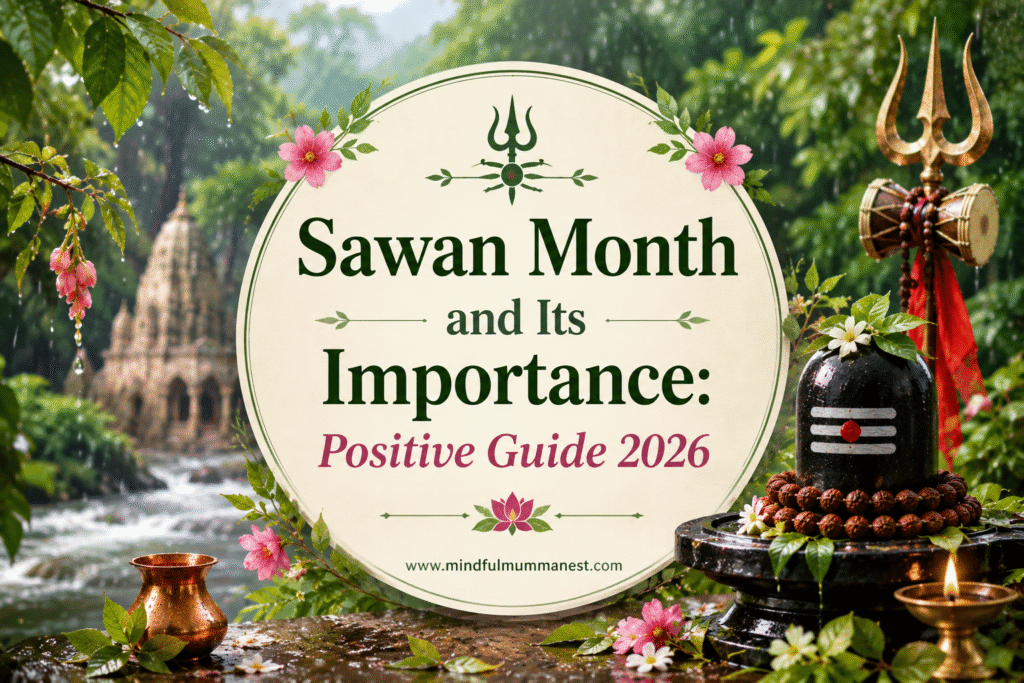
Sawan Month and Its Importance: Nature, Devotion & Growth
What Is Sawan Month?
There is something different about Sawan.
The first rain, the smell of wet earth, greener trees, cloudy skies, temple bells and the sound of “Har Har Mahadev” together create a feeling that is difficult to explain. Sawan is not just another month in the Hindu calendar. It is a beautiful meeting point of nature, devotion, family traditions, spirituality and inner reflection.
For many of us, Sawan brings back memories of childhood—green bangles, mehndi, swings, fasting, visiting temples, listening to Shiv bhajans and enjoying simple homemade food with family.
But have you ever wondered why Sawan is considered so special?
Why is this month connected so deeply with Lord Shiva?
Why do Mondays become important?
Why does nature seem to become part of the celebration?
And can the values we learn during Sawan also help us create a more meaningful lifestyle—and even discover ways to earn money from our skills and creativity?
Let’s understand Sawan from all these beautiful angles, without losing the simplicity and faith behind it.
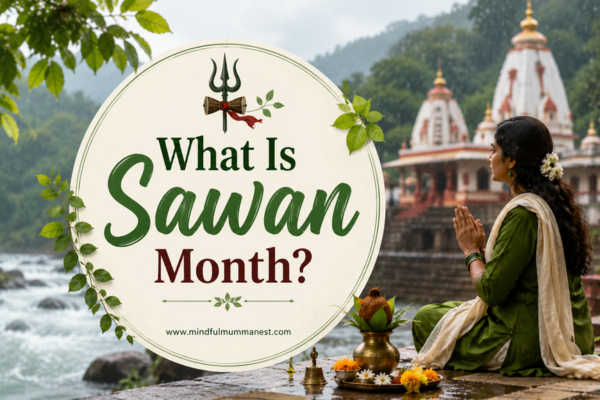
What Is Sawan Month?
Sawan, also called Shravan or Shravana, is a significant month in the Hindu lunar calendar. It is especially associated with Lord Shiva, fasting, prayer, temple visits and several important festivals and traditions.
The word may sound different in different parts of India, but the feeling remains beautifully connected.
- Uttar Pradesh and several North Indian states commonly use Sawan.
- Maharashtra and Gujarat commonly use Shravan Maas.
- Karnataka observes Shravana Maasa.
- Andhra Pradesh and Telangana use Shravana Masam.
- West Bengal and Assam commonly use Shrabon.
- Tamil Nadu observes the corresponding period through its regional calendar traditions.
- Kerala follows its own Malayalam calendar, where the monsoon season has a different month name and cultural rhythm.
This itself tells us something beautiful about India.
One season. Many names. Many traditions. One cultural connection.
Sawan 2026: Why Are the Dates Different Across India?
This is important because you may see different Sawan dates online and wonder which one is correct.
India follows different traditional calendar systems in different regions.
In much of North India, including Uttar Pradesh, Uttarakhand, Rajasthan, Madhya Pradesh, Punjab, Himachal Pradesh, Bihar, Jharkhand and Chhattisgarh, the Purnimanta system is commonly followed.
For these regions, Sawan 2026 begins on 30 July and ends on 28 August 2026. The four Sawan Somwars are 3 August, 10 August, 17 August and 24 August 2026.
In several western and southern regions, including Maharashtra, Gujarat, Goa, Karnataka, Andhra Pradesh and Telangana, the Amanta system is followed. There, Shravan 2026 begins on 13 August and ends on 11 September 2026.
So, if your family follows a different date from someone living in another state, it does not necessarily mean that one person is celebrating Sawan “wrong.”
India’s calendars themselves carry regional traditions.
The best practice is to follow the calendar traditionally observed by your family, community and local temple.
Why Does Sawan Come With the Monsoon?
Now comes one of my favourite connections—Sawan and nature.
Sawan arrives during India’s monsoon season, when the dry landscape begins transforming.
The earth receives water.
Trees become greener.
Rivers and ponds receive fresh flow.
Farmers prepare their fields.
Birds, insects and other living beings respond to the changing environment.
The whole landscape seems to breathe differently.
And perhaps this is one reason Sawan feels so alive.
It reminds us that life can begin again after a dry period.
Just like the earth waits for rain, we too sometimes need a season of rest, reflection and renewal.
Sawan can therefore be seen not only as a religious period but also as a beautiful reminder to reconnect with the natural world around us.
Sawan, Nature and the Feeling of Renewal
Think about the simple things around you during Sawan.
A tulsi plant looking fresher after rain.
A balcony filled with green leaves.
The sound of rain against the window.
A muddy pathway after the first shower.
A temple surrounded by wet trees.
A family sitting together with a cup of chai while rain falls outside.
These moments may look ordinary, but they teach us something important.
We do not always need more. Sometimes we simply need to notice more.
That is where Sawan beautifully connects with the philosophy of Mindful Mumma Nest.
Mindful living does not always mean doing something big.
Sometimes it means slowing down.
Looking at what we already have.
Using our skills.
Creating something meaningful.
Taking care of our home.
Spending time with family.
And finding purpose in simple everyday life.
Why Is Sawan Associated With Lord Shiva?
Sawan is traditionally considered especially sacred for devotees of Lord Shiva. Devotees may observe fasting, offer water to the Shivling, visit temples, chant prayers and participate in other devotional practices during the month.
But the connection between Sawan and Shiva is deeper than simply visiting a temple.
Lord Shiva is often understood through qualities such as simplicity, meditation, detachment, compassion, strength and acceptance.
He is not surrounded by excessive luxury.
He is associated with mountains, forests, rivers, animals and the natural world.
His appearance itself carries powerful symbols—the Ganga, the crescent moon, the serpent, the trident and the ash.
So when Sawan arrives with rain, greenery and a quieter natural rhythm, the season seems to complement the imagery associated with Shiva.
It gives us an opportunity to ask ourselves:
Can I simplify my life a little?
Can I become calmer?
Can I control what I can and release what I cannot?
Can I use what I already know to create something meaningful?
These questions take Sawan beyond ritual and bring it into everyday life.
The Mythological Connection: The Samudra Manthan
One of the most well-known stories associated with Lord Shiva is the Samudra Manthan, or churning of the cosmic ocean.
According to Hindu mythology, devas and asuras churned the ocean to obtain amrita, the nectar of immortality.
During this process, a deadly poison called halahala emerged.
The poison was so powerful that it threatened the entire creation.
Lord Shiva consumed the poison to protect the universe.
According to the traditional story, Goddess Parvati stopped the poison from travelling further into his body, and Shiva became known as Neelkanth, the blue-throated one.
This story is a sacred mythological tradition, not a scientific account of an historical event.
And perhaps its deeper lesson is what makes it so powerful.
Sometimes protecting others requires strength, responsibility and sacrifice.
For a mother, this idea can feel especially familiar.
We often absorb the worries of our homes, children and families.
But Sawan can also remind us of something equally important:
Strength does not mean carrying everything alone.
We need moments of silence, rest, prayer, creativity and renewal too.
And sometimes, taking care of yourself is the first step towards taking care of everything else.
Sawan Is Not Only About Shiva
Although Shiva is central to Sawan traditions, the month is also connected with Goddess Parvati, family traditions, women’s celebrations, nature and several important festivals.
Mondays are traditionally associated with Shiva, while Tuesdays during Shravan are associated in many traditions with Mangal Gauri, a form of worship connected with Goddess Parvati.
This gives Sawan a beautiful balance.
Shiva represents stillness and consciousness.
Parvati represents strength, devotion and Shakti.
Together, they remind us that life needs both:
calmness and action,
strength and softness,
faith and effort.
And this is where our journey from Sawan → mindful living → women → skills → earning money will slowly begin.
Because earning money is not only about money.
It can also be about identity, confidence, independence and using the abilities we already carry within us.
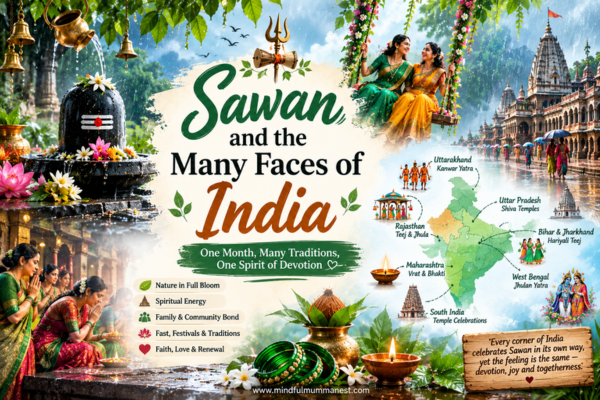
Sawan and the Many Faces of India
One of the most beautiful things about Sawan is that India does not celebrate it in just one way.
The same season can look completely different from one state to another.
In one place, you may see devotees carrying Kanwar on their shoulders. In another, women may gather for Mangal Gauri traditions. Somewhere there are green bangles and mehndi, while somewhere else the focus is on temple visits, folk songs, fasting or family gatherings.
The rituals may change.
The language may change.
The food may change.
But the feeling of devotion, renewal and togetherness remains.
Sawan in Uttar Pradesh
Uttar Pradesh has a particularly strong connection with Sawan and Lord Shiva.
Cities and pilgrimage centres connected with Shiva see devotees visiting temples, offering water and observing Sawan Somwar traditions.
The Kanwar Yatra is especially significant in many parts of North India. Devotees, known as Kanwariyas, traditionally collect sacred water from places such as Haridwar and carry it to Shiva temples.
The journey can involve walking long distances, maintaining discipline and following devotional practices.
It is not simply a religious trip for many devotees.
It becomes an experience of faith, endurance and community.
Sawan in Uttarakhand
Uttarakhand has a particularly natural connection with Sawan.
The Himalayan landscape becomes greener during the monsoon, while rivers, forests and mountain pathways create a completely different atmosphere.
Haridwar, Rishikesh and other pilgrimage areas become important destinations for devotees during this season.
The Ganga is especially sacred in Hindu tradition, and the collection of Ganga water for religious offerings is an important part of Kanwar traditions.
Here, spirituality and nature seem to meet naturally.
Mountains.
Rain.
Rivers.
Temples.
Forest paths.
And the sound of bells and prayers.
It reminds us that Indian spirituality has historically developed closely alongside the natural world.
Sawan in Maharashtra
Maharashtra traditionally follows the Amanta calendar, so its Shravan period falls on different dates from North Indian Sawan.
Shravan is considered an important month for worship, fasting and festivals.
Women especially participate in several traditional celebrations connected with family, prosperity and devotion.
Mangal Gauri is one of the most recognised traditions associated with married women in Maharashtra during Shravan.
Women may gather together, worship Goddess Gauri and enjoy traditional songs, games and social celebrations.
This is a lovely example of how a religious tradition can also create community and connection among women.
Sawan in Karnataka
In Karnataka, the month is known as Shravana Maasa.
It is associated with religious observances, temple visits, fasting and festivals.
Families may celebrate important occasions at home and prepare traditional food according to their customs.
The month is also connected with several festivals that bring families together.
This shows us something important:
Festivals are not only about rituals.
They are also about preserving memories and passing traditions from one generation to another.
Sawan in Andhra Pradesh and Telangana
In Andhra Pradesh and Telangana, Shravanam is traditionally considered an important period for worship and family observances.
Women participate in different regional traditions, prayers and celebrations.
The cultural expressions may be different from North India, but the basic feeling remains familiar:
prayer, family, gratitude and hope.
Sawan in West Bengal and Assam
In eastern India, the month is known by names such as Shrabon or Shrabana.
The monsoon becomes a major part of the cultural atmosphere.
Rain, poetry, music, greenery and devotional traditions naturally become connected with the season.
In Bengal, the rainy season has historically inspired writers, poets, musicians and artists.
And this gives us another beautiful lesson.
Nature can become creativity.
The rain that one person simply watches from a window can become a poem, painting, photograph, song, reel, blog or handmade product for another person.
That is exactly where tradition can meet modern opportunity.
Sawan and Women: More Than Rituals
When we talk about Sawan, we often talk about fasting, पूजा, mehndi, bangles and festivals.
But there is another side worth noticing.
Women have historically played a major role in keeping household and community traditions alive.
They remember recipes.
They prepare festival food.
They decorate homes.
They teach children rituals.
They preserve songs.
They create rangoli.
They make traditional crafts.
They organise family gatherings.
They pass stories from grandparents to children.
Much of this knowledge may never appear in a textbook.
Yet it has enormous cultural value.
And sometimes, the skills we consider “ordinary” at home are actually useful skills that can be developed into income-generating skills.
What Can Sawan Teach a Homemaker About Her Own Skills?
Imagine a woman who makes beautiful mehndi designs for every Sawan gathering.
Another woman prepares homemade vrat snacks.
Someone else knows how to decorate a puja thali beautifully.
Another creates handmade torans.
Someone enjoys writing devotional captions.
Another knows how to make short festival videos.
One woman may be excellent at explaining traditions to children.
Another may be good at photography.
Another may know how to design beautiful Canva posts.
These are not necessarily businesses yet.
But they are skills.
And a skill becomes more valuable when we learn how to present it, improve it and solve a problem for someone else.
That is where the idea of earn money from home becomes practical.
From Sawan Tradition to Earn Money
Let us take a simple example.
Suppose you love making Sawan-themed decorations.
Instead of making one decoration only for your own home, you could learn to create:
- Handmade puja decorations
- Sawan gift hampers
- Decorative thalis
- Mehndi designs
- Digital invitation cards
- Festival Canva templates
- Printable devotional planners
- Sawan social media posts for small businesses
- Festival recipe ebooks
- Short devotional videos
- Regional festival content
You do not have to start with a shop.
You do not have to invest a huge amount.
You can begin by asking:
“What do I already know how to do?”
Then:
“Who might find this useful?”
And finally:
“Can I turn this skill into something people are willing to pay for?”
This is the kind of thinking we encourage at Mindful Mumma Nest.
The Modern Sawan: Tradition Meets Technology
Our grandmothers could preserve traditions through recipes, stories, songs and handwritten notes.
Today, we have smartphones.
That changes everything.
A phone can become a small creative studio.
You can record a Sawan recipe.
You can explain the meaning of a ritual.
You can create a short video about regional traditions.
You can photograph your handmade decoration.
You can design a festival post.
You can write a blog.
You can create a digital product.
You can teach a skill online.
And gradually, these activities can become part of a genuine earn money from home journey.
The technology is new.
The creativity is not.
Sawan and the Environment
There is another connection we should not miss.
Sawan arrives with rain, and rain reminds us how deeply our lives depend on nature.
Water supports agriculture.
Trees protect soil.
Rivers support communities.
Rain replenishes natural systems.
The monsoon is therefore not merely a beautiful background to Sawan celebrations.
It is part of the season’s meaning.
This is also why our celebrations can become more mindful.
Instead of buying something new for every festival, we can sometimes reuse what we already have.
Instead of excessive plastic decoration, we can explore flowers, leaves, cloth and reusable materials.
Instead of wasting food, we can prepare thoughtfully.
Instead of throwing away decorations after one use, we can store and reuse them.
Devotion and responsibility towards nature can beautifully exist together.
Sawan, Simplicity and Mindful Living
Lord Shiva is often represented through simplicity.
Sawan gives us a chance to bring some of that simplicity into our own lives.
We can ask ourselves:
- Do I really need to buy everything I see?
- Can I celebrate without creating unnecessary waste?
- Can I spend more time with family?
- Can I reduce digital distractions?
- Can I reconnect with nature?
- Can I learn one useful skill?
- Can I turn something I already know into a small opportunity?
A simple life does not mean a life without ambition.
It means knowing what truly matters.
And sometimes, simplicity gives us the mental space to discover what we are capable of.
Sawan Somwar: Why Mondays Are So Important
If you have grown up hearing about Sawan, you have probably heard the phrase Sawan Somwar many times.
Somwar means Monday, and Mondays during Sawan are traditionally considered especially sacred for Lord Shiva.
Devotees may visit Shiva temples, offer water to the Shivling, chant mantras, observe fasts and spend time in prayer.
For some people, the fast is a strict religious practice.
For others, it is a personal spiritual discipline.
And for many families, it is simply a tradition passed from one generation to another.
The important thing is to understand that different families and regions follow different customs.
Why Is Monday Connected With Lord Shiva?
In Hindu tradition, Monday is associated with Lord Shiva, and Sawan Somwar has therefore become an important devotional observance.
Devotees believe that worshipping Shiva during Sawan, especially on Mondays, carries special spiritual significance.
Many people offer:
- Water
- Milk
- Bel leaves
- Flowers
- Fruits
- Datura according to traditional practice
- Sandalwood
- Other offerings according to their family tradition
The exact rituals can vary from temple to temple and family to family.
There is no single way in which every Indian household observes Sawan Somwar.
And that diversity is part of India’s living culture.
The Meaning Behind Offering Water
One of the most recognisable Sawan traditions is offering jal, or water, to the Shivling.
This practice has deep devotional significance.
But when we look at it from a symbolic perspective, water also makes us think about life itself.
We cannot live without water.
Nature cannot survive without water.
Agriculture depends upon water.
Animals depend upon water.
Our bodies need water.
And Sawan arrives during the monsoon—the season when the land receives this precious resource.
So a simple act of offering water can also become an opportunity to remember gratitude for nature and the resources that sustain us.
What Is a Shivling?
The Shivling, or Shiva Lingam, is one of the central symbols of Shiva worship.
Devotees offer prayers and various traditional offerings to it in Shiva temples and homes.
Its symbolism has been interpreted in different theological and philosophical ways within Hindu traditions.
For devotees, it represents a sacred form through which they connect with Lord Shiva.
It is therefore important to speak about the Shivling respectfully rather than reducing it to a simple object or superstition.
Why Are Bel Patra Leaves Offered to Shiva?
The bel tree, also known as bael, has a special place in Shiva worship.
Its leaves are commonly offered to the Shivling.
A traditional belief connects the three leaflets of the bel patra with different aspects of Shiva and Hindu theology.
The practice also reflects the wider relationship between Hindu worship and plants from the natural world.
This is another beautiful reminder that Indian traditions often bring nature into the space of devotion.
A leaf is not merely a decoration.
It becomes part of a prayer.
The Kanwar Yatra and Sawan
The Sawan season also brings the famous Kanwar Yatra, particularly across North India.
Kanwariyas traditionally collect sacred water from the Ganga and carry it to Shiva temples.
Haridwar, Gaumukh and other sacred locations associated with the Ganga become important destinations for devotees.
The journey can involve long walks, physical hardship, discipline and collective participation.
The sight of people walking together carrying decorated Kanwars has become one of the most recognisable visual symbols of Sawan in North India.
But behind the colour and energy is something deeper:
commitment.
A person begins a journey because something matters deeply to them.
That thought can apply beyond religion too.
Whether you are learning a skill, starting a blog or trying to earn money from home, progress rarely comes from one day of effort.
It comes from continuing.
Sawan Fasting: Tradition and Mindfulness
Fasting is another important part of Sawan for many devotees.
However, fasting practices vary widely.
Some people observe a complete fast.
Some consume fruits and milk.
Some eat specific foods permitted within their tradition.
Some observe a simpler form of dietary restraint.
Some do not fast at all.
There is no need to compare one person’s devotion with another’s.
The spiritual intention can be more important than comparison.
Fasting can also encourage people to become more conscious of what they eat, how much they consume and how they manage their habits.
But anyone with dietary, medical or other health considerations should follow appropriate professional advice rather than adopting a fasting practice simply because others are doing it.
Sawan and the Idea of Discipline
This is where Sawan becomes relevant to everyday life.
A vrat requires discipline.
Prayer requires consistency.
A pilgrimage requires commitment.
Learning a skill requires practice.
Building an income requires patience.
These things have something in common:
small actions repeated over time.
If you want to learn Canva, you may not become an expert in one day.
If you want to start writing, your first article may not be perfect.
If you want to create YouTube videos, your first video may receive very few views.
If you want to build an online income, the first earning may be very small.
But that does not mean the journey is failing.
It means the journey has started.
Sawan and Women’s Traditions
Sawan has a special cultural connection with women in many parts of India.
Green bangles, mehndi, swings, folk songs, traditional clothing and gatherings among women are associated with monsoon and Sawan celebrations in several regions.
The colour green itself beautifully reflects the season.
Fresh leaves.
New grass.
Fields.
Trees.
Rain.
Life.
In some communities, women gather to sing traditional songs and enjoy swings during the monsoon.
These traditions create a sense of friendship and belonging.
They also preserve local culture.
Why Is Green So Special During Sawan?
Green is strongly associated with Sawan in many Indian cultural traditions.
The reason is easy to understand when we look outside.
After the arrival of monsoon, the landscape changes dramatically.
Dryness gives way to greenery.
Fields become lively.
Trees look fresh.
New plants appear.
So green naturally becomes a symbol of growth, fertility, freshness and renewal.
For women, green bangles and green clothing became part of many regional Sawan traditions.
But the deeper message can be interpreted beautifully:
Just as nature renews itself, we too can give ourselves permission to begin again.
Mangal Gauri and the Power of Women Together
In Maharashtra and some neighbouring cultural traditions, Mangal Gauri observances during Shravan hold an important place among women.
Women may gather for worship, songs, traditional games and social celebrations.
The gathering itself is meaningful.
A woman who spends much of her day managing home and family may rarely get time to simply sit with other women, laugh, talk and celebrate.
Festivals create that space.
And community matters.
Sometimes a conversation with another woman can give us an idea.
Sometimes a friend can introduce us to an opportunity.
Sometimes someone notices a skill in us that we have never considered valuable.
This is why women supporting women can become more than a beautiful slogan.
It can become a practical path towards confidence and independence.
From Women’s Traditions to Women’s Income
Imagine a group of women who meet during Sawan.
One knows cooking.
One knows mehndi.
One knows stitching.
One knows photography.
One knows social media.
One knows Canva.
One is good at speaking.
One is good at organising.
Instead of thinking, “I am only a homemaker,” imagine thinking:
“I already have skills. I only need to understand how to use them.”
That change in thinking can be powerful.
You may start by helping a neighbour.
Then a friend.
Then a local business.
Then an online customer.
And slowly, something that began as a simple skill can become a source of income.
That is one of the biggest messages we want to bring into our Mindful Mumma Nest journey.
Sawan as a Time to Learn Something New
If Sawan represents renewal in nature, why not use it as a personal reset too?
Choose one skill.
Not ten.
Just one.
For example:
Canva – learn to create social media designs.
Writing – learn to write useful blog posts.
Cooking – learn to package recipes into digital content.
Video editing – create short-form videos.
Teaching – offer online lessons.
Crafting – create handmade products.
Photography – build a small portfolio.
Social media management – help a local business manage its pages.
The goal is not to become rich overnight.
The goal is to become useful, confident and consistent.
Income can follow when your skill begins solving a real problem for someone.
A Sawan Question Worth Asking Yourself
While everyone is talking about what to buy, what to wear and where to visit this Sawan, ask yourself something different:
“What can I create?”
Maybe you can create a beautiful home.
Maybe you can create a recipe.
Maybe you can create a video.
Maybe you can create a blog.
Maybe you can create a product.
Maybe you can create a service.
Maybe you can create a new version of yourself.
Because sometimes the biggest blessing of a festival is not something we receive.
It is something we discover within ourselves.
Sawan Festivals, Rituals and Traditions Across India
Sawan is not celebrated through one single ritual.
India is too diverse for that.
Every region has its own calendar, food, songs, clothing, temple traditions and family customs.
Some traditions are deeply religious.
Some are seasonal.
Some are social.
And many are a beautiful mixture of all three.
Understanding these differences helps us see Sawan not simply as a month of fasting and temple visits, but as a living part of India’s cultural heritage.
Sawan Somwar
Sawan Somwar refers to Mondays observed during Sawan.
Devotees may visit Shiva temples, offer prayers, perform abhishekam, offer bel patra and observe a fast according to their family or regional tradition.
In 2026, the North Indian Sawan Somwar dates are:
- 3 August 2026
- 10 August 2026
- 17 August 2026
- 24 August 2026
In regions following the Amanta calendar, the corresponding Shravan Mondays fall on different dates.
This difference is a useful reminder that Indian traditions cannot always be understood through one calendar alone.
Mangal Gauri
Mangal Gauri is especially associated with Maharashtra during Shravan.
It is traditionally observed on Tuesdays, with women participating in worship and social celebrations connected with Goddess Gauri.
Women may gather together, sing, play traditional games and share food.
The celebration creates something that modern life often takes away from us:
time together.
No complicated technology is needed.
Just women sitting together, talking, laughing, praying and sharing memories.
That simple togetherness itself has value.
Nag Panchami During Sawan
Nag Panchami is another important festival that falls during the broader monsoon period and is observed in many parts of India.
The festival is associated with the worship and reverence of snakes.
The traditions vary considerably by region.
The connection with the monsoon season is particularly interesting because snakes and other animals become more visible during periods of heavy rain and changing habitats.
Traditional practices around Nag Panchami therefore also offer an opportunity to think about our relationship with animals and the environment.
We do not need to turn every tradition into a scientific explanation.
Faith and ecology are different ways of understanding the world.
But both can encourage us to develop respect for living beings.
Raksha Bandhan and the Sawan Season
In many North Indian communities, Raksha Bandhan falls around the end of Sawan or close to this seasonal period, depending on the lunar calendar.
The festival celebrates the bond between siblings.
A sister ties a rakhi, while families exchange affection, blessings and gifts.
At its heart, Raksha Bandhan is about relationships.
And Sawan, with its family gatherings and monsoon atmosphere, often creates the perfect setting for these emotional connections.
Janmashtami and the Shravan-Bhadrapada Transition
Another important festival that follows the Sawan period in many calendars is Krishna Janmashtami.
The exact date belongs to the next lunar month in many traditions, but the festivals are culturally connected through the broader monsoon festive season.
This is one reason Indian festivals can feel less like isolated events and more like a continuous cultural calendar.
One celebration leads into another.
One story connects to another.
One season slowly changes into the next.
Jhulan Yatra: Swings and Monsoon Joy
The monsoon season is closely associated with swings and Jhulan Yatra traditions in several parts of India, especially in Vaishnava communities.
Decorated swings may be used for devotional celebrations associated with Radha and Krishna.
At the same time, swings have a much wider cultural connection with Indian monsoon traditions.
Women and girls gathering around swings, singing folk songs and enjoying the rainy season became an important part of monsoon culture in many regions.
This is where nature and celebration beautifully meet.
Why Do Swings Belong to the Monsoon?
There is a practical and cultural reason behind the tradition.
During the hot months, outdoor activity can be uncomfortable.
With the arrival of monsoon, trees and gardens become greener and the weather becomes more pleasant in many regions.
A swing tied to a strong tree becomes a simple form of entertainment.
Over generations, it becomes part of songs, stories and festivals.
What begins as a seasonal activity can eventually become cultural heritage.
This teaches us something about tradition:
Traditions often begin with ordinary life before becoming extraordinary memories.
Sawan Songs and Folk Culture
Can you imagine Sawan without songs?
Across India, the monsoon has inspired countless forms of folk music and poetry.
Different regions have their own styles.
Some songs speak about rain.
Some speak about separation from loved ones.
Some celebrate marriage and family.
Some describe nature.
Some are devotional.
Some are simply playful.
These songs were traditionally passed orally from one generation to another.
Today, technology gives us a new way to preserve them.
A grandmother’s Sawan song can be recorded.
A local folk tradition can become a short documentary.
A traditional recipe can become a video.
A regional story can become a blog.
A forgotten song can be archived digitally.
This is where culture and content creation meet.
Sawan Food Traditions
Food is another important part of Sawan.
Fasting traditions can include foods such as:
- Sabudana
- Kuttu
- Singhara
- Samak rice
- Fruits
- Milk and dairy products
- Nuts
- Certain vegetables
- Homemade vrat snacks
However, fasting food differs greatly from family to family and region to region.
Some households may prepare elaborate vrat meals.
Others may prefer simple fruits and milk.
Some families may not fast at all.
There is no need to turn food into a competition.
The beauty of traditional food lies in understanding why and how our families prepare it.
Can Sawan Recipes Become an Earning Idea?
Absolutely—but only if we approach it realistically.
Suppose you have a family recipe for vrat snacks.
You can begin by documenting it.
Take clear photographs.
Write down the ingredients.
Explain the process.
Create a short video.
Share the story behind the recipe.
Then you could explore different ways to build value around your knowledge.
For example:
- Food blogging
- YouTube recipe videos
- Instagram content
- Recipe ebooks
- Online cooking classes
- Local festive food orders
- Recipe photography
- Social media content for food businesses
- Affiliate content around kitchen products
You do not need to do all of these.
Start with the skill you already have.
Sawan and Handmade Creativity
Sawan also gives space to traditional creativity.
Mehndi.
Bangles.
Torans.
Puja thalis.
Decorations.
Cloth crafts.
Handmade gifts.
Festival cards.
Flowers.
Rangoli.
Many women already create these things at home.
The difference between hobby and income-generating skill is often how we package and present the work.
For example, making one beautiful puja thali for your home is a hobby.
Learning to make ten consistent designs, photograph them properly, calculate costs and offer them to customers turns the same skill into a possible small business.
That does not guarantee income.
But it creates an opportunity.
The Digital Sawan Opportunity
Today, festivals create a huge amount of online interest.
People search for:
- Sawan dates
- Sawan Somwar
- Shiva temples
- Vrat recipes
- Sawan decorations
- Mehndi designs
- Festival outfits
- Puja ideas
- Regional traditions
- Devotional songs
- Festival captions
- Gift ideas
This means people with useful knowledge can create helpful content around these topics.
A homemaker who knows her regional traditions may have something valuable to share with people who have never heard of them.
A mother who knows easy vrat recipes can help busy families.
A teacher can explain the mythology behind a festival in simple language.
A craft lover can show handmade decoration ideas.
A content creator can bring regional traditions to a wider audience.
And yes, useful content can eventually support different forms of earn money opportunities.
But Should We Commercialise Every Tradition?
No.
This is an important distinction.
Not every prayer needs to become a product.
Not every religious practice needs to become content.
Not every festival needs to become a business opportunity.
Faith deserves respect.
The idea is not to commercialise devotion.
The idea is to recognise that skills developed around culture, creativity, teaching, cooking, writing, design and communication can sometimes become income opportunities.
There is a difference.
Keep the devotion sacred.
Use your skills wisely.
Sawan and Sustainable Celebrations
A mindful Sawan can also be a greener Sawan.
Try:
- Reusable decorations
- Cloth instead of disposable plastic
- Natural flowers where practical
- Reusing jars and containers
- Avoiding unnecessary food waste
- Supporting local artisans
- Buying only what you actually need
- Reusing festive clothing and accessories
- Choosing durable products instead of disposable ones
This is not about making celebration complicated.
It is about making our choices more conscious.
Supporting Local Artisans During Festivals
Festivals create seasonal demand for handmade products.
Instead of always choosing mass-produced decorations, we can sometimes support local artisans.
A handmade diya.
A locally made basket.
A traditional textile.
A handmade puja accessory.
A regional sweet.
A craft made by a small woman-led business.
When we purchase thoughtfully, our money can travel beyond the product itself.
It can support another person’s skill, household and livelihood.
And that is another beautiful connection between Sawan, women, community and earning money.
The Real Beauty of Sawan
Maybe the greatest lesson of Sawan is that everything is connected.
Rain connects us with nature.
Nature connects us with gratitude.
Gratitude connects us with devotion.
Devotion can bring discipline.
Discipline can build confidence.
Confidence can encourage us to learn.
Learning can develop skills.
Skills can create opportunities.
And sometimes, those opportunities can become a way to earn money while staying connected to the life we already have.
Sawan does not ask us to become someone else.
Perhaps it simply reminds us to look again at what is already within us.
Sawan, Mythology and the Truth Behind the Stories
Whenever we talk about Sawan, mythology naturally becomes part of the conversation.
You may have heard stories about the Samudra Manthan, Lord Shiva drinking poison, the Ganga coming to Earth, Goddess Parvati’s devotion and many other stories connected with Shiva.
But there is an important distinction we should make.
Mythology is not the same thing as modern scientific history.
These stories belong to India’s religious and cultural traditions. They carry symbolism, philosophy, devotion and moral ideas that have been passed through generations.
We can respect their spiritual meaning without presenting every supernatural element as scientifically proven history.
This distinction makes our discussion more meaningful rather than less respectful.
The Samudra Manthan: The Story Behind Neelkanth
The story of Samudra Manthan is one of the most famous stories connected with Lord Shiva.
According to Hindu mythology, the devas and asuras churned the cosmic ocean in search of amrita, the nectar of immortality.
During the churning, many things emerged.
Among them was the terrible poison known as halahala.
The poison was believed to be so powerful that it could destroy creation.
Lord Shiva came forward and consumed it to protect the universe.
According to the traditional account, Goddess Parvati prevented the poison from moving further into Shiva’s body.
His throat became blue.
He was therefore called Neelkanth, meaning the blue-throated one.
The story has been interpreted in many philosophical ways.
One simple interpretation is this:
Someone with great strength can protect others by containing what could otherwise cause destruction.
But there is another lesson we can take into our everyday lives.
We cannot keep absorbing every problem around us forever.
Even Shiva is remembered through meditation, stillness and detachment.
So perhaps the story also reminds us that strength needs balance.
Is the Samudra Manthan Scientifically Proven?
No.
There is no scientific evidence that a literal cosmic ocean was churned by devas and asuras in the physical manner described in the mythology.
It belongs to the sacred narrative tradition of Hinduism.
That does not make the story meaningless.
Myths can preserve cultural memory, philosophical ideas and moral teachings without being scientific explanations.
This is an important approach when discussing religion online.
Respect belief. Respect science. Do not confuse the two.
The Story of the Ganga and Lord Shiva
Another beautiful story associated with Shiva is the descent of the Ganga.
According to Hindu tradition, King Bhagiratha performed intense penance to bring the sacred Ganga to Earth.
The force of the river was believed to be too powerful to reach Earth directly.
Lord Shiva received the Ganga in his matted hair and allowed her waters to descend safely.
This is why Shiva is often depicted with the Ganga flowing from his hair.
Again, this is a sacred mythological narrative rather than a scientific description of the geological formation of the Ganges River.
Yet its symbolism is powerful.
The story connects:
water + nature + divine power + responsibility.
And that connection feels particularly appropriate during Sawan.
The Real Ganga and Our Responsibility
While mythology gives the Ganga spiritual significance, the physical river is a real ecological system that supports millions of people.
The Ganga basin supports agriculture, communities, biodiversity and livelihoods.
This is where devotion can become responsibility.
If we call a river sacred, perhaps that should encourage us to protect it.
If we worship water, perhaps we should avoid wasting it.
If we celebrate the monsoon, perhaps we should respect the ecosystems that depend upon it.
This is where ancient values and modern environmental awareness can meet beautifully.
Why Is Shiva Called Pashupati?
Lord Shiva is also known as Pashupati, a title commonly understood as “Lord of beings” or “Lord of animals.”
This connects beautifully with the natural imagery surrounding Shiva.
He is associated with:
- Mountains
- Forests
- Rivers
- Animals
- Serpents
- The moon
- Ganga
- Meditation
- Simplicity
Whether you approach these symbols through faith, philosophy or cultural history, they encourage us to notice our relationship with nature.
Sawan, therefore, gives us an opportunity to step outside our busy routines and remember that we are part of a much larger ecosystem.
Why Is the Snake Associated With Shiva?
The serpent around Shiva’s neck is one of his most recognisable symbols.
In Hindu traditions, the serpent can carry several layers of symbolism, including power, transformation and the cycle of life.
Shiva’s association with snakes also reminds us that creatures that people may fear or avoid can still have a place within the natural world.
During the monsoon, snakes and other animals may move into areas where people live because rain changes their habitats.
So instead of reacting with unnecessary harm, we can learn to respond responsibly and seek appropriate local wildlife help when needed.
The Crescent Moon on Shiva’s Head
The crescent moon is another important symbol associated with Shiva.
The moon has long been connected with time, cycles and change.
And isn’t that exactly what nature teaches us?
The moon changes.
The seasons change.
The weather changes.
Our children grow.
Our homes change.
Our priorities change.
Even we change.
Sawan can therefore become a reminder that change is not always something to fear.
Sometimes change is simply the beginning of a new season.
Why Does Sawan Feel Like a Spiritual Reset?
Perhaps because the season itself feels like a reset.
Before the monsoon:
Heat.
Dust.
Dryness.
Fatigue.
Then comes rain.
The air changes.
The landscape changes.
Our routines change.
And suddenly, we want to slow down.
This seasonal shift may help explain why Sawan has such a strong emotional atmosphere.
Of course, spiritual significance comes from religious tradition, not simply from the weather.
But nature can create the perfect environment for reflection.
The Psychology of Ritual
Rituals can also give structure to our lives.
A weekly temple visit.
A Monday prayer.
A fasting routine.
Lighting a diya.
Sitting quietly for a few minutes.
Preparing a traditional meal.
Calling a family member.
These small repeated actions can create a sense of rhythm.
And rhythm can be comforting.
Modern life is often full of notifications, deadlines and unfinished tasks.
A simple ritual can tell the mind:
“Pause. This moment matters too.”
Can Rituals Improve Our Relationship With Money?
This may sound surprising, but the connection is actually quite practical.
Many Sawan practices encourage discipline.
And discipline is also important in financial life.
For example:
A person who learns to avoid unnecessary spending during a festival may become more conscious of money.
A person who plans meals may reduce food waste.
A person who reuses decorations may save money.
A person who learns a skill instead of buying everything may become more self-reliant.
A person who tracks small expenses may understand where money disappears.
So spirituality does not have to remain separate from practical life.
Mindfulness can influence how we spend, save, create and earn.
Sawan and the Idea of “Enough”
One of the most beautiful lessons we can take from Shiva symbolism is simplicity.
In a world where advertisements constantly tell us that we need more, Sawan can become a small reminder to ask:
What is enough for me?
Do I need another outfit?
Another decoration?
Another kitchen item?
Another expensive gift?
Or can I celebrate beautifully with what I already own?
Saving money is not about refusing yourself every joy.
It is about spending with intention.
And every rupee you do not waste can remain available for something more meaningful.
That could be:
- Education
- Skill development
- Emergency savings
- Investment
- Family needs
- A small business
- A future goal
This is where earn money and mindful living naturally connect.
From Saving to Earning
Saving money is important.
But there is another side of financial confidence:
earning money.
If you constantly reduce expenses but never explore your earning potential, your options may remain limited.
So ask yourself two questions:
Where can I spend less?
And:
Where can I create more value?
The first question develops financial awareness.
The second can lead you towards skills and income.
Maybe your answer is writing.
Maybe teaching.
Maybe cooking.
Maybe designing.
Maybe selling.
Maybe content creation.
Maybe freelancing.
Maybe helping another business.
You do not have to know the answer immediately.
Sawan can simply be the month when you begin exploring.
Mythology Can Inspire Modern Life Without Replacing Reality
This is perhaps the healthiest way to approach mythology.
We do not need to prove every story scientifically.
We do not need to dismiss every story as meaningless.
We can understand mythology as a part of India’s spiritual and cultural heritage and ask:
What does this story make me think about?
The Samudra Manthan can make us think about difficult situations.
Neelkanth can make us think about responsibility.
Ganga can make us think about water.
Shiva’s simplicity can make us think about consumption.
Parvati can make us think about strength and devotion.
The monsoon can make us think about renewal.
And our own skills can make us think about independence.
That is how an ancient story can still speak to a modern woman sitting at home with her phone, her responsibilities and her dreams.
Sawan Is a Story of Transformation
Perhaps that is the strongest common thread.
The earth transforms with rain.
The landscape transforms with greenery.
A devotee transforms through discipline.
A household transforms through mindful choices.
A skill transforms into confidence.
And sometimes confidence transforms into income.
So when we talk about Sawan month and its importance, we are not only talking about a calendar month.
We are talking about a season that invites us to pause, reconnect, reflect and begin again.
Sawan and the World Beyond India
Sawan is deeply rooted in Indian Hindu traditions, but its stories, deities, rituals and cultural influence have travelled far beyond India’s borders.
Hindu communities living in different countries continue to observe festivals connected with Shiva, Shravan, monsoon traditions and other Hindu religious occasions.
The way people celebrate may change according to their country, climate, community and family background.
But the emotional connection can remain surprisingly strong.
A mother living outside India may still prepare a traditional recipe.
A family may visit a Hindu temple.
Children may learn the story of Shiva.
Someone may listen to a Sawan bhajan thousands of kilometres away from the place where their grandparents celebrated it.
This is how culture travels.
Not only through books.
But through people, families, food, music, stories and memory.
Sawan and the Indian Diaspora
Indian communities around the world have created temples, cultural organisations and community spaces where Hindu traditions continue to be practised.
Countries with significant Indian and Hindu communities include:
- Nepal
- Mauritius
- Fiji
- Trinidad and Tobago
- Guyana
- Suriname
- South Africa
- United Kingdom
- United States
- Canada
- Australia
- New Zealand
- Singapore
- Malaysia
- United Arab Emirates
The traditions may not look exactly like those in India.
And that is perfectly natural.
Culture changes when people move.
A festival celebrated in London may have a different atmosphere from one celebrated in Varanasi.
A Sawan gathering in Mauritius may look different from one in Uttarakhand.
But the central emotions—faith, family, identity and belonging—can remain.
Nepal and the Shravan Tradition
Nepal has deep historical and cultural connections with Hindu traditions.
The month of Shrawan is observed with religious practices, Shiva worship and fasting.
The famous Pashupatinath Temple in Kathmandu is one of the most important Shiva temples in the world.
During important Shiva-related occasions, devotees gather at the temple to pray and participate in religious practices.
For many devotees, places such as Pashupatinath demonstrate how Shiva traditions extend beyond the boundaries of modern India.
Mauritius and Hindu Traditions
Mauritius has a significant Hindu population and a strong Indian cultural heritage.
Shiva worship is particularly important.
One of the country’s most sacred sites is Ganga Talao, a crater lake in the interior of Mauritius associated with Hindu pilgrimage.
Devotees visit the site, especially around Maha Shivaratri and other important religious occasions.
The site offers a fascinating example of cultural continuity.
Indian religious traditions travelled across the ocean with communities and became part of the cultural landscape of another country.
Fiji and the Preservation of Culture
Indo-Fijian communities have also preserved many Hindu traditions.
Temples and community organisations provide spaces where families can maintain religious practices and teach younger generations about their heritage.
For families living far away from India, festivals can become especially meaningful.
They are not only religious occasions.
They can also answer a deeper question:
“Where do I come from?”
This is one reason festivals matter so much to immigrant families.
They connect generations.
Trinidad and Tobago
Hindu communities in Trinidad and Tobago have maintained many traditions brought by Indian ancestors.
Religious celebrations, temples, devotional music and cultural events help preserve these connections.
Again, the traditions are not frozen in time.
They evolve.
Local influences become part of the celebration.
New generations reinterpret old customs.
That is how culture survives.
Sawan in the Modern Global World
Today, geographical distance is no longer the same barrier it once was.
A person living in Canada can watch a Shiva abhishekam in India online.
A grandmother in India can teach a Sawan recipe to her granddaughter living in Australia through a video call.
A creator in India can explain the meaning of Sawan to viewers in the United States.
A woman can create Hindi, Bengali, English or regional-language content and reach people across the world.
This is where technology becomes a bridge for culture.
Your Language Can Become Your Strength
Many Indian women think:
“My English is not perfect, so I cannot create content.”
But that is not true.
Your language can actually become your advantage.
You can create content in:
- Hindi
- Bengali
- Marathi
- Punjabi
- Gujarati
- Tamil
- Telugu
- Kannada
- Malayalam
- Assamese
- English
- Or a combination of languages
There are people searching for information in all these languages.
A regional perspective can make your content more personal and more useful.
Imagine a woman explaining:
“How my family celebrates Sawan in Bengal.”
Another sharing:
“Sawan recipes from Uttar Pradesh.”
Another explaining:
“Shravan traditions in Maharashtra.”
Another documenting:
“What Sawan looks like in Uttarakhand.”
This is not just content.
It is cultural storytelling.
Cultural Content Can Become a Skill
If you enjoy researching festivals, you can learn:
- Blog writing
- SEO
- Video scripting
- Voice-over
- Canva design
- Photography
- Short-form video editing
- Social media management
- YouTube content creation
These are modern skills.
But the raw material can come from something very traditional:
your own culture.
This is one of the strongest connections between Sawan and the idea of earn money.
You do not always need to search for a completely new topic.
Sometimes, you already carry knowledge that someone else wants to learn.
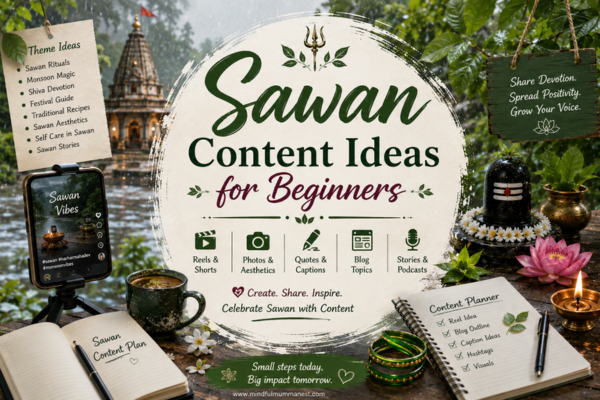
Sawan Content Ideas for Beginners
If you want to experiment with content creation, Sawan can give you many simple starting points.
You could create:
A blog:
“Why Is Sawan Important?”
A short video:
“3 Things You Should Know About Sawan Somwar”
A recipe reel:
“Easy Sawan Vrat Snack”
A Canva post:
“Sawan 2026 Dates”
A storytelling video:
“Why Shiva Is Called Neelkanth”
A cultural post:
“How Maharashtra Celebrates Shravan”
A nature post:
“Why Monsoon Makes Sawan Feel Special”
A family post:
“My Grandmother’s Sawan Tradition”
You do not need expensive equipment.
A smartphone, basic research and consistency can be enough to begin.
How Can This Lead to Earn Money?
Creating one post does not automatically make money.
That is important to understand.
Income generally comes when content attracts an audience and you build a useful business model around it.
Depending on your skills and platform, possibilities can include:
- Freelance content writing
- Social media management
- Affiliate marketing
- Digital products
- YouTube monetisation
- Brand collaborations
- Online classes
- Festival-related products
- Photography services
- Design services
- Blogging and advertising
The exact earning potential varies widely.
There is no guaranteed income.
But the principle is simple:
Create something useful → build trust → develop a skill → solve a problem → explore suitable income opportunities.
A Homemaker’s Knowledge Is Not “Just Home Knowledge”
This is something I want every woman reading Mindful Mumma Nest to remember.
You may know:
How to prepare vrat food.
How to decorate for festivals.
How to organise a puja.
How to manage a household budget.
How to teach children about traditions.
How to make handmade decorations.
How to tell stories.
How to speak beautifully.
How to organise family events.
How to create a warm home.
These abilities may have been developed without a certificate.
But that does not mean they have no value.
The next step is learning how to translate knowledge into a useful service, product or piece of content.
From Tradition to Digital Entrepreneurship
Let’s take one simple example.
Suppose you know how to make traditional Sawan decorations.
Start small.
First, create five designs.
Then photograph them.
Then calculate the material cost.
Then create a simple catalogue.
Then share it with people you know.
If there is interest, take small orders.
Later, you could create tutorials.
Eventually, you might teach others.
One skill.
Multiple possibilities.
This is how a traditional skill can gradually become a modern opportunity.
Sawan and the Indian Woman Abroad
There is another beautiful possibility.
Indian women living outside India may actively look for familiar traditions.
They may want:
- Indian festival recipes
- Traditional decorations
- Regional clothing ideas
- Puja guidance
- Children’s cultural stories
- Hindi or regional-language resources
- Handmade Indian products
- Festival gift ideas
A woman in India who understands these traditions can potentially serve this audience through digital content or products.
The internet has made cultural knowledge searchable.
That means your heritage can become your niche.
But Keep Authenticity First
If you create cultural content, do not copy random information from social media.
Research properly.
Check regional differences.
Mention when something is a belief or traditional story.
Do not present mythology as scientific fact.
Do not tell people that one ritual is compulsory for everyone.
Do not make health claims about fasting.
And do not use fear to get clicks.
People deserve information that is both respectful and responsible.
The Global Lesson of Sawan
Sawan teaches us something larger than one festival.
A tradition can travel.
A language can travel.
A recipe can travel.
A story can travel.
A skill can travel.
And today, your knowledge can travel through a smartphone.
A woman sitting at home in India can create something that reaches someone in London, Dubai, Toronto, Melbourne or Mauritius.
That does not mean every post will become successful.
It means the possibility exists.
And sometimes, possibility is where every new journey begins.
Your Culture Can Be Your Content, But Your Skill Makes It Valuable
This is the key.
Culture alone does not guarantee income.
A festival alone does not guarantee business.
But culture can provide inspiration.
Your knowledge can provide content.
Your skill can provide value.
Your consistency can build trust.
And your business model can create an opportunity to earn money.
That is the modern Sawan story we can carry forward.
From temple bells to smartphones.
From folk songs to digital videos.
From family recipes to ebooks.
From handmade crafts to small businesses.
From traditional knowledge to modern skills.
Sawan may belong to an ancient tradition, but the way we connect with it can continue evolving.
Sawan and the Art of Mindful Living
Sawan gives us a beautiful reason to slow down.
Not because life suddenly becomes easier.
But because the season itself seems to whisper:
Pause. Breathe. Look around.
The rain slows the streets.
The greenery softens the landscape.
The sound of temple bells creates a different rhythm.
Families come together.
People spend more time indoors.
Traditional food returns to the kitchen.
And suddenly, ordinary things can feel special.
This is where Sawan becomes more than a religious month.
It becomes an opportunity to practise mindful living.
What Does Mindful Living Mean?
Mindful living does not mean sitting quietly all day or giving up your responsibilities.
It simply means becoming more aware of how you live.
Notice what you eat.
Notice how you spend.
Notice what you buy.
Notice how you speak.
Notice where your time goes.
Notice what makes you peaceful.
Notice what constantly drains you.
And most importantly, notice what you are capable of creating.
Sawan can become a gentle reminder to live with more intention.
Sawan and a Simple Home
During the monsoon, our homes naturally need a little extra care.
Humidity increases.
Clothes may take longer to dry.
Food needs careful storage.
Floors may become slippery.
Plants may need different attention.
Instead of seeing these things only as chores, we can use them as opportunities to make our homes more mindful.
Try simple habits such as:
- Keep the home well ventilated.
- Avoid unnecessary clutter.
- Store grains and food properly.
- Dry damp clothes properly.
- Keep frequently used areas clean and dry.
- Reuse suitable containers for storage.
- Take care of indoor and outdoor plants.
- Avoid unnecessary disposable decorations.
A peaceful home does not need to be expensive.
It needs attention.
Sawan and the Beauty of Less
Festivals can sometimes become associated with shopping.
New clothes.
New decorations.
New gifts.
New kitchen items.
New accessories.
But celebration does not have to mean buying everything new.
You can wear something you already love.
Reuse last year’s decorations.
Make something by hand.
Cook a family recipe.
Use flowers from your garden where appropriate.
Decorate with things already available at home.
And save the money you would otherwise spend unnecessarily.
This is not about being miserly.
It is about asking:
“Will this purchase actually add value to my life?”
Saving Money Is Also a Skill
We often talk about earning money.
But before increasing income, understanding our existing money is equally important.
Suppose you save ₹500 by avoiding unnecessary purchases.
That ₹500 can remain available for something useful.
Maybe you use it for:
- A book
- An online course
- Internet expenses
- A useful tool
- A small business material
- Savings
- An investment according to your financial goals
Small amounts matter because habits matter.
A person who learns to manage ₹500 may gradually become more comfortable managing ₹5,000.
Financial confidence often begins with awareness, not a huge salary.
Sawan and the Value of Time
Money is not our only resource.
Time is another.
A mother may spend her entire day moving from one responsibility to another.
Cooking.
Cleaning.
Children.
Family.
Work.
Messages.
Bills.
Appointments.
And somewhere in between, her own dreams can get pushed aside.
Sawan can become a small reminder to ask:
“Where is my time going?”
Maybe you can reserve thirty minutes a day for yourself.
Not for scrolling.
Not for household work.
Not for solving someone else’s problem.
For learning.
Thirty Minutes Can Change a Skill
You do not need five free hours every day to learn something.
Suppose you spend thirty minutes daily learning Canva.
In one week, you have several hours of practice.
Continue for a month, and you have a meaningful amount of practice.
The same can happen with:
- Writing
- English communication
- Video editing
- Excel
- Social media
- Photography
- Teaching
- Digital marketing
- Cooking
- Crafting
The first few days may feel slow.
That is normal.
A skill grows through repetition.
Sawan and the Power of Routine
Many Sawan traditions are based around repeated practices.
Monday prayer.
Daily puja.
Fasting on particular days.
Temple visits.
Mantra chanting.
Traditional meals.
These routines can teach us something useful even outside religion.
Consistency beats occasional enthusiasm.
You may feel motivated today to start a blog.
Tomorrow you may feel tired.
The next day you may become busy.
If your work depends only on motivation, it becomes difficult to continue.
But if you create a small routine, progress becomes easier.
Even twenty minutes can count.
Create a “Sawan Skill Hour”
Why not make this Sawan a personal experiment?
Choose one hour—or even thirty minutes—several days a week.
Call it your Sawan Skill Hour.
During this time, do only one thing.
Learn.
Practise.
Create.
Do not worry about earning immediately.
Your first goal is capability.
For example:
Week 1: Learn Canva basics.
Week 2: Create five simple designs.
Week 3: Learn how to write captions.
Week 4: Create a small portfolio.
At the end, you may have something you did not have before:
a usable skill.
And a usable skill can become a foundation for future income.
Sawan and Digital Detox
There is another modern habit that fits beautifully with mindful living.
Digital detox.
We use our phones for everything.
Prayer.
Shopping.
Banking.
Work.
Entertainment.
Communication.
Learning.
But the same phone can quietly consume hours.
During Sawan, try creating small periods without unnecessary scrolling.
You could:
- Keep your phone away during prayer.
- Avoid checking social media immediately after waking up.
- Take a quiet walk when the weather allows.
- Sit near a window and listen to the rain.
- Spend time with your children without recording everything.
- Read instead of endlessly scrolling.
- Use your phone intentionally for learning.
The goal is not to hate technology.
The goal is to control how you use it.
Your Phone Can Become a Tool for Earning Money
This is where Mindful Mumma Nest takes the conversation one step further.
The same phone that can consume your time can also help you build something.
You can use it to:
- Learn a skill.
- Research a topic.
- Create content.
- Edit videos.
- Design graphics.
- Communicate with customers.
- Manage social media.
- Promote a small business.
- Find freelance opportunities.
- Build a portfolio.
So instead of asking:
“How much time do I spend on my phone?”
also ask:
“How much value can I create with my phone?”
That question can change your relationship with technology.
Sawan and Creativity
Rain has inspired artists for centuries.
Writers write about rain.
Musicians compose songs.
Painters capture clouds.
Photographers capture reflections.
Filmmakers use monsoon landscapes.
Chefs create seasonal recipes.
Designers create festive collections.
Creators make reels.
This tells us something very simple:
Nature gives us ideas.
You do not always need to sit down and force creativity.
Look around you.
A rainy window can become a photograph.
Green leaves can become a design inspiration.
A family recipe can become a blog.
A grandmother’s story can become a video.
A local tradition can become an article.
A festival can become a teaching opportunity.
Sawan and the Creative Woman
Many women say:
“I am not creative.”
Then you visit their homes.
You see how beautifully they arrange a puja thali.
How they decorate a room.
How they style a saree.
How they plate food.
How they make a child’s project.
How they organise a festival.
That is creativity.
It may not look like professional design.
But creativity does not always begin with software.
It begins with observation and imagination.
The next step is learning how to turn that creativity into something useful.
One Skill, Three Income Directions
Suppose your skill is cooking.
You could explore:
Content:
Create recipe videos or a food blog.
Service:
Offer local food orders or cooking classes.
Digital product:
Create a recipe guide or meal planner.
Suppose your skill is designing.
You could explore:
Content:
Share design tips.
Service:
Create posts for small businesses.
Digital product:
Sell templates.
Suppose your skill is teaching.
You could explore:
Content:
Educational videos.
Service:
Online tutoring.
Digital product:
Worksheets, guides or courses.
The same skill can sometimes create several paths.
Do Not Chase Every Earning Idea
This is important.
When you start searching for ways to earn money online, you will find hundreds of ideas.
Do not try everything.
One week blogging.
Next week YouTube.
Then affiliate marketing.
Then dropshipping.
Then freelancing.
Then trading.
Then something else.
You will become exhausted before you become skilled.
Instead:
Choose one skill.
Choose one audience.
Choose one problem.
Choose one platform.
Then practise.
Your journey may become much clearer.
Sawan and Inner Strength
There is another lesson hidden in the stories of Shiva and Parvati.
Strength does not always look loud.
Sometimes strength is patience.
Sometimes it is discipline.
Sometimes it is knowing when to say no.
Sometimes it is starting again.
Sometimes it is admitting that you want more from life.
A woman can love her family deeply and still want her own identity.
She can enjoy homemaking and still want income.
She can be devoted to her family and still build something of her own.
These things do not have to fight each other.
Earning Money and Identity
Money is not the only reason to work.
Sometimes earning brings something else.
Confidence.
Decision-making power.
A sense of achievement.
Professional identity.
A feeling that your abilities matter.
Even a small earning can feel meaningful when you know:
“I created this through my own effort.”
That feeling should never be underestimated.
A Sawan Promise to Yourself
This Sawan, instead of making only a religious resolution, make one personal promise.
Maybe:
I will learn one skill.
I will waste less money.
I will spend less time scrolling.
I will create something every week.
I will respect my own time.
I will explore one honest way to earn money.
I will not compare my beginning with someone else’s success.
Choose only one.
Small promises are easier to keep.
And every promise you keep to yourself builds trust in yourself.
Sawan Is About Renewal
Look outside after the rain.
The same tree can look completely different.
The same road can look different.
The same garden can look different.
Nothing magical had to be added.
The environment simply received what it needed.
Perhaps we sometimes need the same thing.
Not a completely new life.
Just the right nourishment.
A little rest.
A little learning.
A little discipline.
A little courage.
A little faith.
And maybe one small step towards creating our own identity.
That is the Sawan spirit we can carry beyond the month.
Sawan and the Everyday Life of a Woman
Sawan is not only something we celebrate in a temple. It can quietly enter our kitchen, home, family conversations, wardrobe, routine and even our dreams. For a woman managing a home, children, relationships and responsibilities, Sawan can become a gentle reminder that her own life and identity matter too.
Sawan at Home
The simplest Sawan celebration can begin at home. You do not need an expensive decoration or a large gathering. A clean prayer space, a few flowers, a diya, a traditional meal and a peaceful mind can be enough.
- Clean one small corner for prayer.
- Use flowers or leaves available locally.
- Reuse decorations from previous years.
- Prepare simple traditional food.
- Involve children in age-appropriate traditions.
- Explain the meaning behind a ritual instead of asking children to follow it blindly.
Sawan With Children
Children may enjoy festivals more when they understand the stories behind them. Instead of simply saying, “This is Sawan, so we pray,” tell them about Lord Shiva, the monsoon, the Ganga, nature and the different ways families celebrate.
You can also make learning playful.
- Tell the story of Neelkanth.
- Show them different Shiva temples in India.
- Let them draw a monsoon picture.
- Teach them a simple devotional song.
- Cook a traditional recipe together.
- Ask them how people in another state celebrate Sawan.
A festival then becomes both a cultural experience and a learning opportunity.
Sawan and Family Stories
Every family has its own version of a festival. Your mother may remember a Sawan swing from her childhood. Your grandmother may know a song that nobody else remembers. Your aunt may have a special vrat recipe.
These stories are precious.
Write them down.
Record them.
Take photographs.
Ask older family members questions.
- What did Sawan look like when you were young?
- What food did your family prepare?
- Which songs did women sing?
- Did your village have swings?
- Which temple did you visit?
- What traditions have changed?
One day, these simple answers may become your family’s own cultural archive.
Sawan and Regional Identity
India’s beauty lies in the fact that a festival can have many local expressions. A woman from Uttar Pradesh may describe Sawan differently from a woman in Maharashtra. Someone from Bengal may connect it strongly with monsoon poetry, while someone from Uttarakhand may remember the mountains, Ganga and temples.
None of these experiences has to cancel the other.
They add to the story.
Your regional experience is valuable because nobody else can tell it exactly the way you can.
Your Regional Knowledge Can Become Content
Suppose you know how Sawan is celebrated in your hometown. You could create a simple article or video about it.
- “Sawan Traditions in My Village”
- “How We Celebrate Sawan in Uttar Pradesh”
- “My Family’s Traditional Sawan Recipe”
- “Sawan in Uttarakhand: Rain, Temples and Nature”
- “Shravan Traditions in Maharashtra”
- “Traditional Sawan Songs I Heard From My Grandmother”
You do not need to pretend to be an expert. Simply document what you know and clearly mention when something is a family or regional tradition.
Sawan and Photography
Monsoon gives photographers endless inspiration. Wet roads, green trees, temple bells, flowers, clouds, rivers and traditional decorations can all become beautiful subjects.
A smartphone is enough to start practising.
- Photograph natural light after rain.
- Capture details rather than only wide scenes.
- Photograph handmade decorations.
- Create a small festival photo collection.
- Practise taking food photographs.
- Learn basic editing.
Good photography can later become a useful freelance or content-creation skill.
Sawan and Canva
If you enjoy designing, Sawan is also a wonderful practice theme for Canva.
You can create:
- Sawan greeting cards.
- Sawan Somwar posts.
- Festival calendars.
- Recipe cards.
- Puja checklists.
- Instagram posts.
- Pinterest graphics.
- Blog feature images.
- Festival invitations.
The purpose at first should not be to earn money immediately.
Create ten good designs.
Save them as a portfolio.
Then you can show your work to local businesses, creators or people who may need festival designs.
Sawan and Small Businesses
Festivals create content needs for many businesses. A sweet shop may need festive posts. A boutique may want Sawan outfit designs. A mehndi artist may want promotional graphics. A restaurant may want a special menu. A local temple or community group may need an announcement poster.
If you know Canva, writing, photography or social media, you can potentially help such businesses.
This is a practical example of how earn money can connect with a traditional festival without turning devotion itself into a product.
Sawan and Handmade Products
If you enjoy making things with your hands, festivals can also give you seasonal product ideas.
Think about what people genuinely need.
- Puja thalis.
- Cloth bags.
- Handmade torans.
- Festival gift boxes.
- Decorative candles or diyas.
- Reusable decorations.
- Handmade jewellery.
- Mehndi services.
- Traditional craft items.
Before investing money, test your idea with a small quantity. Calculate material cost, packaging, delivery and your time.
Never assume that sales are guaranteed.
Sawan and the Power of Pre-Orders
One simple way to reduce unnecessary investment is to test demand before making a large quantity.
Suppose you make handmade Sawan gift boxes.
Instead of making fifty immediately, create two or three samples.
Take clear photographs.
Show them to potential customers.
Ask whether they would actually order.
If you receive genuine interest, you can make according to confirmed orders.
This approach can help reduce waste and protect your limited budget.
Sawan and Local Women Entrepreneurs
Look around your own neighbourhood during festival season.
You may find women who make:
- Homemade sweets.
- Pickles.
- Mehndi.
- Clothes.
- Jewellery.
- Decorations.
- Puja items.
- Cakes.
- Gift hampers.
Buying from them can support their income.
And if you have your own skill, their journey can also inspire you.
You do not have to compete with every woman.
Sometimes you can collaborate.
One person can make the product.
Another can photograph it.
Another can design the post.
Another can manage social media.
Another can handle delivery.
Women supporting women can create a stronger local earning ecosystem.
Sawan and Collaboration
Imagine a local Sawan collaboration.
A homemaker makes vrat snacks.
A Canva designer creates the menu.
A photographer takes the pictures.
A social media manager promotes the business.
A delivery partner handles local orders.
Everyone contributes a different skill.
This is an important lesson for anyone who wants to earn money from home.
You do not necessarily have to do everything yourself.
Sometimes your strength is knowing what you are good at and finding people whose skills complement yours.
Sawan and Content Writing
If you enjoy writing, festivals can give you many topics.
You could write about:
- Sawan history.
- Sawan traditions.
- Shiva temples.
- Regional celebrations.
- Vrat recipes.
- Monsoon lifestyle.
- Sustainable festivals.
- Women’s traditions.
- Indian mythology.
- Family memories.
Businesses and websites often need seasonal content too.
With practice in research, writing and SEO, content writing can become a freelance skill.
Sawan and Teaching
Teaching is another skill that can grow from cultural knowledge.
You could teach children about Indian festivals through:
- Storytelling.
- Worksheets.
- Online classes.
- Craft activities.
- Cultural sessions.
- Simple presentations.
If you already have teaching experience, you do not necessarily need to start from zero.
Think about what you already know and how you can package it for a specific audience.
Sawan and YouTube
A Sawan video does not need a studio.
A phone, natural light and clear audio can be enough to begin.
Possible topics include:
- Sawan dates explained.
- Why Sawan is important.
- Sawan Somwar rituals.
- Easy vrat recipes.
- Shiva mythology explained simply.
- Regional Sawan traditions.
- Monsoon home care.
- Sawan decoration ideas.
- Traditional songs and stories.
The most important thing is to provide genuine value.
Do not copy someone else’s script.
Do not make exaggerated religious claims just to get views.
And do not promise quick income from YouTube.
Build trust first.
Sawan and Blogging
A festival blog can also become part of a larger website.
For example, one Sawan article can naturally connect with articles about:
- Simple living.
- Home decor.
- Indian traditions.
- Women’s lifestyle.
- Saving money.
- Earning money from home.
- Cooking.
- Mindfulness.
- Seasonal wellness.
- Family activities.
This is exactly how a website can build a meaningful content cluster instead of publishing unrelated articles.
Sawan and Affiliate Marketing
If you already create useful festival content, you may eventually recommend relevant products through legitimate affiliate programmes where available.
For example:
- Books on mythology.
- Cookbooks.
- Kitchen tools.
- Reusable home products.
- Craft supplies.
- Traditional clothing.
- Festival decoration items.
But recommendations should be honest.
Do not recommend something simply because it offers a commission.
Ask:
“Would I genuinely recommend this to my reader?”
Trust is more valuable than one quick commission.
Sawan and Digital Products
Digital products can be another interesting direction for someone who likes creating resources.
A simple Sawan-themed digital product might be:
- A festival planner.
- A recipe ebook.
- A children’s activity sheet.
- A cultural storybook.
- A printable prayer journal.
- A monsoon home checklist.
- A festival content calendar.
- Canva templates.
Create something useful rather than simply adding decorative pages.
People pay for solutions, convenience, knowledge and well-designed resources.
Sawan and the Homemaker’s Hidden Portfolio
Many women already have a portfolio without realising it.
Your portfolio could be sitting inside your phone.
Your recipes.
Your photographs.
Your designs.
Your handmade work.
Your teaching worksheets.
Your social media posts.
Your videos.
Your writing.
Your before-and-after home projects.
Instead of keeping everything scattered, create a simple folder.
Call it:
My Work Portfolio.
Add your best five to ten examples.
That tiny step can make your skills feel much more real.
Sawan and Earning Without Losing Yourself
Earning money should not mean turning every free moment into work.
You still need rest.
You still need family time.
You still need festivals.
You still need moments when you create something simply because you enjoy it.
The goal is not to make every hobby commercial.
The goal is to know that if you ever need or want an income opportunity, you can look at your existing abilities with fresh eyes.
A Simple Sawan Skill-to-Income Map
Take a notebook and write three columns.
What I Know → What I Can Create → Who May Need It
For example:
Cooking → Recipe videos → Food lovers
Canva → Social media posts → Small businesses
Teaching → Online classes → Children
Writing → Blog articles → Websites
Crafting → Handmade products → Gift buyers
Photography → Product photos → Small brands
Video editing → Reels → Creators
This exercise can be more useful than reading another hundred random “earn money” ideas.
Sawan and Self-Respect
There is something powerful about knowing that you can contribute financially.
Even if the amount is small.
Even if you start slowly.
Even if nobody notices your first few attempts.
The first goal is not to prove yourself to the world.
It is to prove something to yourself:
“I can learn.”
“I can create.”
“I can improve.”
“I can contribute.”
And perhaps one day:
“I can earn from something I built.”
That is a beautiful form of independence.
Let This Sawan Be About Creation
Pray if you pray.
Fast if your tradition and circumstances allow it.
Visit a temple if you wish.
Enjoy the rain.
Wear green.
Make your family recipe.
Listen to a Sawan song.
But also create something.
Write one page.
Learn one skill.
Make one design.
Record one video.
Photograph one product.
Teach one person.
Save one small amount.
Explore one honest earning opportunity.
Because a season of renewal does not have to remain outside your window.
It can begin inside you.
Sawan, Food, Festivals and the Joy of Simple Living
Sawan brings a different kind of food culture into Indian homes. Fasting, seasonal ingredients, family recipes and simple homemade meals become part of the month. Food is not only about eating during a festival; it carries memories, regional identity and family knowledge from one generation to another.
Sawan Vrat Food
Different families follow different fasting traditions during Sawan. Some people eat fruits and milk, while others prepare dishes using ingredients traditionally considered suitable for vrat. The important thing is to follow your own family tradition and take care of your nutritional needs rather than copying someone else’s fasting routine.
- Sabudana khichdi
- Kuttu roti
- Singhara flour dishes
- Samak rice
- Fruits
- Milk and curd
- Nuts and seeds
- Potatoes prepared according to vrat traditions
- Homemade vrat snacks
Regional Food
Sawan food changes beautifully from one region to another. What is common in Uttar Pradesh may not be the same in Maharashtra, Bengal, Uttarakhand, Gujarat or South India. This diversity makes Indian festival food a wonderful subject for storytelling, blogging and content creation.
Food Carries Memories
Ask your mother or grandmother what she prepared during Sawan when she was young. You may discover a recipe that has never been written anywhere. Write it down, photograph it and record the story behind it. A simple family recipe can become a valuable piece of cultural memory.
From Recipe to Content
If you love cooking, you can turn your knowledge into useful content without immediately trying to sell anything. Start by documenting recipes clearly and consistently.
- Create recipe photographs.
- Record short cooking videos.
- Write ingredient lists.
- Explain regional variations.
- Share the story behind the recipe.
- Create simple recipe cards.
- Build a collection of your best recipes.
Over time, this can become a food blog, YouTube channel, social media page, online class or digital recipe collection.
From Food to Earn Money
Cooking can become a skill-based earning opportunity when you solve a real problem for someone. You could explore local food orders, cooking classes, recipe writing, food photography, recipe ebooks, content creation or social media work for food businesses. Start small, calculate your costs properly and never assume that an idea will automatically generate income.
Sawan and Home Cooking
Sawan also brings us back to the beauty of homemade food. Instead of constantly ordering food, a simple home-cooked meal can save money and create healthier family routines according to individual dietary needs. The money saved can then be redirected towards something meaningful, such as education, savings, skill development or another financial goal.
Traditional Recipes as Digital Products
Imagine collecting your family’s best vrat recipes into a beautifully designed digital recipe book. You could include photographs, ingredients, preparation methods, regional stories and personal memories. A digital product like this takes time and effort to create, but it shows how traditional knowledge can be organised into something useful.
Sawan and Home Decoration
Monsoon naturally makes us want our homes to feel fresh and welcoming. You do not need expensive decorations to create a Sawan atmosphere. Use what you already have and add simple natural elements where appropriate.
- Fresh flowers
- Green leaves
- Reusable fabric decorations
- Diyas
- Handmade torans
- Traditional artwork
- Existing brass or wooden items
- Reusable festive pieces
A beautiful home is not necessarily the home with the most things. It is often the home where everything has a little thought behind it.
Sustainable Sawan
A mindful celebration can also be an environmentally conscious celebration. Avoid unnecessary single-use decorations, reduce food waste and reuse items wherever practical. Supporting local artisans and small businesses can also make your festival spending more meaningful.
Sawan and Monsoon Nature
Look at Sawan through the eyes of nature. The rain changes the colour of the landscape, fills water bodies, supports crops and creates new life. This is why the month feels so closely connected with renewal. Nature does not hurry, yet it continues growing. That is a beautiful lesson for us too.
Grow Like Nature
A tree does not become large overnight. A field does not become green in one morning. In the same way, a woman does not build confidence, skills or income in one week. Growth needs patience, care and repetition. If you are trying to learn something new this Sawan, allow yourself to grow slowly.
Sawan and Financial Mindfulness
Festival spending can easily increase when we shop emotionally. Before buying something, ask yourself whether you need it, whether you can reuse it and whether it fits your budget. Mindful spending does not mean avoiding celebrations. It means enjoying them without creating unnecessary financial pressure.
A Simple Festival Budget
Before buying anything for Sawan, create three categories:
- Need: Things genuinely required for your tradition or household.
- Want: Things you would enjoy but can live without.
- Skip: Things you are considering only because of social pressure or advertising.
This small exercise can help you celebrate while keeping your finances under control.
Save Before You Spend
If you know that festivals bring extra expenses, start planning early. Even putting aside a small amount regularly can make the season easier financially. Saving ₹20, ₹50 or ₹100 at a time may look small, but the habit of planning can become more valuable than the amount itself.
Earn Before You Expand
If you want to start a small festive business, do not immediately spend a large amount on stock, packaging or advertising. First test your idea. Make a few samples, show them to potential customers and understand whether there is genuine demand. Then decide whether it makes sense to invest more.
Sawan and Local Markets
Local markets become especially interesting during festival seasons. You may find flowers, traditional items, handmade crafts, food products, clothing and decorations created by small sellers. Shopping locally can help you discover products while supporting people who are trying to build their own livelihoods.
Support Women-Owned Businesses
When you buy something from another woman who is earning through her skill, you are doing more than purchasing a product. You are supporting her confidence, work and economic participation. Whether she sells food, clothing, crafts, jewellery, mehndi or digital services, a genuine customer can sometimes become an important part of her journey.
Collaborate Instead of Competing
Suppose you make handmade decorations and another woman makes gift hampers. Instead of seeing her only as competition, you could create a combined festive package. Collaboration can help small creators reach new customers and divide responsibilities according to their strengths.
Sawan and Social Media
Festivals create a natural opportunity to share useful and beautiful content. But instead of posting only generic greetings, try creating something that teaches, helps or inspires people.
- Explain a tradition.
- Share a regional difference.
- Teach a recipe.
- Show a decoration.
- Tell a family story.
- Discuss sustainable celebration ideas.
- Share a simple financial tip.
- Introduce a local woman entrepreneur.
Useful content has a longer life than a simple greeting.
Create With Your Phone
You do not need a professional camera to begin. A smartphone can help you photograph food, record videos, design graphics, edit reels, write captions and communicate with customers. The important thing is not owning expensive equipment; it is learning how to use the tools you already have.
Sawan and Photography Skills
Rain creates natural opportunities to practise photography. Try capturing water droplets, leaves, temple architecture, flowers, food, traditional clothing and everyday monsoon moments. Learn basic composition and editing and save your best work in a portfolio. What starts as festival photography can gradually become a broader creative skill.
Sawan and Writing Skills
If you can explain traditions clearly, you already have a starting point for writing. You can write articles, captions, scripts, newsletters or social media posts. Websites and small businesses often need seasonal content, so improving your writing and research skills can open different freelance possibilities.
Sawan and Voice Content
Not everyone enjoys writing. Some women are naturally good at speaking. If that sounds like you, explore voice-over videos, podcasts, storytelling or educational content. Your voice can carry stories, recipes, traditions and personal experiences to an audience.
Sawan and Teaching From Home
A woman who understands Indian traditions can also teach them in simple ways. Parents living away from India may want their children to learn about Indian festivals. You could create storytelling sessions, activity sheets or cultural classes for children. Teaching does not always require a large classroom; knowledge can travel through the internet.
Sawan and the Global Audience
Indian festivals are no longer discussed only within India. People of Indian origin living abroad often want to understand and preserve their traditions, while others may simply be curious about Indian culture. This creates space for well-researched cultural content in English and regional Indian languages.
Your Mother Tongue Is Valuable
Do not believe that only English content has value. Hindi, Bengali, Marathi, Gujarati, Punjabi, Tamil, Telugu, Kannada, Malayalam and other Indian languages have audiences. You can also mix languages naturally when that suits your audience. Your language can help your content feel authentic and personal.
Sawan and Personal Branding
If you repeatedly create useful content around a particular subject, people may begin to associate that subject with you. Perhaps you become known for regional recipes, Indian festivals, mindful homemaking, traditional crafts, cultural storytelling or simple earning ideas. This is the beginning of personal branding.
Do Not Chase Virality
One viral video does not automatically create a successful business. It is better to build trust slowly than to chase attention through exaggerated claims. Create useful work, understand your audience and keep improving. A small loyal audience can sometimes be more valuable than a large audience that does not care about what you offer.
Sawan and the Woman Behind the Work
Remember that you are not only a mother, wife, daughter, homemaker or caregiver. You are also a person with interests, abilities, dreams and potential. Your responsibilities may be important, but they do not have to erase your identity.
A Small Sawan Challenge
Give yourself one simple challenge for this month. Choose one skill and work on it consistently. Do not measure success only through money. Measure it through what you learn, what you create and how much more confident you become.
- Learn one new skill.
- Create five pieces of work.
- Save your best examples.
- Share them with someone you trust.
- Ask for honest feedback.
- Improve your weakest area.
- Explore one realistic earning opportunity.
The Bigger Meaning
Sawan teaches us to appreciate rain, nature, devotion, family, tradition and renewal. But it can also remind us to appreciate our own potential. A woman can honour her traditions while learning modern skills. She can enjoy homemaking while building an identity. She can practise devotion while planning her finances. She can live simply while still dreaming bigger.
From Sawan to Mindful Mumma Nest
This is exactly where the spirit of Mindful Mumma Nest comes alive. We do not have to choose between tradition and modern life. We can carry our values forward while learning new skills, making thoughtful financial choices and exploring ways to earn money.
Sawan can be a reminder that growth does not always begin with something new. Sometimes it begins by looking at what is already in your hands and asking, “What can I create with this?”
Sawan, Mindful Living and Our Journey to Earn Money
Connect Sawan With Everyday Life
Sawan is not only about devotion, fasting and festivals. It also teaches us to look at our home, time, money, skills and choices with more awareness. If you enjoy creating a beautiful and meaningful home, continue with our Home Plan Layout Ideas, Lifestyle & Earn Money blog, where we connect lifestyle choices with practical earning ideas. If financial awareness interests you, our Education Budget of India & Earn Money blog shows how education and money can come together in practical ways.
From Creativity to Opportunity
Sawan also reminds us that our everyday skills can have value. If you enjoy content creation, brands, communication or social media, explore our Partnership with Influencers to Earn Money blog to understand how creative partnerships can become part of a modern earning journey. And when you are ready to understand another side of financial growth, read our Mutual Fund: Earn Money From ₹100 Guide for a simple introduction to investing.
What Sawan Can Teach Us
Sawan connects many parts of life together.
- Nature: Rain reminds us about renewal and the importance of water.
- Devotion: Shiva traditions encourage reflection, faith and discipline.
- Culture: Regional celebrations show India’s incredible diversity.
- Family: Recipes, songs and rituals pass memories between generations.
- Women: Sawan creates spaces for connection, creativity and community.
- Lifestyle: Simplicity can help us spend and live more mindfully.
- Skills: Everyday abilities can be developed into useful services or content.
- Money: Saving wisely and building skills can support financial confidence.
- Earning: Honest work can turn knowledge and creativity into income opportunities.
Why Mindful Mumma Nest Matters
Mindful Mumma Nest is not only about one festival or one way to earn money. It brings together mindful living, women’s growth, family life, lifestyle, learning, creativity and practical earning ideas. Our aim is to help you look at the life you already have and discover what can be improved, learned, created or transformed.
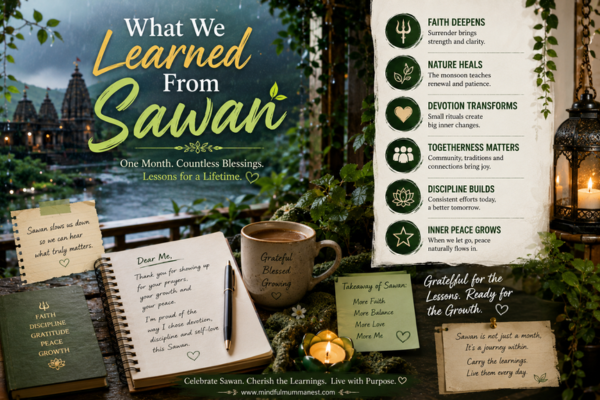
What We Learned From Sawan
Sawan teaches us that growth can happen quietly. Nature grows after rain, confidence grows through practice, relationships grow through care and skills grow through consistency. We can respect our traditions while learning modern technology, celebrate festivals while managing money wisely and care for our families while building our own identity.
The biggest lesson is simple: you do not always need to start with something new; sometimes you need to recognise the value of what you already know.
Final Thoughts
Sawan is a month of rain, greenery, Shiva devotion, family traditions, regional culture and inner reflection. Its stories belong to India’s rich religious heritage, while its seasonal connection with nature makes it feel especially alive. We should respect mythology as mythology, distinguish faith from scientific fact and appreciate the many ways different communities observe the month. Most importantly, we can carry Sawan’s values beyond the calendar—into our homes, choices, relationships, learning and financial lives.
And if this Sawan inspires you to learn one skill, save a little more carefully, create something useful or take your first honest step towards earn money, let that small beginning matter.
Guest Corner – With Gratitude
A beautiful blog is never created in isolation. It grows from the books we read, the people we learn from, the creators who share their experiences and the platforms that make knowledge accessible.
With heartfelt gratitude to James Clear, Robin Sharma, Eckhart Tolle, Jay Shetty, Oprah Winfrey, Mel Robbins, Marie Forleo, Ali Abdaal, Ankur Warikoo, Ranveer Allahbadia, Sadhguru, Deepak Chopra, Sri Sri Ravi Shankar and BK Shivani for sharing ideas around mindfulness, personal growth, courage, learning, spirituality and purposeful living.
We are also grateful to learning and wellbeing platforms such as Insight Timer, Headspace, Calm, Art of Living and Coursera, which continue to give people opportunities to learn, reflect and grow.
At Mindful Mumma Nest, gratitude is part of our journey. Every meaningful idea, every lesson and every shared experience can help someone take one more step towards a calmer life, stronger identity and more confident future.
Mindful Mumma Nest Final Words
Sawan reminds us to slow down. Nature reminds us to grow. Devotion reminds us to believe. Learning reminds us to improve. And our skills remind us that we can create something of our own.
May this Sawan bring you peace in your home, gratitude in your heart, clarity in your choices and courage to build the life you truly want.
Har Har Mahadev.
FAQs
1. What is Sawan month and why is it important?
Sawan, or Shravan, is an important Hindu lunar month traditionally associated with Lord Shiva, prayer, fasting and several regional festivals. It also coincides with India’s monsoon season, making nature an important part of the month’s atmosphere.
2. When is Sawan in 2026?
In North Indian traditions following the Purnimanta calendar, Sawan 2026 runs from 30 July to 28 August, with Sawan Somwar on 3, 10, 17 and 24 August. In several South and West Indian traditions following the Amanta calendar, Shravan runs from 13 August to 11 September, with Mondays on 17 and 24 August, 31 August and 7 September. Regional calendars can differ, so readers should follow their local Panchang. (Drik Panchang)
3. Why are Mondays important during Sawan?
Sawan Somwar, the Mondays of Shravan, are traditionally dedicated to Lord Shiva. Devotees may fast, visit temples, offer prayers and perform abhishekam according to their family and regional customs. (Drik Panchang)
4. Can Sawan traditions help us learn how to earn money?
The traditions themselves are devotional and should not be treated simply as business opportunities. However, skills connected with cooking, crafts, writing, teaching, photography, design and cultural storytelling can sometimes be developed into legitimate earning opportunities.
5. How can I celebrate Sawan mindfully?
You can keep your celebration simple, respect your family’s traditions, avoid unnecessary waste, spend according to your budget, reconnect with nature, learn something new and use the season as an opportunity for reflection rather than comparison.
Sources & Tools
- Drik Panchang – Regional Sawan dates and Sawan Somwar calendar information. Drik Panchang
- Mindful Mumma Nest – Lifestyle, mindful living and practical earning guidance. Mindful Mumma Nest
- Shiva Purana – Traditional source for Shaiva mythology and devotional stories.
- Bhagavad Gita – Classical text for reflection, duty and spiritual philosophy.
- Canva – Useful for creating festival graphics, recipe cards and digital content. Canva
- YouTube – Useful for learning, cultural storytelling and responsible content creation. YouTube