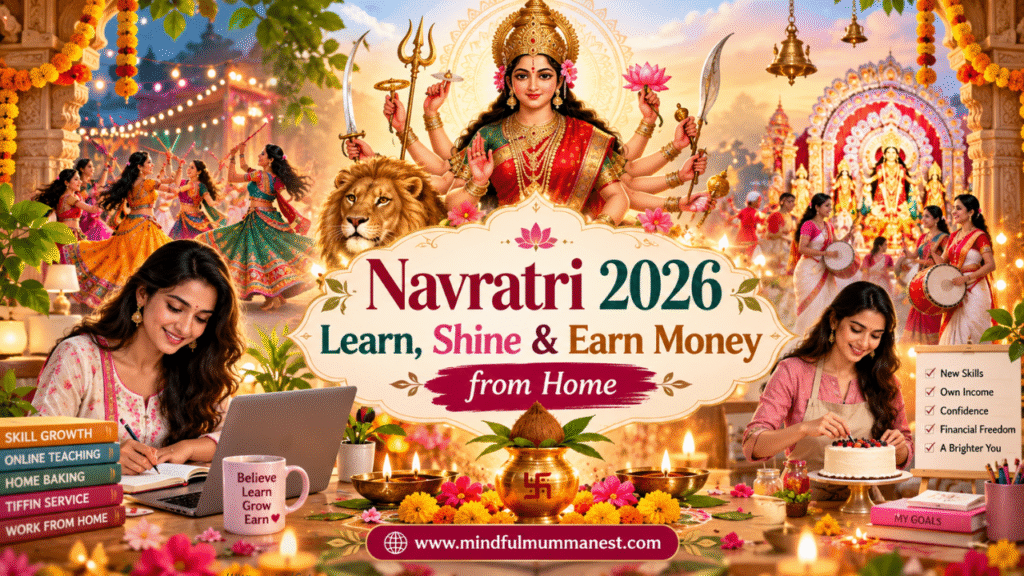
Navratri 2026: Dates, Ghatasthapana and Shubh Muhurat
Navratri 2026 Ghatasthapana Shubh Muhurat
Navratri 2026: The Nine Days of Maa Durga
Happy Shardiya Navratri 2026! Jai Mata Di!
May Maa Durga bring courage to your heart, peace to your home, wisdom to your decisions, and the strength to stand up for yourself. This Navratri, let us celebrate our beautiful Hindu culture while learning something meaningful about our faith, our history, our daughters, and our own inner Shakti.
At Mindful Mumma Nest, we believe that learning is not limited to books or classrooms. We grow when we understand our roots, respect our traditions, learn new skills, and become capable of standing on our own feet.
Table of Contents
- Navratri 2026: Dates, Ghatasthapana and Shubh Muhurat
- Navratri: The Real Meaning of Nine Nights
- Durga Puja: What Our Scriptures Tell Us
- Navratri Puja at Home: Step-by-Step Guide
- Navratri Mantras: Meaning, Positivity and Benefits
- Navratri Fasting: Why Many Families Eat Vegetarian Food
- Mahalaya and Bengali Durga Puja: The Story Behind the Celebration
- Navratri Across India: Garba, Golu, Dussehra and More
- Durga Puja in West Bengal: Different Traditions and Experiences
- Navratri and Women’s Safety: Worship Shakti, Respect Women
- Nine Forms of Durga: Lessons for Every Girl and Woman
- Navratri and Earn Money: Turn Your Inner Shakti into Independence
- Guest Corner: Gratitude, Learning and Growing Together
- Frequently Asked Questions About Navratri 2026
- Final Thoughts: Awaken Your Shakti and Build Your Own Future
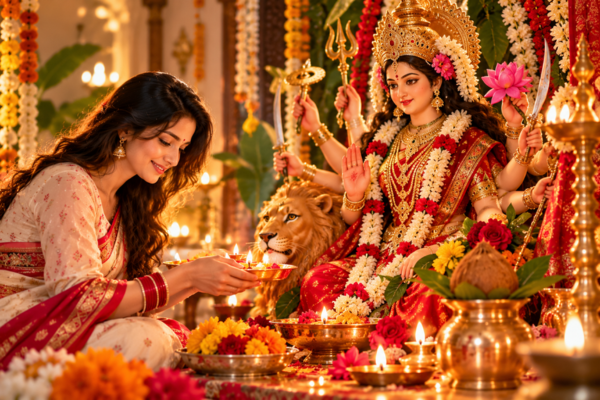
1. Navratri 2026: Dates, Ghatasthapana and Shubh Muhurat
Shardiya Navratri begins on Sunday, 11 October 2026, according to the Hindu calendar. It is a festival of devotion to Maa Durga and her nine divine forms, celebrated through prayer, fasting, music, dance, family traditions, and community gatherings.
The nine days are observed from 11 to 19 October, followed by Vijayadashami on 20 October in the commonly followed North Indian calendar. Bengali Durga Puja follows its own ritual calendar, with its main celebrations running from Shashthi through Vijayadashami on 16–21 October this year. Drik Panchang and the West Bengal Durga Puja calendar provide further details.
Navratri 2026 Ghatasthapana Shubh Muhurat
Ghatasthapana, also called Kalash Sthapana, marks the beginning of Navratri worship. It symbolises inviting Maa Shakti into our home and beginning the nine-day period with devotion.
- Date: Sunday, 11 October 2026
- Morning Ghatasthapana Muhurat: 6:19 AM to 10:12 AM, according to the Delhi Panchang
- Abhijit Muhurat: 11:44 AM to 12:31 PM, according to the same source
- First-day goddess: Maa Shailputri
These timings are location-specific, and traditional Panchang calculations may differ. The listed morning period also has Panchang considerations relating to Chitra Nakshatra and Vaidhriti Yoga, so families who follow strict ritual timings should consult their local Panchang or priest.
If you are reading this after the morning Muhurat has passed, please do not feel frightened or guilty. Offer a simple prayer to Maa Durga, light a diya safely, chant her name, and ask for guidance with a sincere heart. For formal Kalash Sthapana, follow the timing and method recommended by your family tradition.
Navratri 2026: The Nine Days of Maa Durga
| Date | Goddess | Quality to remember |
| 11 October | Maa Shailputri | Strength and stability |
| 12 October | Maa Brahmacharini | Discipline and dedication |
| 13 October | Maa Chandraghanta | Courage and alertness |
| 14 October | Maa Kushmanda | Creativity and hope |
| 15 October | Maa Skandamata | Care and protection |
| 16 October | Maa Katyayani | Courage and justice |
| 17 October | Maa Kalaratri | Fearlessness |
| 18 October | Maa Mahagauri | Peace and purity |
| 19 October | Maa Siddhidatri | Wisdom and fulfilment |
| 20 October | Vijayadashami | The victory of good over evil |
These qualities give us a beautiful way to reflect on our own lives. We can pray to Maa Durga and also practise courage, kindness, discipline, and self-respect in our everyday decisions.
2. Navratri: The Real Meaning of Nine Nights
The word Navratri comes from two Sanskrit words: nava, meaning nine, and ratri, meaning night. The festival honours the Divine Feminine, often understood through the concept of Shakti—the power that creates, protects, transforms, and sustains life.
Hindu traditions do not celebrate Navratri in exactly the same way everywhere. Some families worship the nine forms of Durga, others honour the Goddess through regional traditions, and many combine prayer with fasting, dancing, music, and community celebrations.
Why Navratri Is More Than a Religious Festival
- Faith: It gives people a dedicated time for prayer and reflection.
- Discipline: Fasting and daily rituals can encourage self-control when practised sensibly.
- Family: Preparing bhog, decorating the home, and attending celebrations bring generations together.
- Culture: Traditional clothing, songs, dance, crafts, and regional food preserve local heritage.
- Personal growth: The festival can remind us to work on fear, anger, laziness, and harmful habits.
What I find especially beautiful is that Hindu culture has many ways to express devotion. One family may begin the day with a mantra, another may prepare flowers for a Golu display, and another may spend the evening dancing Garba.
The rituals may differ, but the desire to find strength, hope, and meaning connects us.
Why Are People Around the World Attracted to Navratri?
People from different countries and cultural backgrounds may be drawn to Navratri because it brings together music, movement, colourful clothing, storytelling, art, food, and community. Garba events are now held in many countries, while Durga Puja attracts visitors interested in Indian art, craftsmanship, architecture, and living traditions.
Some people also appreciate the festival’s focus on the feminine divine. Others come to learn dance, experience Indian hospitality, or understand the stories behind the celebrations.
We should not assume that every foreign visitor comes for the same reason. But the international interest in these traditions shows how cultural experiences can help people connect across backgrounds.
Our culture becomes even more beautiful when we share it with knowledge, kindness, and respect.
3. Durga Puja: What Our Scriptures Tell Us
To understand Navratri properly, we need to look at the stories that have shaped its meaning over generations. One of the most important sources is the Devi Mahatmya, also known as Durga Saptashati or Chandi Path, which forms part of the Markandeya Purana.
It describes the Goddess as a powerful force who defeats destructive forces and restores balance. The stories are religious narratives interpreted through different traditions, and their meaning goes beyond the battles themselves.
Navratri and the Story of Mahishasura
According to the Devi Mahatmya tradition, Mahishasura became a powerful threat to the devas. Unable to defeat him individually, the gods’ energies came together, manifesting as the Goddess Durga.
She fought Mahishasura and ultimately defeated him. Her victory represents the restoration of order and the triumph of divine power over arrogance, violence, and destructive ambition.
For us, the story also offers a personal lesson. Sometimes our own Mahishasura may be fear, self-doubt, injustice, or the belief that we are not capable of building a better life.
We may not defeat these challenges in one day, but every honest step forward matters.
Navratri, Raktabija and Maa Kali: Understanding the Blood Story
There is another powerful episode in the Devi Mahatmya involving the demon Raktabija. In the story, every drop of his blood that reaches the ground produces another version of him, making the battle increasingly difficult.
Maa Kali intervenes by drinking his blood and preventing the drops from falling to the ground. This allows the Goddess to overcome the seemingly endless multiplication of the demon.
It is important to distinguish these two stories: Mahishasura is defeated by Durga, while the blood-drinking episode belongs to the battle with Raktabija and the Goddess’s fierce form, Kali.
Your understanding connects with the dramatic imagery of the Goddess drinking blood, but the traditional narrative places that specific act in the Raktabija episode rather than the Mahishasura battle.
What Can We Learn From Raktabija’s Story?
- Problems multiply when left unchecked: One harmful habit can create several more difficulties.
- Courage needs strategy: Strength alone may not solve every problem; we also need wisdom.
- Repeated challenges need a different approach: If the same difficulty keeps returning, we may need to change our method.
- Fierceness can protect: The fierce Goddess represents the power to confront what threatens life and justice.
These are personal interpretations of a sacred narrative, not claims that the scripture is a modern self-help manual. But they show how ancient stories can encourage reflection in our lives today.
Navratri, Shakti and the Respect We Owe Women
Maa Durga is not shown as powerless. She is the force who confronts danger, protects the world, and defeats a powerful adversary.
That image invites us to ask a difficult question: if we worship the Goddess, do we also respect the women around us?
Do we encourage girls to study, make decisions, develop skills, earn money, and speak up when something is wrong? Do we respect a woman’s right to say no? Do we teach boys that respect is their responsibility, not something a girl must earn by changing her clothes or restricting her freedom?
These questions are not against our culture. They are an opportunity to live up to its highest ideals.
4. Navratri Puja at Home: Step-by-Step Guide
You do not need an elaborate mandir or expensive decorations to worship Maa Durga. A clean space, a few simple offerings, and a sincere heart can make your home feel peaceful and meaningful.
Navratri Puja Samagri
Keep the following items ready according to your family tradition:
- A picture or idol of Maa Durga
- A clean cloth for the puja space
- A kalash or suitable water vessel
- Clean water, and mango leaves or other traditional items if available
- Rice or grains, flowers, and kumkum
- A diya, cotton wicks, and suitable oil or ghee
- Incense, if you use it
- Fruits, sweets, or homemade bhog
- A small plate for prasad
You do not have to buy everything on this list. Traditions differ, and a simple prayer is better than putting yourself under financial pressure to perform an elaborate ritual.
Navratri Ghatasthapana: How to Perform It
Step 1: Clean the puja space. Choose a quiet, clean area and arrange your Goddess image, puja cloth, and basic offerings.
Step 2: Prepare the kalash. Fill a clean vessel with water and decorate it according to your family’s custom. Some traditions use mango leaves, a coconut, grains, or other auspicious items.
Step 3: Sow barley if your tradition includes it. Barley seeds are placed in soil or a suitable vessel and watered. Their growth is traditionally associated with prosperity and new beginnings.
Step 4: Invoke Maa Durga. Sit comfortably, fold your hands, and offer a prayer. You may chant a simple mantra or recite a familiar hymn.
Step 5: Offer flowers and bhog. Offer what you have prepared with devotion. Fruits, sweets, and other customary offerings are common.
Step 6: Perform aarti. Sing or recite your family’s preferred aarti. Keep the diya away from curtains, children, and other flammable objects.
Step 7: Continue your daily worship. Offer prayers, water the barley if planted, and maintain the space respectfully throughout the festival.
Important: Ghatasthapana is a specific ritual with traditional rules and auspicious timings. If you are observing it formally, follow a reliable local Panchang and your family’s ritual guidance.
Navratri Puja: What to Do Every Day
- Spend a few quiet minutes in prayer.
- Read a short passage from a devotional text or listen to a trusted recitation.
- Chant a mantra that you understand and feel connected to.
- Prepare a simple bhog or offer fruit.
- Practise one act of kindness at home or outside.
- Encourage a girl or woman to learn something new.
- Reflect on one habit you want to improve.
Navratri Puja: What Not to Do
Practices differ between families, so these are general suggestions rather than universal religious rules.
- Do not frighten others by claiming that a small mistake automatically brings the Goddess’s anger.
- Do not waste food or spend beyond your means to impress others.
- Do not use a religious fast as a reason to neglect your health.
- Do not insult people who follow different regional customs.
- Do not treat worship as a substitute for kindness, honesty, or responsibility.
- Do not keep an open flame unattended.
If you miss a ritual, feel unwell, or cannot observe a fast, you can still pray and participate in ways that suit your circumstances.
5. Navratri Mantras: Meaning, Positivity and Benefits
Mantras are an important part of many Hindu devotional traditions. A mantra may be a name of the Goddess, a sacred syllable, or a verse repeated during prayer.
For many devotees, chanting creates a sense of connection with Maa Durga. Repeating familiar words can also give the mind something steady to focus on during a stressful day.
Navratri Mantra for Maa Durga
Om Dum Durgayei Namaha
This is a widely used devotional mantra addressed to Maa Durga. Devotees chant it while asking for courage, protection, and strength.
You can repeat it 11 times, 21 times, or for as long as is comfortable. These are common devotional choices, not a guarantee of a particular outcome.
Navratri Mantra for Maa Shailputri
Om Devi Shailputryai Namah
This mantra honours the first form of Navdurga, Maa Shailputri. On the first day of Navratri, devotees traditionally pray to her for stability, strength, and a firm beginning.
How Navratri Mantras May Support Your Mind
- Focus: Repetition gives your attention a clear point to return to.
- Calm: A quiet chanting routine may help you slow down and pause.
- Routine: A daily practice can create a small, predictable moment of reflection.
- Hope: Devotional words can remind believers of their values and faith.
- Gratitude: Prayer can encourage people to notice what they appreciate in their lives.
Some people experience these benefits deeply, while others connect more through reading, music, meditation, or service. Research on meditation and repetitive prayer suggests that structured contemplative practices can support relaxation for some people, but the effects vary.
We should not claim that a mantra automatically cures an illness, removes every problem, or guarantees wealth. Its spiritual significance belongs to faith, while practical decisions still require knowledge, effort, and support.
Navratri’s Biggest Mantra for Everyday Life
Along with prayer, I would love every girl and woman to remember these words:
I deserve respect. I can learn. I can grow. I can ask for help. I can build skills. I can make decisions. I can create a future in which I do not have to surrender my dignity to survive.
That is a powerful intention to carry beyond the nine days.
6. Navratri Fasting: Why Many Families Eat Vegetarian Food
In many North Indian households, Navratri is associated with vegetarian food, fasting, and a simplified diet. Some families avoid meat, fish, eggs, onion, and garlic during their observance, while others follow different rules.
There is no single dietary practice followed by every Hindu family. The rules vary according to region, community, family tradition, and the type of fast being observed.
Navratri Fasting Foods in North India
Common choices include:
- Kuttu: Buckwheat flour puris or rotis
- Singhara: Water-chestnut flour dishes
- Sabudana: Khichdi or vadas
- Makhana: Roasted snacks or kheer
- Fruits: Bananas, apples, and seasonal fruit
- Dairy: Milk, curd, or paneer where permitted
- Sendha namak: Rock salt used by many fasting households
Some people eat only fruits and milk, while others prepare full meals using fasting ingredients. There is no need to copy another person’s fasting routine if it does not suit your health or family practice.
Why Do Many People Avoid Non-Vegetarian Food During Navratri?
For many devotees, vegetarian eating is associated with sattva, simplicity, restraint, and spiritual discipline. Avoiding certain foods can also be a way of making the nine days feel different from an ordinary routine.
Others observe the festival through prayer, charitable work, music, or family rituals without fasting at all.
The important point is that a person’s devotion cannot be measured simply by what is on their plate. Food customs should be discussed with respect, not used to judge another community.
If you have a medical condition, are pregnant, or need a regular diet for health reasons, seek appropriate medical advice before undertaking a restrictive fast.
7. Mahalaya and Bengali Durga Puja: The Story Behind the Celebration
As someone who values Bengal’s cultural heritage, I feel that Mahalaya deserves a special place in this article. It marks a deeply emotional beginning to the Durga Puja season for many Bengali families.
Mahalaya fell on Saturday, 10 October 2026, just before Shardiya Navratri began. It is traditionally associated with the end of Pitru Paksha and the beginning of the devotional anticipation of Durga Puja.
Why Is Mahalaya Important in Bengal?
Mahalaya is connected with remembrance, devotion, and the welcoming of Maa Durga. Many Bengali households listen to the celebrated Mahishasura Mardini broadcast, with devotional recitations and music associated with Birendra Krishna Bhadra’s iconic rendition.
For many people, hearing these voices early in the morning brings back childhood memories, family rituals, and the feeling that Pujo is near.
Mahalaya is also associated with the traditional idea that the Goddess begins her journey towards the earthly world. The exact theological interpretation and ritual observances differ across communities.
How Did Durga Puja Develop in Bengal?
Durga worship has deep roots in eastern India’s religious history. Over centuries, household rituals, community patronage, local artistic traditions, and public celebrations helped shape the Durga Puja we see today.
Bengal’s public and community pujas developed into major cultural gatherings. They now bring together idol-makers, artisans, musicians, decorators, volunteers, cooks, designers, and visitors.
Durga Puja is therefore both a religious observance and a living cultural tradition. It preserves artistic knowledge while allowing each generation to express its own ideas.
Why Is Durga Puja So Emotional for Bengalis?
For many Bengali families, Pujo means more than visiting a pandal. It means new clothes, meeting relatives, sharing bhog, walking through beautifully decorated streets, and hearing familiar dhak rhythms.
Some people travel home after months away. Others remember relatives who are no longer with them. Children discover the festival through their parents, while young artists create new ways to represent the Goddess.
And when Bijoya arrives, the celebration carries a mixture of joy, gratitude, and the sadness of saying goodbye until next year.
8. Navratri Across India: Garba, Golu, Dussehra and More
India’s festivals are beautiful because they do not always look the same. The same season can bring devotional dance in one state, a grand procession in another, a display of dolls in one home, and a traditional temple ceremony somewhere else.
Gujarat: Navratri Garba and Dandiya
In Gujarat, Navratri is famous for Garba and Dandiya Raas. People gather in traditional clothing, form circles, dance to devotional songs, and celebrate the Goddess through rhythm and movement.
Garba is traditionally associated with the sacred lamp and the symbolism of life. Dandiya uses decorated sticks in a coordinated dance.
Today, celebrations range from neighbourhood gatherings to large organised events. Garba is also performed by Indian communities around the world.
North India: Navratri, Fasting and Dussehra
In many parts of Uttar Pradesh, Delhi, Uttarakhand, Haryana, and neighbouring regions, devotees observe fasts, worship the Goddess, and attend Ramlila performances.
Dussehra is associated with the victory of Lord Rama over Ravana in the Ramayana tradition, while Durga’s victory over Mahishasura is another important expression of the triumph of good over evil.
Families may visit temples, attend local fairs, prepare fasting meals, or organise Kanya Pujan near Ashtami or Navami.
Maharashtra: Ghatasthapana and Community Traditions
Many Maharashtrian households perform Ghatasthapana and worship the Goddess during the nine days. Regional customs may include offerings, traditional foods, devotional singing, and gatherings of women.
The exact rituals differ by family and community.
West Bengal: Durga Puja
In Bengal, the festival is marked by beautifully crafted idols, elaborate pandals, dhak music, bhog, cultural performances, and pandal-hopping.
The central focus is Maa Durga’s arrival and victory over Mahishasura. Families and communities celebrate together before the farewell rituals of Vijayadashami.
Tamil Nadu: Navratri Golu
In Tamil Nadu, many families arrange Golu, also called Bommai Kolu: rows of steps decorated with dolls representing deities, mythological stories, daily life, and cultural scenes.
Families invite friends and neighbours, sing devotional songs, and offer traditional snacks. The display can become a creative project that children and adults build together.
Karnataka: Mysuru Dasara and Gombe Habba
Karnataka is known for the grand Mysuru Dasara celebrations, including cultural programmes and processions. Some families also observe Gombe Habba, a doll-display tradition related to Golu.
Andhra Pradesh and Telangana: Bommala Koluvu and Bathukamma
In Andhra Pradesh and Telangana, doll displays known as Bommala Koluvu are part of the festive season in many homes.
Telangana is also famous for Bathukamma, a floral festival celebrated by women who arrange flowers in colourful layers and gather for songs and dances. Its timing and local observance are connected with the wider autumn festival season.
Kerala: Saraswati Puja and Vidyarambham
In Kerala, the final days of Navratri are associated with Saraswati worship, books, music, and learning. Vidyarambham is an important tradition in which young children are introduced to writing and learning.
For a website focused on Learning (Skill Growth), this tradition carries a lovely message: learning itself can be treated as sacred.
Himachal Pradesh: Kullu Dussehra
Kullu Dussehra is known for its distinctive regional traditions, processions, and gatherings of local deities. Its celebrations continue after Dussehra has ended in many other parts of India.
What Do People Eat During Navratri in Different States?
Food varies widely. Some households prepare fasting meals, others share vegetarian bhog, and others follow their usual regional customs.
- North India: Kuttu, sabudana, fruit, and fasting thalis
- Gujarat: Fasting dishes, snacks, and regional festive meals
- Bengal: Bhog, khichuri, vegetables, sweets, and other traditional dishes
- Tamil Nadu: Sundal, fruits, and snacks offered during Golu gatherings
- Maharashtra: Regional fasting dishes and festive offerings
- Karnataka: Local sweets, savouries, and temple offerings
These are examples, not rules for every household. The variety of our food traditions is part of India’s cultural richness.
9. Durga Puja in West Bengal: Different Traditions and Experiences
West Bengal’s Durga Puja is not one single kind of celebration. Different families, neighbourhoods, and communities bring their own histories and artistic styles to the festival.
Bonedi Bari Durga Puja
Bonedi Bari pujas are traditional family celebrations held in the ancestral homes of established families. They often feature historic courtyards, traditional idols, family rituals, and customs preserved over generations.
Examples include the pujas at Sovabazar Rajbari and other historic Kolkata households.
Barowari and Sarbojanin Durga Puja
Community pujas bring neighbours together to organise worship, decorations, cultural events, and public gatherings. Sarbojanin pujas are intended for the wider community, while the word Barowari is historically associated with collective organisation.
These celebrations are an important part of the public character of Durga Puja.
Theme-Based Durga Puja Pandals
Many modern pandals are built around a theme. Artists may explore folk traditions, architecture, environmental concerns, literature, social issues, or regional crafts.
The pandal becomes a temporary work of art, and visitors walk through it as part of the festive experience.
Traditional Durga Puja and Ekchala Idols
Some pujas preserve the traditional arrangement in which Durga and her accompanying deities are presented together in a single composition, often called an ekchala style.
Other pujas use different artistic forms. Both traditional and contemporary styles contribute to the festival’s living heritage.
How Do Bengali Families Celebrate Durga Puja?
Shashthi: The Goddess is welcomed through rituals that mark the beginning of the main celebrations.
Saptami: Puja continues with traditional ceremonies and offerings.
Ashtami: Many devotees observe special worship, Anjali, and community bhog. Sandhi Puja is performed at the transition between Ashtami and Navami according to the ritual calendar.
Navami: Worship and cultural celebrations continue, often with special offerings.
Dashami: The Goddess is given a farewell. Sindoor Khela is observed by some married women, and many families exchange greetings during Bijoya Dashami.
Not every ritual is followed by every family, and the exact schedule depends on the local calendar.
Why Do Some Bengali Families Eat Fish or Meat During Durga Puja?
This is an important cultural question, and the answer is not simply that Bengalis follow different rules because of Mahishasura’s blood.
Bengali food traditions are diverse. Some households offer vegetarian bhog, and many people eat vegetarian food during particular puja rituals. Other Bengali families include fish or meat in festive meals, depending on family custom, religious practice, and the specific day.
In some Bengali Shakta traditions, animal sacrifice or symbolic substitutes have a place in particular ritual contexts. Other communities reject sacrifice and follow vegetarian practices. These differences should not be treated as a single rule for all Bengalis.
The story of Raktabija’s blood belongs to the Devi Mahatmya narrative, but it is not an established universal explanation for why Bengali families eat non-vegetarian food during Durga Puja.
Food customs develop through regional history, local religious traditions, family habits, and social life. We can respect those differences without inventing a single explanation for everyone.
What Makes Bengal’s Durga Puja Special?
It is the way devotion, art, food, music, and community life come together. A family can visit a historic household puja in the morning, explore a modern pandal in the evening, share bhog with neighbours, and end the night listening to dhak.
For visitors, it can be an introduction to Bengali culture. For people who grew up with Pujo, it can feel like returning to a part of themselves.
10. Navratri and Women’s Safety: Worship Shakti, Respect Women
I want to discuss something that should not be hidden behind beautiful decorations or festive photographs.
During Navratri, we worship a Goddess who is powerful, fearless, and capable of confronting injustice. Yet girls and women in India still face harassment, domestic violence, discrimination, unequal opportunities, and fear for their safety.
Why do we celebrate the power of a Goddess but sometimes restrict the freedom of a girl?
This is not a question against Hindu culture. It is a question about whether we are practising the values we celebrate.
Navratri Should Change More Than Our Decorations
- At home: Teach boys and girls the same respect, responsibility, and right to learn.
- At school: Take bullying, harassment, and discrimination seriously.
- At work: Support equal opportunities, fair pay, and safe workplaces.
- In public: Challenge victim-blaming and harassment instead of asking women to carry the entire burden of prevention.
- Online: Respect consent, privacy, and boundaries.
- In families: Listen when a girl says she feels unsafe. Do not dismiss her fear.
Women deserve safety because they are human beings, not because they resemble a goddess, follow a particular dress code, or behave according to someone else’s expectations.
Why Girls Need Education and Financial Independence
Education gives a girl knowledge. Skills give her options. Financial independence can give her greater freedom to make decisions, plan for the future, and seek help when she needs it.
Earning money does not automatically solve every social problem, and no woman should be blamed if she cannot earn. But access to income, savings, and useful skills can strengthen her choices.
This is one reason I want Mindful Mumma Nest to be a place where women can learn practical ways to grow. We can celebrate Maa Durga and also help women discover what they can do with their own abilities.
Navratri’s Message for Every Girl
You do not have to be fearless every day. You can ask for help. You can learn slowly. You can change direction. You can leave a harmful situation when it is possible and safe to do so.
Strength does not mean carrying every burden alone. Sometimes strength means speaking, sometimes planning, sometimes learning a new skill, and sometimes accepting support.
Let us teach girls that their voices matter throughout the year—not only during nine days of worship.
11. Nine Forms of Durga: Lessons for Every Girl and Woman
The nine forms of Navdurga can be a meaningful way to reflect on the different strengths women use in everyday life. These are personal lessons inspired by the Goddess traditions, not the only meanings assigned to each form in religious practice.
1. Maa Shailputri: Build Your Foundation
Maa Shailputri represents the first step of the journey. Her name connects her with the mountains.
In our lives, this can remind us to build a strong foundation through education, healthy routines, self-respect, and the courage to begin again.
2. Maa Brahmacharini: Keep Learning
Her form is associated with devotion and discipline. For a woman trying to improve her life, this can mean practising a skill even when progress feels slow.
You do not need to learn everything in one month. Consistent effort matters.
3. Maa Chandraghanta: Speak With Courage
Her form is associated with bravery and the readiness to confront danger.
In everyday life, courage can mean speaking up against disrespect, asking a question in class, applying for a job, or setting a boundary.
4. Maa Kushmanda: Create Something New
Maa Kushmanda is associated with creative cosmic energy.
We can connect this with the ability to create a blog, teach a student, design a product, start a home kitchen, or develop a small business from an idea.
5. Maa Skandamata: Care Without Losing Yourself
Her form represents motherhood and nurturing.
Mothers often care for everyone else. But caring for children and family should not mean giving up all personal growth. A mother can love deeply and still learn, work, rest, and have ambitions.
6. Maa Katyayani: Stand Up for Justice
Maa Katyayani is associated with powerful action against destructive forces.
Her story can remind us that unfair treatment should not be accepted as normal. We need laws, responsible institutions, supportive communities, and people willing to challenge injustice.
7. Maa Kalaratri: Face Your Fears
Maa Kalaratri is a fierce form of the Goddess.
In our lives, this can mean confronting difficult truths, asking for help, learning about our rights, or taking practical steps to protect ourselves.
8. Maa Mahagauri: Make Space for Peace
Maa Mahagauri is associated with purity and peace.
Peace does not mean remaining silent when something is wrong. It can mean letting go of unnecessary guilt, choosing healthier routines, and creating a home where people feel respected.
9. Maa Siddhidatri: Keep Growing
Maa Siddhidatri is associated with spiritual accomplishment and fulfilment.
For us, growth can mean using what we have learned to build a meaningful life. It may be a qualification, a stable job, a small business, a creative project, or the confidence to make our own decisions.
Navratri and Women Who Inspire Us
We can find examples of courage and determination in many fields. Savitribai Phule worked for girls’ education in nineteenth-century India. Kalpana Chawla became an astronaut. Mary Kom built an extraordinary career in boxing, and Kiran Bedi broke barriers in public service.
Their lives are different, and none represents every aspect of the Goddess. But their determination reminds us that women’s achievements grow when courage meets opportunity, preparation, and persistence.
We should not expect every woman to become famous to prove her worth. A woman who raises a child, studies after years away from education, supports her family, starts a small business, or learns to speak up deserves respect too.
12. Navratri and Earn Money: Turn Your Inner Shakti into Independence
At Mindful Mumma Nest, our focus is Learning (Skill Growth). We believe that every woman deserves opportunities to learn something useful and explore ways to build income from her own abilities.
The message of Shakti can inspire us, but practical progress comes from learning, practising, serving people, and making thoughtful decisions.
You do not need to wait until your life is perfect to begin. You can start with the knowledge, time, and resources available to you.
Navratri: Five Skills You Can Learn to Earn Money From Home
1. English teaching
If you have a good command of English, you may be able to teach school students, support spoken-English learners, or offer online lessons. Start by identifying your subject level and preparing a simple lesson plan.
Read our guide: English Online Teaching Jobs: Learn How to Earn Money.
2. Tiffin service
If you enjoy cooking and can prepare food safely and consistently, a small tiffin service may be worth exploring. Begin by understanding local demand, costing each meal, packaging, and any food-business registration requirements that apply.
Read: Earn Money With a Tiffin Service for Housewives.
3. Home baking
Cakes, cookies, breads, and festive treats can become a small business when you develop a reliable recipe, calculate costs, and build a local customer base. Start with a manageable menu rather than buying too much equipment at once.
Read: How to Start a Home Baking Business and Earn Money.
4. Online work for beginners
If you are new to online earning, explore skills such as writing, virtual assistance, graphic design, editing, or social media support. Learn what each role requires before applying, and never pay a stranger for a guaranteed job.
Read: How to Make Money Online for Beginners.
5. Content creation and digital products
If you enjoy explaining things, writing, designing, or teaching, you can explore blogging, YouTube, short videos, printable planners, and digital guides. These activities take time to build, and income is not guaranteed, but they can help you develop a portfolio and discover what your audience needs.
Navratri: Useful Platforms for Learning and Finding Work
These platforms serve different purposes. Check eligibility, fees, payment terms, and current availability before committing your time or money.
- Google Skillshop: Training for Google’s advertising and analytics tools.
- Coursera: Courses and professional learning programmes.
- Udemy: Courses on practical skills, business, technology, and creative work.
- YouTube: Free tutorials and opportunities to develop a public portfolio.
- LinkedIn: Professional networking and job discovery.
- Internshala: Internships and entry-level opportunities in India.
- Upwork and Fiverr: Freelance marketplaces where clients and service providers connect; competition and platform fees apply.
Learning a skill does not guarantee a job. A strong portfolio, realistic pricing, practice, and clear communication are important.
Navratri: A Simple Seven-Day Skill-Growth Challenge
Day 1 — Discover: Choose one skill you already have or genuinely want to learn.
Day 2 — Research: Find a trustworthy course, tutorial, or learning resource.
Day 3 — Practise: Spend 30 minutes creating something small, such as a lesson plan, sample design, recipe costing sheet, or writing sample.
Day 4 — Improve: Ask for feedback and correct mistakes.
Day 5 — Prepare: Create a simple portfolio or description of your service.
Day 6 — Explore: Research real opportunities, local customers, or people who might need your service.
Day 7 — Take one step: Apply for a suitable opportunity, share your work, or speak to a potential customer.
You can repeat the challenge and improve your work each week. The aim is not to become rich in seven days; it is to turn learning into action.
Navratri: Why Your Own Money Matters
Having your own income can help you contribute to household expenses, save for emergencies, support your children’s education, invest in learning, and make more independent choices.
But please remember: a woman’s worth does not depend on her earnings. Some women cannot work because of caregiving, health, safety, or other responsibilities. They deserve the same respect.
The goal is to create more choices, not another reason to feel guilty.
Your own money can strengthen your ability to stand up for yourself. Your skills can open doors. And your growth can begin with one small, practical step.
13. Guest Corner: Gratitude, Learning and Growing Together
At Mindful Mumma Nest, I am grateful for the platforms and learning resources that help people discover knowledge, develop skills, and explore new opportunities. Google has given me an opportunity to share useful information through search and online publishing, and I value the work that goes into creating content readers can learn from. I also appreciate the wider learning communities around Coursera, Udemy, Headspace, Calm, and Art of Living, which offer different ways to explore education, wellbeing, and personal growth. These names are included as resources and expressions of gratitude, not as claims of formal sponsorship or endorsement. Thank you for being part of a world where learning can travel from one home to another and help people move forward.
14. Frequently Asked Questions
1. When does Navratri start in 2026?
Shardiya Navratri begins on 11 October 2026, with the first day dedicated to Maa Shailputri. Vijayadashami falls on 20 October in the commonly followed North Indian calendar.
2. What is the Ghatasthapana Muhurat for Navratri 2026?
For Delhi, the listed morning Muhurat is 6:19 AM to 10:12 AM on 11 October, with an Abhijit Muhurat from 11:44 AM to 12:31 PM. Local timings and Panchang considerations can differ.
3. Why do some Bengalis eat non-vegetarian food during Durga Puja?
Bengali food customs vary by family, region, and religious tradition. Some households follow vegetarian puja rules, while others include fish or meat in festive meals; Raktabija’s story is not a universal explanation for these practices.
4. What should I do if I cannot fast during Navratri?
You can pray, chant a mantra, read a devotional text, or take part in community activities without fasting. Follow your health needs and family tradition rather than putting yourself at risk.
5. How can I use Navratri for personal growth and earning money?
Choose one useful skill, learn from a trustworthy resource, practise consistently, and explore genuine work opportunities. Income takes time and effort, but steady learning can help you build more choices.
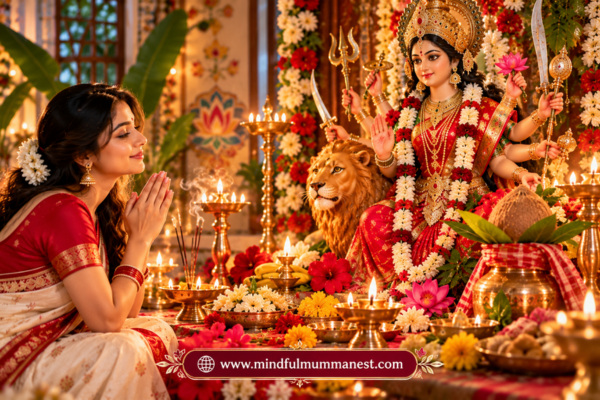
15. Final Thoughts: Awaken Your Shakti and Build Your Own Future
Navratri teaches us to remember the power of the Goddess, the beauty of our traditions, and the courage needed to confront what is wrong. Through Durga Puja, Garba, fasting, Golu, Mahalaya, and the many regional celebrations across India, we see how one season can carry so many forms of devotion and cultural expression.
We have explored the nine forms of Maa Durga, the stories of Mahishasura and Raktabija, the meaning of mantras, the traditions of Bengali Durga Puja, the diversity of Indian food customs, and the importance of respecting women beyond the festival. We have also connected the spirit of Shakti with learning, skill development, and ways to explore earning money from home.
Mindful Mumma Nest continues to bring together learning, lifestyle, practical skills, and opportunities for women who want to grow. If any of these ideas inspires you, explore the linked guides, choose one skill, and take your next step at your own pace.
You do not need to change your whole life overnight. You need the courage to begin, the patience to learn, and the belief that your future is worth working towards.
May Maa Durga bless every home with peace, every girl with safety, every woman with dignity, and every learner with the courage to grow.
Happy Navratri and Shubho Durga Puja!
Be you. Be motivated. Keep learning. Keep growing. And may the Shakti within you help you build a life filled with dignity, freedom, and hope.
With love and gratitude,
Mindful Mumma Nest Care