

A Sample 5-Day Tiffin Menu
Build a Menu That Makes Customers Want Tomorrow’s Tiffin
Your Kitchen Can Become More Than a Kitchen
There is something very special about the food we cook at home.
It may be a simple dal, two rotis, sabzi and rice. But sometimes, that simple meal is exactly what someone living away from home is searching for.
And if you are a housewife, you probably already have one skill that you have been using every single day without calling it a skill — cooking, planning, managing ingredients, feeding people and keeping a kitchen running.
At Mindful Mumma Nest, we don’t believe that becoming a mother or managing a family means your identity has to disappear.
Sometimes, your identity is simply waiting inside the things you already know.
That is why in our Learning (Skill Growth) Series, I don’t want to give you another list of random earning ideas. I want to show you how one ordinary skill can slowly become your own source of confidence, identity and income.
Today, we are talking about tiffin service.
But not the usual “buy containers, cook food and find customers” advice.
We are going to look at 5 different ways to build a tiffin service, how to start from your society, how to plan your week, what to cook, where to find customers, which tools can make your work easier and how to grow without making your whole life revolve around the kitchen.
So take your cup of chai.
Let’s start.

Tiffin Service: Can Your Everyday Home Meal Become Your First Income?
Yes — and the easiest place to begin may be much closer than you think.
You don’t need to imagine a restaurant, a huge kitchen or 100 customers on your first day.
Start with the food you already cook well.
Your first customer could be the working woman in your building. It could be a bachelor living two streets away, a student missing ghar ka khana, an elderly person who finds daily cooking difficult or a mother who simply wants one healthy meal without entering the kitchen.
A tiffin service works particularly well when you think local first, repeat customers second and expansion third.
And there is one beautiful advantage:
You can cook according to the number of confirmed orders instead of cooking blindly and hoping someone buys.
For example:
- Start with 3 tiffins.
- Then try 5.
- Then 10.
- Build a weekly subscription.
- Improve your menu.
- Ask for feedback.
- Repeat what works.
Don’t start by saying, “I need 50 customers.”
Start by saying:
“Can I make 5 people happy with today’s lunch?”
That is a much better first target.
If you are completely new to earning online or from home, you may also like my earlier beginner guide: How to Make Money Online for Beginners. Start small, learn one skill and build from there.
Tiffin Service: What Makes Your Food Different?
This is where I want you to stop and think.
There are already thousands of people selling tiffins.
So why should someone order yours?
Because you are not selling only food. You are selling a reason to come back tomorrow.
Your difference could be:
- Simple ghar ka khana.
- Less-oil meals.
- Regional food.
- Bengali home-style meals.
- North Indian lunch.
- Light meals for elderly customers.
- Office lunch boxes.
- Student-friendly meals.
- Jain-friendly options.
- No-onion/no-garlic days.
- Protein-focused meals.
- Seasonal menus.
- “Sunday special Maa ke haath ka khana.”
- A rotating menu that customers don’t have to think about.
You don’t have to become famous.
You have to become memorable in a small area.
That is the secret I want you to remember.

5 Unique Tiffin Service Ideas for Housewives & Seekers
1. Society Tiffin Club
Don’t search for customers across the whole city.
Own your society first.
Imagine 8 working women in your apartment building.
Instead of each person deciding what to eat every afternoon, you offer:
Monday–Friday Home Lunch Subscription
For example:
Monday: Dal + Jeera Rice + Aloo Gobhi + Roti
Tuesday: Rajma + Rice + Salad + Roti
Wednesday: Kadhi + Rice + Seasonal Sabzi + Roti
Thursday: Chole + Rice + Salad + Roti
Friday: Special Home Meal + Sweet
You can even create a fixed delivery point inside the society instead of running from door to door.
How to start
- Speak to 10–15 neighbours.
- Ask what they normally spend on lunch.
- Ask whether they prefer lunch or dinner.
- Offer a 2-day trial.
- Collect genuine feedback.
- Start with 3–5 subscriptions.
- Fix one delivery time.
- Keep one weekly menu.
- Take advance payment for subscriptions.
Your first goal is not maximum profit. Your first goal is repeat customers.
And once 5 families trust you, getting the next 5 becomes easier.
If you enjoy teaching yourself new digital skills along the way, my guide on English Online Teaching Jobs is another example of how an existing skill can become an income path from home.
2. The “One Person” Comfort Tiffin
This is one of my favourite ideas.
Instead of thinking only about families, think about people who live alone.
There are students, bachelors, working professionals, elderly people and people who have recently moved to a new city.
They don’t always want a large restaurant meal.
Sometimes they want exactly what you would put on your own family’s plate.
So create a smaller:
“One Person Ghar Ka Tiffin.”
Your menu could include
- 2–3 rotis
- One seasonal sabzi
- Dal
- Small rice portion
- Salad
- Pickle
- One small homemade special once or twice a week
You could even have:
Light Tiffin
Regular Tiffin
Special Weekend Tiffin
Where can you find these customers?
- PGs
- Hostels
- Paying guests
- Coaching centres
- Small offices
- Nearby gyms
- Clinics
- Libraries
- Apartment groups
- Local WhatsApp groups
And don’t forget Google.
Create a proper Google Business Profile so people searching for home food in your locality can discover you.
The smaller your starting area, the easier it is to manage delivery.
3. Regional “Maa Ke Haath Ka Khana” Tiffin
Now let’s make your tiffin memorable.
Don’t sell:
“Indian Food.”
Sell a story.
Maybe your strength is Bengali food.
Then create:
Monday Bengali Home Lunch
Tuesday North Indian Comfort Meal
Wednesday Light Khichdi & Seasonal Meal
Thursday Regional Special
Friday Maa Ke Haath Ka Friday
Or perhaps you know authentic Garhwali, Punjabi, Gujarati, South Indian, Bengali or Rajasthani recipes.
Your family recipes can become your USP.
This is something I strongly believe women should stop underestimating.
A recipe that you have cooked for 20 years may feel ordinary to you.
It may be completely new to someone else.
And this is exactly what we can learn from women like Bhagyalakshmi Gohokar. She carried her mother’s handwritten recipes and cooking traditions into a much larger food venture, Santosham. Her story is a beautiful reminder that what looks like an old family recipe can become a valuable identity when you preserve and present it well.
Make it even more special
Give each day a tiny story.
For example:
“Today’s lunch is inspired by the meal my mother used to make on rainy afternoons.”
Now you aren’t only delivering a tiffin.
You are delivering a memory.
And memories are much harder to copy.
4. The Healthy Tiffin Subscription
This is for the woman who enjoys learning about food, balanced meals and simple healthy cooking.
Don’t try to become a medical expert.
Simply create a practical food category around:
“Simple, home-cooked, lighter meals.”
For example:
- Less-oil meals
- Seasonal vegetables
- Dal and pulses
- Homemade curd
- Millet options
- Simple khichdi
- Vegetable pulao
- Sprouts or salad add-ons
- Homemade chutneys
You can create:
5-Day Light Lunch Plan
Instead of changing everything every day, keep the cooking manageable.
Example
Monday: Moong dal + sabzi + roti
Tuesday: Vegetable khichdi + curd
Wednesday: Dal + rice + seasonal vegetable
Thursday: Millet roti + sabzi + dal
Friday: Vegetable pulao + raita + salad
And remember:
Never make health claims you cannot prove.
“Homemade,” “light,” “less-oil” and “balanced” are very different from promising to cure a disease.
Your job is to make good food.
Not to become someone’s doctor.
5. Tiffin + Content: Turn One Kitchen Skill Into Two Income Streams
Now comes the idea I really want our Mindful Mumma Nest readers to notice.
Don’t stop at selling the tiffin.
Document what you are learning.
For example:
You cook dal.
You make a 20-second Instagram Reel.
You show your weekly menu.
You share how you calculate the cost.
You show your packing routine.
You share “today’s tiffin.”
You teach one small cooking tip.
You tell your story.
Over time, your tiffin business can become content.
And content can create another income path through:
- Brand collaborations
- Affiliate links
- YouTube
- Recipe PDFs
- Paid recipe collections
- Cooking workshops
- Digital meal planners
- Kitchen product recommendations
This is exactly the kind of skill stacking I want women to understand.
One skill does not have to produce only one income source.
If you are interested in learning another digital skill alongside your food business, you can also read my guide on Video Editing with DaVinci Resolve and see how a completely different skill can become another earning possibility.
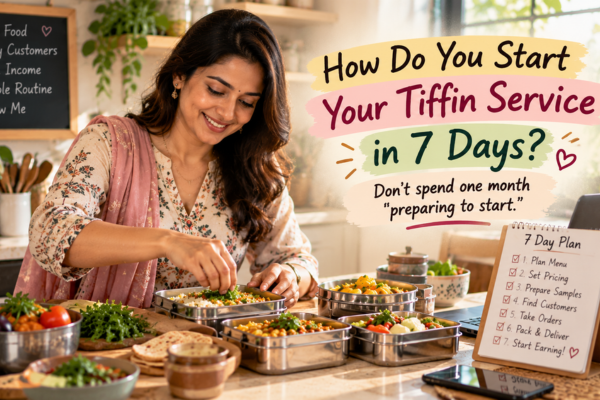
How Do You Start Your Tiffin Service in 7 Days?
Don’t spend one month “preparing to start.”
Give yourself seven days to test the idea.
Day 1 — Choose Your Customer
Write down one customer only.
For example:
“Working women in my society.”
Not everyone.
Not the whole city.
One clear customer.
Day 2 — Create Your Menu
Prepare a simple 5-day menu.
Don’t offer 25 dishes.
Choose food that:
- You cook confidently.
- Can be prepared consistently.
- Travels well.
- Doesn’t become messy quickly.
- Uses easily available ingredients.
- Gives you a reasonable margin.
Day 3 — Calculate Your Cost
Write down:
Ingredients + gas + packaging + delivery + wastage = actual cost
Then add your profit.
Don’t copy someone else’s price blindly.
A ₹100 tiffin that costs you ₹90 is not a successful business.
It is an exhausting hobby.
Day 4 — Test Your Food
Give 2–3 trial tiffins to people who will tell you the truth.
Ask:
Was the quantity enough?
Was the food too spicy?
Was the packing good?
Would you order it again?
The last question is the most important.
Day 5 — Create Your Identity
You need only a few things initially:
- Simple business name
- WhatsApp Business account
- Menu image
- UPI payment option
- Instagram page if you want one
- Google Business Profile
- Simple order sheet
You don’t need a ₹20,000 logo.
Your food needs to be good before your branding becomes fancy.
Day 6 — Find Your First Customers
Try:
- Society WhatsApp group
- Personal WhatsApp status
- Nearby offices
- PGs
- Coaching centres
- Local Facebook groups
- Google Business Profile
- Friends and relatives
And please don’t feel shy about saying:
“I have started a small home tiffin service.”
You are not begging anyone.
You are offering something useful.
Day 7 — Start Small
Your first target:
3–5 paid customers.
That’s it.
If you can manage 5 properly, try 8.
If you can manage 8 properly, try 12.
Growth should follow your capacity.
Not your excitement.
Your Simple Weekly Tiffin Service Routine
This is where many beginners make mistakes.
They think cooking is the whole business.
It isn’t.
You are now:
Cook + planner + buyer + packer + customer manager + learner.
So create a routine.
| Day | Main Work | Kitchen Focus | Business Focus |
| Monday | Start fresh | Regular menu | Check customer feedback |
| Tuesday | Repeat system | Batch preparation | Post one food photo |
| Wednesday | Improve | Seasonal dish | Check costs |
| Thursday | Customer care | Regular menu | Ask for referrals |
| Friday | Special day | Signature dish | Share next week’s menu |
| Saturday | Planning | Prep ingredients | Accounts + shopping |
| Sunday | Reset | Family cooking/rest | Plan menu + content |
You don’t have to work like a restaurant owner.
You are building a business around your life.
That difference matters.
Add a tiny thank-you card to every everyday tiffin—just 1–2 warm lines that make your customer smile.
“Thank you for choosing our home-cooked meal today.
Your smile makes our kitchen happier.”
A Sample 5-Day Tiffin Service Menu
Keep your first menu simple.
Monday
Dal
Aloo-Gobhi
Roti
Rice
Salad
Tuesday
Rajma
Jeera Rice
Cucumber Salad
Roti
Wednesday
Kadhi
Rice
Seasonal Sabzi
Roti
Thursday
Chole
Rice
Roti
Salad
Friday
Your Signature Meal
Dal
Special Sabzi
Roti
Rice
Small Sweet
Your Friday dish can become your “remember me” dish.
That is where branding begins.
What Should Your Daily Tiffin Service Routine Look Like?
You don’t need to wake up at 4 AM just because someone on the internet does.
Build a routine around your family.
Morning
- Check today’s orders.
- Check ingredients.
- Start preparation.
- Cook in batches.
- Taste before packing.
Before Delivery
- Check quantity.
- Check containers.
- Add label/name.
- Check payment/order list.
- Pack carefully.
Afternoon
- Clean the kitchen.
- Record expenses.
- Reply to customers.
- Note tomorrow’s requirements.
Evening
Spend just 20–30 minutes learning.
Learn:
- Food photography
- WhatsApp Business
- Canva
- Pricing
- Customer service
- Basic accounting
- Instagram Reels
That 30 minutes is not wasted time.
That is your business education.
What Tools Can Make Your Tiffin Service Work Easier?
You don’t need 20 apps.
Start with these:
WhatsApp Business
For orders, customer messages, menu sharing and quick replies.
Canva
For your menu card, price list, festival offers and Instagram posts.
Google Sheets
For tracking:
- Customers
- Payments
- Expenses
- Ingredients
- Orders
Google Business Profile
For local discovery.
UPI
For simple digital payments.
A simple kitchen weighing scale
Because “thoda sa” is fine for family cooking.
Business cooking needs consistency.
If one customer gets three rotis today and five tomorrow, your business becomes difficult to manage.
What Should You Learn About Tiffin Service Before You Grow?
You don’t need an MBA.
You need a few practical skills.
Learn:
- Basic costing
- Menu planning
- Food hygiene
- Customer service
- WhatsApp marketing
- Basic photography
- Simple bookkeeping
- Packaging
- Local marketing
- Repeat-customer management
And please learn one thing early:
Never mix business money and household money.
Keep a simple record even if you make only ₹500.
That ₹500 is teaching you how business works.
Which Books Can Help You Grow Your Tiffin Service Business?
You don’t need to read ten books.
Start with these:
The E-Myth Revisited — Michael E. Gerber
It teaches an important lesson: don’t only work in your business; slowly learn how to work on it.
The 1-Page Marketing Plan — Allan Dib
Helpful for understanding customers, marketing and simple business growth.
Atomic Habits — James Clear
Not a food-business book, but very useful for building a small daily routine and staying consistent.
And if you don’t enjoy reading business books, that’s okay.
Read 5 pages a day.
You are not preparing for an exam.
You are building yourself.
Which YouTube Channels Can Help You Learn?
For cooking inspiration and technique, you can learn from established creators such as:
- Ranveer Brar — cooking technique, presentation and food storytelling.
- Hebbars Kitchen — practical recipe ideas and simple food presentation.
- Kabita’s Kitchen — everyday Indian cooking inspiration.
- Cook with Parul — accessible Indian recipes and kitchen ideas.
But don’t become a recipe-copying machine.
Watch them to learn:
presentation + consistency + recipe structure + storytelling.
Then develop your own taste.
Your customers should eventually say:
“I want her food.”
Not:
“This tastes exactly like that YouTube recipe.”
4 Women & Food Entrepreneurs You Should Know Before starting your Kitchen Service
Sometimes we need a real person to remind us:
“Maybe I can do it too.”
1. Devni Devi — From Homemaker to Amma Kitchen
Devni Devi’s story is particularly powerful for this article.
She entered a large joint family young and spent years cooking for a big household. Later, she started serving ₹20 tiffins to students. Her journey eventually grew into Amma Kitchen, a much larger food business.
The lesson?
The years you spent feeding everyone may have secretly taught you planning, quantity control and kitchen management.
2. Bhagyalakshmi Gohokar — Recipes Became a Legacy
Bhagyalakshmi Gohokar started her food journey much later in life and eventually co-founded Santosham with her son.
Her mother’s handwritten recipes became part of the identity of the food business.
The lesson?
Your old family recipes are not “just recipes.” They may be your story.
3. Sunita Agarwal — Four Products Became a Business
Sunita Agarwal began Kitchen & Gupshup from home with just a handful of homemade sweets and savouries. Recent reports say the business has grown to serve thousands of customers.
The lesson?
You don’t need 30 products on day one.
Start with four things you can make really well.
4. Almas Khan — A Single Mother With a Tiffin Service
Almas Khan, a single mother running a tiffin service, recently appeared on KBC 18. Her story received attention not because everything in her journey was easy, but because she kept moving forward despite difficult circumstances.
The lesson?
Your current circumstances don’t have to become your permanent identity.
What About FSSAI and Legal Requirements?
This part is important.
If you are selling food commercially from your home, don’t ignore food-safety requirements.
FSSAI states that food business operators in India need to be registered or licensed according to the applicable category and eligibility. Its current FoSCoS eligibility information lists registration for petty food businesses up to the applicable turnover threshold.
Before starting commercially:
- Check the current FSSAI/FoSCoS requirements.
- Maintain kitchen hygiene.
- Use suitable food-grade packaging.
- Keep ingredients properly stored.
- Follow local requirements applicable to your business.
- Keep your records.
Rules and fees can change, so always check the official FSSAI source before applying.
A beautiful business should also be a responsible business.
How Can You Get Customers Without Spending a Lot?
Here is your simple local marketing formula:
1. WhatsApp
Post today’s tiffin.
2. Society
Offer a trial to a few residents.
3. Referrals
Give existing customers a reason to recommend you.
4. Instagram
Show food, preparation, packaging and your story.
5. Google
Make your local business discoverable.
6. Offices
Approach small offices instead of trying to win huge companies.
7. PGs and hostels
Offer weekly or monthly plans.
8. Senior citizens
Create a simple, dependable meal option.
And remember:
One happy customer can become five customers.
That is why customer service is marketing too.
How Much Can You Earn From a Tiffin Service?
Let’s use a simple example rather than promising a fixed income.
Suppose you eventually have:
10 customers × ₹2,500 monthly plan = ₹25,000 revenue
That is revenue, not profit.
You still have to subtract:
- Ingredients
- Packaging
- Gas/electricity
- Delivery
- Wastage
- Platform costs, if any
- Other business expenses
This is why you must learn costing before you increase orders.
A larger number of customers does not automatically mean a larger profit.
Profit comes from a healthy system.
Is There a 100% Sure Way to Succeed?
I want to be completely honest with you here.
No genuine person can guarantee 100% income from a tiffin service.
There will be slow months.
There may be customers who cancel.
Vegetable prices can change.
Delivery can go wrong.
Some menus will work.
Some won’t.
But your chances become much stronger when you follow the right track:
Start small → calculate properly → listen to customers → improve → create repeat plans → control costs → stay consistent → grow slowly.
That is the kind of “surety” I can honestly give you.
Not a promise of money.
A clear path to learn how to build it.
If You Feel “But I Am Only a Housewife…”
Then please read this slowly.
You are not “only” a housewife.
You may already know:
- How to plan meals.
- How to manage a monthly grocery budget.
- How to cook for different people.
- How to manage time.
- How to solve last-minute problems.
- How to work without anyone applauding you.
These are business skills.
You simply haven’t been calling them that.
Now you can.
And if cooking isn’t your only strength, don’t forget the other skills you may already have. In my How to Make Money Online for Beginners guide, I explain how beginners can start looking at their existing abilities differently and turn them into possible earning skills.
Guest Corner: A Little Thank You From Mindful Mumma Nest
Behind every useful idea, there is someone who has shared knowledge, built a tool, written a book or taken the first difficult step.
So today’s Guest Corner is my small way of saying thank you.
FSSAI
For helping us understand the food-safety and registration side of running a food business in India.
Canva
For making it possible for a beginner to create a menu, poster or social media design without being a professional designer.
WhatsApp Business
For giving small local businesses a simple way to communicate with customers.
Google Business Profile
For helping local customers discover businesses around them.
Michael E. Gerber
For reminding small-business owners that building a business is different from simply doing the work every day.
James Clear
For teaching us that small habits, repeated consistently, can create much bigger changes.
Ranveer Brar
For showing how cooking can become not just food, but storytelling, presentation and identity.
Devni Devi
For reminding every homemaker that it is never too late to turn years of cooking into something of your own.
Bhagyalakshmi Gohokar
For showing us how family recipes and memories can become a meaningful food identity.
And finally, thank you to you.
Because every time you read, learn and try something new, Mindful Mumma Nest becomes more than a website.
It becomes a small place where women remind each other that they still have dreams.
Final Thoughts: Your Tiffin Can Be the Beginning
Maybe today you cook only for your family, but tomorrow your hands can feed three people, then ten, and one day someone may say, “Didi, please keep my tiffin ready—I don’t want to miss your food.”
What was once called “just housework” can become your skill, your customers, your income—and the identity you thought you had lost.
You don’t need ₹1 lakh, 100 customers, or a perfect business to begin—you need one skill, one customer, and the courage to take the first step.
At Mindful Mumma Nest, I don’t promise overnight success; I want to share real skills, real learning, and real possibilities that you can actually build into your life.
So if motherhood, family or life made you forget who you were, please remember—you are not starting from zero; you are starting with everything you have already learned.
And I, Surbhi, will keep walking beside you through every new skill, every mistake and every little victory—because your story didn’t end when you became a mother; maybe that was the moment your real story began.
5 Quick FAQs
1. Can a housewife start a tiffin service from home?
Yes. Start locally with a few customers, a simple menu and the food you already cook confidently.
2. How many customers should I start with?
Start with 3–5 customers. Increase only when you can maintain quality and timing.
3. What food should I sell?
Start with your strongest home-style dishes. Keep the menu small, affordable and easy to prepare consistently.
4. Do I need FSSAI registration?
Food businesses in India are subject to FSSAI registration/licensing requirements according to the applicable category. Check the current FoSCoS eligibility before starting.
5. Can a tiffin service become a full-time income?
It can grow into a meaningful business, but income is not guaranteed. Your results depend on pricing, costs, customers, food quality, repeat orders and consistency.
Sources & Tools
1. FSSAI / FoSCoS
The official source for food-business registration and eligibility in India.
2. DMI Finance
Useful for understanding the basic home-tiffin model, customer acquisition, pricing and operational challenges.
3. Nomio
Helpful for understanding niche menus, subscriptions, repeat customers and the practical home-chef model.
4. Santosham
A beautiful real-world example of how family recipes and cooking knowledge can become a food identity.
5. Indian Express / NDTV Food
Useful real-life stories showing how women and homemakers have transformed cooking and traditional food knowledge into businesses.
Mindful Mumma Nest note: Sources can teach us the road, but your own experience, local customers and consistent learning will teach you how to walk it.