
Janmashtami 2026: Date, Nakshatra, Puja Vidhi & Krishna’s Life Lessons
A Heartfelt Guide to Krishna’s Birth, Worship, Faith, Love & Finding Your Own Path

Janmashtami 2026 Is Not Just About Celebrating Krishna’s Birth
Every year, when Janmashtami comes, we decorate our homes, bring flowers, prepare bhog and wait for midnight. But this year, I want to look at Krishna a little differently. I want to look beyond the flute, peacock feather, butter and beautiful pictures. I want to look at the child who was born in a prison, the mother who could not hold her newborn son, the father who had to carry him away in the darkness, the child who grew up with another mother, and the young Krishna who eventually had to leave the place and people he loved. Krishna’s story is beautiful, but it is also full of separation, responsibility, courage, sacrifice and love. And perhaps that is exactly why so many of us feel that Krishna understands our lives. (vedabase.io)
I am writing this not as someone who knows everything about God. I don’t. I am writing this as a woman who has gone through difficult phases, who has sometimes felt completely alone, and who slowly found comfort in a very small Gopal Ji who came into my home from my in-laws’ home. He was there, but nobody was really caring for him. I started taking care of him. Somewhere along the way, I stopped looking at him as an idol. He became family.
And no, I don’t believe my Gopal Ji is sitting there waiting for me to ask for everything I want. I don’t ask him for a perfect life. I don’t even manage to care for him perfectly every day. Sometimes I forget. Sometimes life becomes too heavy. Sometimes I am unable to keep everything the way I think I should. But my relationship with him is not about perfection. It is about presence.
Maybe that is what faith has become for me.
Why Krishna Was Born: Janmashtami Begins With a Difficult Story
Krishna’s birth is traditionally connected with a time when Kamsa’s cruelty had created fear and suffering, and the Bhagavata Purana describes the Lord’s appearance as connected with restoring dharma and relieving the burden upon the earth. (vedabase.io)
Krishna was born to Devaki and Vasudeva in Mathura.
But his birth did not happen inside a beautiful palace.
It happened in a prison.
Devaki’s brother Kamsa had imprisoned Devaki and Vasudeva because of the prophecy concerning Devaki’s eighth child. The earlier children of Devaki had been killed by Kamsa. When Krishna finally appeared, Vasudeva and Devaki were still imprisoned. (vedabase.io)
Think about that for a moment.
A mother gives birth to her child.
But instead of holding him freely, she has to think about how to save him.
A father sees his newborn son.
But instead of celebrating openly, he has to carry him away from danger.
That is where Krishna’s earthly story begins.
What Time Was Krishna Born? The Truth About Midnight
The traditional account places Krishna’s appearance at midnight, during Krishna Paksha Ashtami, with the tradition particularly connecting the birth with Rohini Nakshatra. The Bhagavata Purana describes His appearance in the darkness of night. (vedabase.io)
But there is an important difference between scriptural description and a modern clock time.
The scriptures describe Krishna’s birth as occurring at midnight; they do not give us a modern clock reading such as 12:00:00 AM.
Today, the exact Nishita Puja Muhurat changes according to location and Panchang calculations.
Janmashtami 2026: Date & Nishita Puja Timings
Krishna Janmashtami will be celebrated on Friday, September 4, 2026. The main Krishna puja is traditionally performed during Nishita Kaal, around midnight, but the exact time changes according to the location and local Panchang. (Drik Panchang)
Nishita Puja Timings for Important Cities
- Kolkata: 11:13 PM – 11:59 PM, September 4
- New Delhi: 11:57 PM – 12:43 AM, September 5
- Vrindavan: 11:56 PM – 12:41 AM, September 5
- Mumbai: 12:14 AM – 1:01 AM, September 5
- Chennai: 11:45 PM – 12:31 AM, September 5
- Bengaluru: 11:55 PM – 12:42 AM, September 5
- Hyderabad: 11:52 PM – 12:38 AM, September 5
- Jaipur: 12:03 AM – 12:49 AM, September 5
- Ahmedabad: 12:16 AM – 1:02 AM, September 5
- Chandigarh: 11:59 PM – 12:45 AM, September 5
- Noida: 11:57 PM – 12:42 AM, September 5
- Gurugram: 11:58 PM – 12:44 AM, September 5
- Pune: 12:10 AM – 12:57 AM, September 5
- Nainital, Uttarakhand: 11:49 PM – 12:34 AM, September 5
- Haridwar, Uttarakhand: 11:54 PM – 12:39 AM, September 5
- Pauri, Uttarakhand: approximately 11:51 PM – 12:37 AM, September 5 (Drik Panchang)
One Important Reminder
These timings are local to each city, so don’t copy a timing from another place simply because it is nearby. If you live elsewhere in Uttarakhand or another part of India, check your own city’s Panchang or your local temple’s timing before planning the midnight puja.
Check your city-specific Janmashtami 2026 timing on Drik Panchang
The Night Vasudeva Carried Krishna Away
This is one of the most emotional parts of Krishna’s birth story for me. Krishna was born in prison, but Vasudeva could not keep Him there; he had to carry his newborn son through the night to Gokula, where Krishna was placed in Nanda and Yashoda’s care. Read the Bhagavata Purana account
- A father carrying his newborn son: Vasudeva knew that Krishna’s life was in danger, yet he kept moving forward.
- The journey through darkness: He had no comfortable road ahead, only uncertainty and fear.
- Krishna was taken to Gokula: Vasudeva brought Him to the home of Nanda Maharaja and Yashoda.
- A painful separation: Devaki had given birth to Krishna, but she could not raise Him herself.
- A father’s courage: Sometimes love means doing what is necessary to protect someone, even when your own heart is breaking.
- A lesson for our lives: We may not know what tomorrow holds, but we can still take the next step with faith and courage.
Devaki Was His Mother, But Yashoda Became His Mother Too
Krishna was born to Devaki and Vasudeva, but He was raised in Gokula by Yashoda and Nanda Maharaja. The Bhagavata Purana records the joy in Nanda’s household after Krishna’s arrival and describes the celebrations, decorations, music, charity and blessings surrounding His childhood. (vedabase.io)
This part of Krishna’s story always makes me think about what makes someone family.
Is it only blood?
Or is it the person who wakes up for you?
Feeds you?
Protect you?
Worries about you?
Hold you when you are frightened?
Love you without asking what they will receive in return?
Krishna had a biological mother.
He also had the mother who raised him.
And both relationships have their own sacred place in His story.
That is why Yashoda’s Krishna feels so different from Devaki’s Krishna.
One mother gave Him birth.
Another mother gave Him childhood.
And Krishna carried the love of both.
Janmashtami in Gokul, Nandgaon & Vrindavan — Where Krishna’s Childhood Still Feels Alive
When I think about Janmashtami, I don’t see only a festival; I imagine Gokul, Nandgaon and Vrindavan as places filled with memories of Krishna’s childhood—Gokula is connected with His early years, Nanda’s Vraja with His cowherd life, Nandgaon with Nanda and Yashoda in Braj tradition, and Vrindavan with His youthful pastimes. The Bhagavata Purana beautifully describes Krishna’s childhood in Vraja before His journey towards Mathura. Read Krishna’s childhood story in the Bhagavata Purana
- Gokul — where baby Krishna was lovingly raised after leaving Mathura.
- Nandgaon — deeply associated with Nanda Maharaja and Yashoda in Braj tradition.
- Vrindavan — remembered for Krishna’s youthful pastimes and devotion.
- Vraja — the wider sacred landscape connected with Krishna’s childhood.
- Braj — for devotees, more than a place; it is a feeling of Krishna’s presence.
And perhaps that is why Braj feels different to so many hearts—a mother waiting, cows returning home, the sound of a flute somewhere far away, dust rising from the path and the feeling that Kanha could appear around the next corner. For me, Janmashtami is about feeling that love, even when I am thousands of kilometres away.
Janmashtami: When Krishna Had to Leave the Place He Loved
This is one part of Krishna’s story I remember deeply every Janmashtami—He had to leave Vraja, the people He loved and the childhood world that had given Him so much love, and the Bhagavata Purana beautifully describes the pain of the gopis after His departure and Uddhava carrying Krishna’s message to them. Read Krishna’s story in the Bhagavata Purana
- He left Vraja, even though it was His beloved childhood home.
- Separation became part of His story, not the end of His love.
- The gopis continued to remember and love Krishna even when He was far away.
- Sometimes life asks us to leave people, homes, dreams or even an old version of ourselves.
- Leaving someone does not always mean leaving them from our heart.
Maybe this is what Janmashtami reminds me most: we cannot always keep everything we love beside us, but distance cannot erase a love that was truly felt. Sometimes people leave our sight, yet their place in our heart remains forever.
What About Krishna and Radha? — A Love That Taught Me Something About Us
Sometimes I look at relationships today and wonder where patience, care and understanding have gone; people argue, leave, abandon relationships, keep endless expectations, stop making an effort and forget to understand what the other person is feeling. When I think of Radha and Krishna, I see a very different kind of love—not a love without pain, but a love that could hold trust, sacrifice, understanding and separation without simply giving up. Radha is especially central to later Braj and Vaishnava devotional traditions; the Bhagavata Purana does not name Radha directly, while later texts such as the Brahma Vaivarta Purana and Garga Samhita develop her relationship with Krishna in much greater detail. (Radhakrishna)
What Their Love Makes Me Think About
- Love is not only staying together; it is understanding each other’s heart.
- Care means making an effort, even when things are difficult.
- Love should not be built only on expectations of what the other person will give us.
- Separation does not automatically erase love; Radha’s longing became one of the deepest expressions of devotion.
- Real love needs patience, respect and surrender, not constant fighting and the need to win every argument.
There is also a beautiful tradition about their secret wedding at Bhandirvan, described in the Brahma Vaivarta Purana and Garga Samhita, where Brahma is said to have officiated. This is a later devotional tradition, not something narrated in the Bhagavata Purana, and I want to make that distinction honestly while still respecting the beauty of the story. (Satsang with Ananta)
Maybe this is why Radha-Krishna still touches hearts: they remind us that love is not about possessing someone, demanding from someone or winning every fight—it is about holding a person with such purity that even distance cannot make the heart stop caring.
And perhaps today, when so many relationships are breaking over ego, expectations and a lack of effort, we need to ask ourselves one simple question: Are we really trying to understand the person we love, or are we only trying to prove that we are right?
Krishna’s Life Was Not a Life Without Problems
When I look at Krishna beyond the miracles, I see a life filled with separation, danger, responsibility and change—born in captivity, separated from His birth parents, raised away from them, faced Kamsa’s repeated threats, left His childhood home and later carried the responsibilities of Mathura and Dvaraka. The Bhagavata Purana describes the repeated attacks on Mathura and Krishna’s later establishment of Dvaraka. Read Krishna’s story in the Bhagavata Purana
What His Life Teaches Me
- Problems do not mean God has left us.
- Separation can become a part of our growth.
- Courage means continuing even when we are afraid.
- Responsibility often comes with growth.
- A difficult beginning does not decide the whole story.
So when I say “Krishna is with me in my problems,” I don’t imagine someone who never knew pain; I remember a Krishna whose earthly journey also carried fear, separation, duty and difficult choices. And that gives me hope that my difficult days are not the end of my story either.
What Krishna Taught Me About My Own Life
I have lived through moments I don’t want to decorate with beautiful words—some things hurt, some things changed me, and some things I still cannot explain. Then there is my little Gopal Ji, who came to me from my in-laws’ home; He was there, but no one was really caring for Him, so slowly, I started cleaning Him, dressing Him and thinking about Him as a part of my everyday life. Somewhere along the way, something inside me changed: I stopped asking, “What will Gopal Ji give me?” and started asking, “What can I give Him today?”
That one change quietly changed my understanding of faith, love and care.
My Gopal Ji Doesn’t Need a Perfect Me
I want to say this especially for the woman who may be reading this with guilt in her heart—because I know that feeling. I don’t care for my little Gopal Ji perfectly every single day; there are days when I forget, days when I am exhausted, and days when my own body and life don’t allow me to do everything I normally do, and earlier, I would feel terrible about it. But slowly I understood something: my relationship with Gopal Ji is not a test that I have to pass every day; it is a bond I carry in my heart.
What I Have Slowly Learned
- Love should never become fear.
- Faith should not make us hate ourselves.
- Missing one ritual does not mean we have stopped loving Krishna.
- Taking care of ourselves is also important.
- Sometimes sitting quietly before Gopal Ji is itself a prayer.
My Gopal Ji is not someone I turn to only when I need something; he has become a little part of my family, someone who has silently witnessed the parts of my life that I cannot explain to anyone else. I may forget to dress Him one day, I may not be able to do everything on another day, but I never want my love for Him to become a source of fear or guilt.
For me, devotion is not about doing everything perfectly. It is about keeping the heart connected, returning with love whenever I can, and knowing that even on my imperfect days, my Gopal Ji is still a part of my home and my life.
Does Krishna Give Us Everything We Ask For?
I don’t believe faith should become a shopping list; praying to Krishna doesn’t mean we will always receive exactly what we ask for, because sometimes the answer takes a different form or arrives much later. Sometimes we pray for someone to stay and they leave, sometimes we ask a problem to disappear and it takes years, and sometimes we pray for money but the answer comes through work, learning, courage, opportunity and patience rather than a miracle. Krishna’s teaching in the Bhagavad Gita reminds us to perform our duty without becoming attached to the fruits of our actions, and that thought has changed how I look at my own life. (Gita Supersite)
What I Try to Remember
- Pray with a sincere heart.
- Work instead of only waiting.
- Learn something that can make you stronger.
- Try again when life doesn’t go as planned.
- Do your duty and let go of what you cannot control.
For me, this is also where earn money becomes part of a mindful life: if I want financial independence, I have to learn a skill, create something useful, offer value and work honestly; faith can give me courage, but the effort is still mine. I can ask Krishna to guide my path, but I also have to walk it myself.
What Does Krishna Say About a Pure Offering?
One of the verses I return to again and again is Bhagavad Gita 9.26.
Krishna speaks about accepting a leaf, flower, fruit or water when offered with devotion.
That makes Janmashtami feel less frightening to me.
You don’t need a palace.
You don’t need 56 elaborate dishes.
You don’t need expensive decorations.
You don’t need to prove your devotion through money.
Sometimes a small bowl of makhan mishri made with love is enough for your home.
Sometimes water.
Sometimes a flower.
Sometimes just folded hands.
And sometimes, when life is too difficult for anything else:
“Kanha, I am here, Please Hold Me”
Maybe that is your prayer.
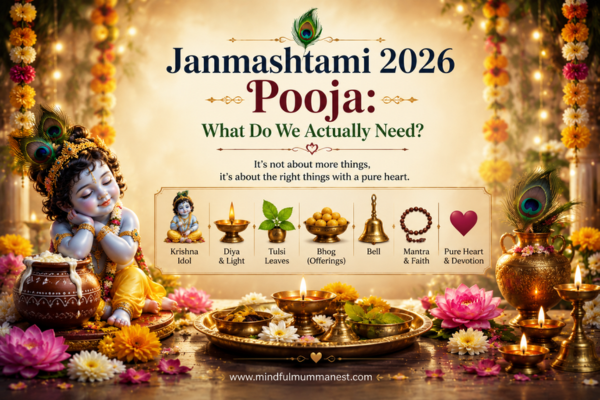
Janmashtami 2026 Pooja: What Do We Actually Need?
If you have the time and want to follow a traditional home puja, you can prepare more.
But if you are a mother, working woman, homemaker, beginner or simply someone who wants a peaceful celebration, please don’t turn Janmashtami into another exhausting task.
The 5 simple things I would keep
- Gopal/Krishna murti — your centre of devotion.
- Clean cloth — for dressing.
- Water or Panchamrit — for traditional bathing if you follow that practice.
- A simple bhog — even makhan mishri is enough for a simple home offering.
- Diya and flowers — for a warm, peaceful atmosphere.
The deeper offering is still your intention.
Three Janmashtami Pooja Vidhi — Choose What Fits Your Life
1. Easy Pooja Vidhi — For a Busy Mumma
If your day is already full with children, home, work and responsibilities, you don’t need a complicated puja to celebrate Krishna with love. Janmashtami worship is traditionally centred around Krishna’s midnight birth, but your home celebration can remain simple and peaceful. (Drik Panchang)
Simple Steps to Follow
- Clean the puja space and keep Gopal Ji in a clean place.
- Dress Him in clean clothes and offer a flower.
- Light a diya and, if you wish, incense.
- Offer water and a simple bhog, such as makhan-mishri or fruit.
- Chant “Hare Krishna” or “Om Namo Bhagavate Vasudevaya” according to your family tradition.
- Sit quietly for a few minutes and speak to Krishna from your heart.
- If you observe the midnight celebration, perform aarti and offer bhog around your local Nishita Muhurat. (Drik Panchang)
That’s it. You don’t have to exhaust yourself to prove your devotion.
For me, the most beautiful part is simply sitting before my little Gopal Ji and saying:
“Kanha, I may not do everything perfectly, but I am here with you.”
Because sometimes a small diya, a simple offering and a pure heart can make a home feel more peaceful than the most elaborate celebration.
2. Medium Pooja Vidhi — For a Traditional Home Celebration
For a traditional home celebration, begin by cleaning your puja space and creating a peaceful little place for Krishna. Decorate it simply with flowers, peacock feathers or a small jhula, then prepare Panchamrit and dress Gopal Ji in clean clothes. Offer sandalwood or tilak according to your family tradition, flowers, Tulsi where appropriate, diya, incense and bhog such as makhan-mishri, fruits or homemade sweets. (vedantu.com)
Important Things to Do
- Clean and decorate your puja space.
- Dress and adorn Krishna with clean clothes and simple decorations.
- Prepare Panchamrit if you follow the abhishek tradition.
- Offer flowers, Tulsi, diya and bhog according to your family practice.
- Read or listen to Krishna’s birth story while waiting for midnight.
- Sing bhajans or Krishna naam with your family.
- Perform aarti around the Nishita Muhurat and celebrate Krishna’s birth.
- Offer prasad to everyone after the puja. (Janamashtami)
And through all of this, I want to remember one thing:
The purpose is not to finish a checklist. The purpose is to remember Krishna, feel His presence and bring a little more love and kindness into our lives.
You may not do everything perfectly. But if your heart is full of love, sit before your Kanha Ji and simply say, “I am here with You.”
3. Detailed Pooja Vidhi — For a Full Janmashtami Celebration
If you want to follow a more traditional Janmashtami puja, you can perform Shodashopachara Puja, which means worship through sixteen traditional steps. The detailed procedure includes welcoming Krishna, offering water, bathing and dressing Him, adorning Him, offering flowers, incense, diya and bhog, followed by aarti and prayers. (Drik Panchang)
Important Steps to Follow
- Dhyan & Avahan — Sit peacefully, remember Krishna and invite Him with love.
- Padyam & Arghyam — Offer water as a respectful welcome.
- Snanam — Bathe Gopal Ji with water or Panchamrit if your murti is suitable.
- Vastra & Abharan — Dress and decorate Him beautifully.
- Gandha & Pushpa — Offer sandalwood/fragrance and fresh flowers.
- Dhup & Deep — Offer incense and light a diya.
- Naivedya — Offer bhog such as makhan-mishri, fruits, panjiri, milk or homemade sweets.
- Aarti & Pushpanjali — Finish with aarti, flowers and heartfelt prayers. (Drik Panchang)
And Please Remember This
You don’t need an expensive puja, a beautifully decorated temple or perfect knowledge of every mantra. If you know the complete traditional procedure, follow it; if you don’t, follow your family tradition or a trusted priest/Panchang rather than copying random rituals online.
Maybe the most beautiful offering is simply saying, “Kanha, I may not do everything perfectly, but I am here with You.”
For the complete sixteen-step procedure and mantras, you can read the detailed Krishna Janmashtami Puja Vidhi on Drik Panchang.
Three Easy Krishna Bhog Recipes
1. Makhan Mishri — The Simplest Krishna Bhog
Take fresh homemade or good-quality unsalted butter and add mishri. You can add a few tulsi leaves according to your family’s devotional practice.
That’s it.
No complicated cooking.
No expensive ingredients.
Butter and Krishna’s childhood are deeply connected in popular Krishna traditions, which is why makhan-based offerings are so beloved during Janmashtami. (Incredible India)
2. Dhaniya Panjiri — A Beautiful Festive Bhog
Dry roast coriander powder gently. Add roasted makhana or nuts, powdered sugar or mishri and a little ghee. Mix everything together and keep the texture crumbly.
The exact recipe differs from home to home.
And that is perfectly fine.
3. Panchamrit — Five Simple Ingredients
A common Panchamrit preparation uses ingredients such as milk, curd, ghee, honey and sugar, although regional and family recipes differ.
Prepare only what your family traditionally uses.
Bhog is not a competition.
What Else Can You Offer Krishna?
If appropriate to your family tradition, offerings may include:
- Makhan mishri
- Fruits
- Milk
- Panchamrit
- Panjiri
- Homemade sweets
- Poha
- Makhana preparations
- Dry fruits
- Simple homemade food
But remember the teaching from Gita 9.26:
The value of the offering is not measured only by its price. Devotion matters.
How to Decorate for Janmashtami Without Spending Too Much
You don’t need to turn your house into a temple overnight.
Try:
- A clean white or yellow cloth as the backdrop.
- A small string of flowers.
- Peacock feathers.
- A little matki.
- Diyas.
- Marigold flowers.
- Handmade paper stars.
- A small swing for Bal Gopal.
- A simple rangoli.
- A soft yellow or blue fabric.
And here is something I have learned through my own journey of minimalist living:
Beautiful does not always mean more.
Sometimes one clean corner, one diya and one little Krishna can create more peace than an entire room filled with decorations.
You can read my earlier thoughts here:
Minimalist Living Ideas — Live With Less, Earn With More Purpose
The Beautiful Connection Between Krishna, Home & Earning Money
This is where I want to bring our Mindful Mumma Nest conversation into Janmashtami.
A festival doesn’t have to mean only spending money.
It can also become a small opportunity to earn money from your skills.
Not by exploiting someone’s faith.
Not by selling unnecessary things.
But by noticing what people genuinely need.
What can women sell around Janmashtami?
- Handmade Krishna decorations.
- Simple Janmashtami thalis.
- Torans.
- Handmade peacock-feather décor.
- Baby Krishna dresses.
- Small festive gift hampers.
- Handmade greeting cards.
- Digital Janmashtami invitation cards.
- Printable colouring sheets for children.
- Krishna-themed wall art.
- Festival planners.
- Puja checklists.
- Homemade festive snacks, where legally permitted.
- Social media designs for local shops and temples.
- Photography or short-form festival content.
- Simple festive décor services.
The opportunity isn’t:
“How can I make money from people’s devotion?”
The better question is:
“What useful thing can I create that makes someone’s celebration easier?”
That difference matters.
Krishna’s Lesson About Work Can Help Us Earn Money Too
Krishna’s teaching is not that we should sit and wait for everything to happen.
The Gita teaches action and duty without unhealthy attachment to the result.
So if you want to earn money from home, take one festival skill and practise it.
- If you can design, create Janmashtami posters.
- If you can cook, explore festive food orders after checking applicable food-safety requirements.
- If you can sew, make Krishna clothes.
- If you can write, create festival content.
- If you can teach, create a small Krishna storytelling activity for children.
- If you can make crafts, create decoration kits.
Your first earning does not have to be ₹1 lakh.
It could be your first ₹500.
Then ₹1,000.
Then ₹5,000.
The amount matters less than the confidence that comes when you realise:
“I created something useful, and someone was willing to pay for it.”
That is the kind of earn money journey I want to encourage at Mindful Mumma Nest.
Not shortcuts.
Not fake promises.
Skills. Patience. Honest work.
How My Home Can Become My First Earn Money Space
This is something I have written about before.
You don’t necessarily need an office.
You may need one small corner.
One table.
One notebook.
One phone.
One skill.
One hour.
My earlier Home Plan Layout Ideas article talks about how our homes can support our routines, productivity and earning possibilities. (mindfulmummanest.com)
Read: Home Plan Layout Ideas for a Better Lifestyle & Earn Money
Janmashtami can become a tiny experiment.
Can I create one product?
Can I show it to ten people?
Will anyone actually buy it?
Can I improve it next year?
That is how an earning journey can begin.
And If You Want to Collaborate, Don’t Chase Followers First
Suppose you make a beautiful Janmashtami décor.
You could eventually work with:
- Local gift shops.
- Home décor pages.
- Parenting creators.
- Festive brands.
- Small clothing businesses.
- Sweet shops.
- Handmade businesses.
But don’t start by thinking:
“How many followers do I need?”
Start by asking:
“What can I create that people trust?”
My earlier article on influencer partnerships explains why trust, consistency and genuine content matter more than simply chasing follower numbers. (mindfulmummanest.com)
Read: How Partnership with Influencers Helps Lifestyle Brands Earn Money
Why Does It Feel Like It Always Rains Around Janmashtami?
This is one of those questions where we should keep both faith and truth together.
Janmashtami occurs around August–September, during India’s monsoon season. So rain around the festival is not surprising.
But there is also a beautiful scriptural description.
The Bhagavata Purana says that when Krishna appeared, clouds gathered and gently thundered, while the devas are described as showering flowers. (vedabase.io)
So when rain falls on Janmashtami, a devotee may feel:
“Kanha has come.”
That feeling is beautiful.
But scientifically, we should still say:
Rain does not happen every Janmashtami because Krishna was born that night.
Faith gives the moment meaning.
Science explains the weather.
Both can exist without us having to fight between them.
How India Celebrates Janmashtami Differently
India never celebrates a festival in only one way.
Mathura & Vrindavan
This is where Krishna’s story feels almost woven into the streets.
Devotees visit temples, listen to Krishna katha, sing bhajans, participate in devotional performances and celebrate the birth of Krishna around midnight. Mathura and Vrindavan are recognised as central places for experiencing Krishna traditions. (Incredible India)
Maharashtra
Here, Dahi Handi becomes one of the most visible celebrations.
Young people form human pyramids to reach and break a hanging pot filled with curd or other offerings, recalling Krishna’s childhood love for butter and the playful traditions associated with him. (Incredible India)
Manipur & Assam
Krishna devotion is expressed through traditions of Rasa Lila, dance and devotional performance. These traditions are also found in the wider Mathura region and other parts of India. (Incredible India)
Gujarat & Rajasthan
Krishna worship has deep roots here, with traditions connected to Vaishnav communities and temples such as Nathdwara, where Shrinathji is worshipped in a distinctive Pushti Marg tradition. (Nathdwara)
Across Indian Homes
And then there are millions of ordinary homes.
A mother making panjiri.
A child dressing as Krishna.
A father hanging a matki.
A grandmother telling a story.
A small diya near a tiny Gopal Ji.
This is also India.
When Thakur Ji Feels Alive
There is something I want to say carefully.
When devotees say:
“Thakur Ji came alive,”
We should understand that as a matter of faith and devotional experience, not something science can prove as a physical event.
There are beautiful temple traditions around this.
The Banke Bihari Temple in Vrindavan’s official history describes the devotional tradition that Swami Haridas received the form of Banke Bihari through divine manifestation, with the image originally worshipped at Nidhivan. (Bihariji)
Similarly, Shrinathji’s tradition describes the deity’s manifestation from Govardhan Hill and the later journey to Nathdwara. (Nathdwara)
For a devotee, the murti is not merely stone.
It can become a relationship.
It can become seva.
It can become the person you speak to when nobody else understands.
And that is exactly what my little Gopal Ji became for me.
Five Things I Believe Make Krishna Happy
I am deliberately not making this about expensive puja items.
1. A Kind Heart
If you can feed someone, help someone or speak gently when you could have hurt them, do it.
2. Honest Work
Krishna’s teaching about duty reminds me that sincere work matters.
3. Caring for People
Krishna’s later conversation with His parents includes a powerful emphasis on the debt and responsibility children have toward those who raised and cared for them. (vedabase.io)
4. Helping Without Showing Off
Do something good even when nobody is watching.
5. Trusting While Still Making Effort
Pray with your heart.
Then get up and do your work.
That is the kind of faith I understand.
What Krishna Says About a Devotee
The Gita describes the devotee dear to Krishna as one who is compassionate, friendly toward living beings, free from envy and steady through happiness and difficulty. (vedabase.io)
That speaks to me more than any expensive decoration.
Because maybe Krishna is not asking us:
“How much did you spend on Me?”
Maybe the better question is:
“How did you treat the people I placed around you?”
Did you become kinder?
Did you become more truthful?
Did you help someone?
Did you keep going when life became difficult?
Did you learn to forgive?
Did you become stronger without becoming cruel?
A Janmashtami Message for the Woman Who Is Tired
If you are reading this after a difficult year, I want you to pause here.
You don’t have to have everything figured out.
You don’t have to be the perfect mother.
You don’t have to be the perfect wife.
You don’t have to be the perfect daughter.
You don’t have to be the perfect devotee.
You are allowed to be tired.
You are allowed to cry.
You are allowed to start again.
Look at Krishna’s story.
His life did not begin with comfort.
Yet His story became a source of comfort for millions.
Maybe your difficult chapter is not the end of your story either.
Janmashtami Can Also Teach Us to Start Again
This is where my own idea of mindful living comes in.
Sometimes we need to remove what is making our life heavy.
Sometimes we need to simplify our home.
Sometimes we need to learn a new skill.
Sometimes we need to start earning.
Sometimes we need to stop waiting for someone else to save us.
My Minimalist Living Ideas article talks about creating space not only in the home but also for learning, confidence and earning. (mindfulmummanest.com)
Read the full Minimalist Living Ideas article
And my Sawan article explored a similar connection between devotion, nature, women, learning and creating opportunities from our everyday skills. (mindfulmummanest.com)
Read: Sawan Month and Its Importance 2026
Books I Would Read Before Janmashtami
You don’t need ten books.
Start with these:
Bhagavad Gita
If you want to understand Krishna’s words, begin here.
Read Bhagavad Gita through Gita Supersite — IIT Kanpur
Srimad Bhagavatam
If you want to understand Krishna’s birth, childhood, Vraja and many of His pastimes, Canto 10 is especially important. (vedabase.io)
Read Krishna’s Canto 10 — Srimad Bhagavatam
Gita Press Editions
For readers who prefer traditional printed Hindu texts, Gita Press provides Bhagavad Gita and other religious literature. (Gita Press)
What Can I Listen to Instead of Scrolling?
On the night of Janmashtami, you can listen to:
- Bhagavad Gita readings.
- Krishna katha.
- Bhagavatam stories.
- Krishna bhajans.
- Temple kirtan.
- Traditional Janmashtami celebrations.
The Gita Supersite provides audio alongside translations and commentaries, so it can be useful when you want to listen rather than read.
Listen and read Bhagavad Gita — Gita Supersite
You can also explore recordings from established temple organisations rather than relying on random social-media claims.
If You Ever Visit Krishna’s Land
If Krishna’s story has touched you deeply, these places can become meaningful destinations:
Mathura
Associated with Krishna’s birth story and the ancient city where Kamsa ruled.
Gokul
Associated with Krishna’s early childhood after Vasudeva brought Him from Mathura.
Nandgaon
Deeply connected with Nanda Maharaja and Yashoda in Braj tradition.
Vrindavan
Associated with Krishna’s youthful pastimes and one of the world’s most important centres of Krishna devotion. (Incredible India)
Govardhan
Associated with the famous Govardhan episode and later Shrinathji tradition. (Nathdwara)
Nathdwara
Home of the famous Shrinathji tradition, where the deity is worshipped in the Pushti Marg tradition. (Shrinathji Temple)
Banke Bihari, Vrindavan
A major Krishna temple whose devotional tradition is associated with Swami Haridas and Nidhivan. (Mathura District)
My Little Prayer to Gopal Ji This Janmashtami
I don’t want to ask my Gopal Ji for a perfect life.
I don’t want to ask him to remove every difficulty.
I only want to say:
“Kanha, when I am lost, remind me who I am. When I am tired, give me the courage to take one more step. When I am successful, don’t let me become proud. When I earn, let me remember to remain kind. When I fail, don’t let me stop trying. And when I forget You, please don’t let me forget the goodness You have taught me.”
Because I don’t know everything about God.
But I know what faith feels like when life becomes too heavy.
And for me, that feeling has a tiny face, little clothes, a little मुकुट and a name I say with love:
My Gopal Ji.
Guest Corner — The Hearts Behind This Story
Devaki — your motherhood reminds us that sometimes love means letting go even when every part of the heart wants to hold on.
Vasudeva — your midnight journey reminds us that courage sometimes means walking forward while carrying fear in our arms.
Yashoda — your love reminds us that motherhood is also built through the everyday care we give.
Nanda Maharaja — your joy reminds us that a child’s arrival can turn an ordinary home into a festival. (vedabase.io)
Radha — your remembered love reminds us that separation cannot always destroy what the heart truly holds. (vedabase.io)
The Gopis of Vraja — your longing reminds us that love can remain alive even when someone is far away. (vedabase.io)
Uddhava — your journey to Vraja reminds us that sometimes we understand another person’s love only after witnessing their pain. (vedabase.io)
Swami Haridas — your devotional tradition reminds us why devotees can experience a murti not simply as an object, but as someone they lovingly serve. (Bihariji)
And to my little Gopal Ji — I don’t know whether I found You or You found me. I only know that when I needed something to hold on to, somehow You became part of my family.
Thank you for letting me care for You, even on the days when I don’t do it perfectly.
Final Thoughts: What Janmashtami Means to Me
Krishna’s life was not free from pain, and perhaps that is why His story reaches so deeply into ours.
He teaches me that separation does not mean love has disappeared, and difficulty does not mean our story is over.
He reminds me that faith and effort can walk together—we can pray with one hand and work with the other.
We can care for our homes, our families, our dreams and even find honest ways to earn money without losing our kindness.
And above everything, Janmashtami reminds me that a pure heart, good intention and compassion are more precious than a perfect celebration.
Frequently Asked Questions About Janmashtami 2026
1. When is Janmashtami 2026?
Krishna Janmashtami will be observed primarily on Friday, September 4, 2026. The midnight puja timing varies by location. (Drik Panchang)
2. What time was Krishna traditionally born?
Scriptural tradition describes Krishna’s appearance at midnight, during Krishna Paksha Ashtami and in connection with Rohini Nakshatra. The exact modern clock time depends on the local Panchang. (vedabase.io)
3. Does it always rain on Janmashtami?
No. Janmashtami occurs during India’s monsoon season, so rain is common in many places. The Bhagavata Purana also describes clouds gathering and gently thundering at Krishna’s birth, but it is not scientifically correct to say that Krishna causes rain every year. (vedabase.io)
4. What is the simplest Janmashtami bhog?
Makhan mishri is one of the simplest choices. You can also offer fruit, milk or another simple homemade preparation according to your family tradition.
5. Do I need an expensive puja for Krishna?
No. The Bhagavad Gita describes Krishna accepting even a leaf, flower, fruit or water when offered with devotion.
6. Can Janmashtami become an opportunity to earn money?
Yes, if you create something genuinely useful—such as decorations, festive cards, Krishna clothes, digital printables, gift hampers, content, design services or other appropriate products. The goal should be serving a real need through an honest skill, not taking advantage of people’s faith.
Sources & Tools I Used for the Facts
Drik Panchang — 2026 Janmashtami dates, Nishita Puja and location-specific Panchang timings.
Srimad Bhagavatam — Vedabase — Krishna’s birth, Devaki, Vasudeva, prison and Gokula account.
Srimad Bhagavatam Canto 10 — Krishna’s childhood, Vraja, Mathura and later pastimes.
Bhagavad Gita — Gita Supersite, IIT Kanpur — Krishna’s teachings, devotion, duty and action.
Incredible India — Janmashtami — Indian regional celebrations and Mathura-Vrindavan traditions.
District Mathura — Banke Bihari Temple — Temple history and Braj connection.
Banke Bihari Temple official site — devotional tradition around Swami Haridas and Banke Bihari Ji.
Shrinathji Temple, Nathdwara — Shrinathji tradition, darshan and devotional practices.
One Last Thing From Me to You
I don’t believe Krishna helps us by taking every problem away; sometimes His presence is the courage to keep going, the right person who helps us, the idea that comes at the right time, or the strength we suddenly find within ourselves. For me, He reminds me that faith gives direction, but we still have to take the steps—to work, learn, care, earn honestly and begin again.
And if you ask me how I see Krishna, I would simply say: look for Him in the strength you didn’t know you had, the kindness you receive, and the hope that returns after your hardest day.
From my little corner of Mindful Mumma Nest, may this Janmashtami remind every woman that even in her most difficult chapter, she is never truly alone.