What Is Chhath Puja and When Is It Celebrated in 2026?
Chhath Puja 2026 Dates, Four-Day Rituals and Traditional Significance
Table of Contents
- Introduction: A Festival That Teaches Us to Respect Nature
- What Is Chhath Puja and When Is It Celebrated in 2026?
- Where Did Chhath Puja Begin? The Ancient Indian Connection
- Why Is Chhath Puja So Closely Connected With Bihar?
- Why Do Devotees Worship Both the Setting and Rising Sun?
- The Four Days of Chhath Puja: Complete Rituals and Traditions
- Chhath Puja 2026: Panchang, Tithi and City-Wise Timings
- Chhath Puja Samagri: Thekua, Soop, Sugarcane and Traditional Offerings
- The Scientific Connection: Sunlight, Water, Fasting and Human Health
- November Weather, Seasonal Changes and Climate Change
- How Different States and Districts Celebrate Chhath Puja
- How Chhath Puja Creates Livelihoods and Helps Women Earn Money
- How to Celebrate an Environment-Friendly and Safe Chhath
- Guest Corner: With Gratitude to Mindful Momanis
- Frequently Asked Questions About Chhath Puja
- Six Best Sources and Tools for Further Knowledge
- Final Thoughts: A Tradition That Connects Our Past and Future
1. Introduction: A Festival That Teaches Us to Respect Nature
There are festivals when we decorate our homes, prepare sweets, buy new clothes and invite everyone for a celebration. But Chhath Puja feels a little different. It asks us to slow down, look towards nature and remember the very source of life: the Sun.
I have always found it beautiful that an ancient Indian tradition teaches gratitude through discipline, cleanliness, family participation and respect for nature.
And perhaps this is what makes Chhath so special. It is not just a festival of Bihar; it is a living connection between our traditions, our environment and the generations that carry them forward.
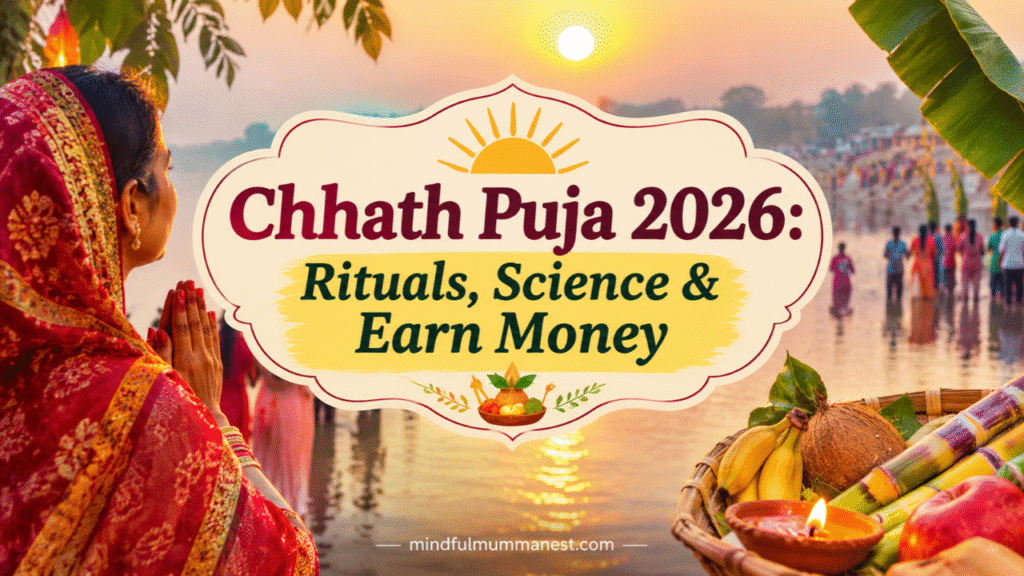
2. What Is Chhath Puja and When Is It Celebrated in 2026?
Chhath Puja, also known as Surya Shashthi, Chhathi, Dala Chhath and Chhath Mahaparv, is an important Hindu festival dedicated to Surya Dev (the Sun God) and Chhathi Maiya.
It is traditionally celebrated with great devotion in Bihar, Jharkhand, eastern Uttar Pradesh and Nepal’s Terai region. Today, people across India and many other countries also observe this festival.
Unlike several other Hindu festivals, Chhath traditionally does not require elaborate idol worship or expensive temple arrangements. Devotees offer prayers directly to the Sun, usually near a river, pond or another suitable water body.
The festival is observed twice a year:
- Kartik Chhath: Celebrated during October–November. This is the more widely observed Chhath festival.
- Chaiti Chhath: Celebrated during March–April, in the Hindu month of Chaitra.
When is Chhath Puja in 2026?
In 2026, Kartik Chhath Puja will be celebrated from Friday, 13 November to Monday, 16 November.
| Day | Date | Ritual |
| Day 1 | 13 November 2026, Friday | Nahay Khay |
| Day 2 | 14 November 2026, Saturday | Kharna |
| Day 3 | 15 November 2026, Sunday | Sandhya Arghya |
| Day 4 | 16 November 2026, Monday | Usha Arghya and Parana |
The main evening offering will take place on 15 November, followed by the morning offering on 16 November.
For the official festival information, visit Bihar Tourism – Chhath Puja.
3. Where Did Chhath Puja Begin? The Ancient Indian Connection
To understand Chhath Puja, we need to travel much further back than modern celebrations.
Long before electricity, scientific laboratories and weather forecasting, human civilisation depended on nature for survival.
The Sun provided warmth and light. Water supported agriculture and drinking needs. Rainfall determined harvests. People understood that without these natural elements, life could not continue.
This relationship between human beings and nature became deeply connected with ancient Indian spiritual traditions.
The connection with the Rigveda
The Rigveda contains several hymns dedicated to Surya and other solar deities.
One particularly interesting example is Rigveda Mandala 1, Sukta 115, which celebrates Surya as an essential force connected with the life of the moving and stationary world.
This tells us that reverence for the Sun has existed in Indian spiritual traditions for thousands of years.
However, there is an important historical distinction. The ancient tradition of solar worship is documented in Vedic literature, but historians have not established one exact year, person or geographical location as the definitive beginning of the present four-day Chhath festival.
We should therefore understand Chhath as a tradition that developed through ancient religious practices, regional customs, agricultural communities and generations of oral storytelling.
You can explore the Rigveda, Book 1, Hymn 115 – Surya.
The story of Karna from the Mahabharata
One popular traditional account connects Chhath with Karna, the son of Surya Dev and Kunti in the Mahabharata.
According to the epic, Karna was a devoted worshipper of the Sun. He offered prayers to his divine father and was remembered for his generosity, discipline and strength.
This story is frequently associated with the ancient practice of Sun worship.
Although the story is an important part of religious tradition, it does not independently establish Karna as the historical founder of Chhath Puja.
The story of Draupadi and the Pandavas
Another popular belief connects Chhath with Draupadi and the Pandavas.
According to traditional narratives, Draupadi observed Surya worship during the difficult period of the Pandavas’ exile.
The practice is associated with prayers for protection, well-being and the removal of difficulties.
The story of Lord Rama and Goddess Sita
Another traditional account connects Chhath with Lord Rama and Goddess Sita.
According to popular religious belief, after returning to Ayodhya, they observed a fast and worshipped the Sun.
These stories give the festival a strong place in Hindu religious memory.
But something remains common in all these accounts: gratitude towards the Sun, faith during difficult times and the belief that nature deserves respect.
The agricultural connection: An interesting historical perspective
There is another way to understand this festival.
The Middle Ganga Plains have supported agricultural communities for generations. The availability of water, sunlight, seasonal crops and fertile land has always been important for survival.
Researchers have also started examining Chhath through archaeology, ethnography and early agricultural traditions.
A recent academic study titled An Archaeological and Ethnographic Exploration of Ritual Survivals within Chhath Puja explores possible connections between the festival and early agrarian practices.
This is an interesting area of research, although it should not be treated as conclusive proof of the festival’s exact origin.
4. Why Is Chhath Puja So Closely Connected With Bihar?
This is one question that deserves a proper explanation.
If the Sun is worshipped across India, why did Chhath become such a powerful cultural identity of Bihar?
The answer lies in geography, agriculture, community life and generations of traditions.
1. The relationship with rivers and agriculture
Bihar has historically been shaped by important river systems, including the Ganga, Gandak, Kosi, Son and their tributaries.
These rivers have supported farming, settlements, trade and everyday life.
For agricultural communities, sunlight and water were not abstract religious ideas. They were essential for growing crops and sustaining families.
Chhath became a way of expressing gratitude towards these natural resources.
2. A tradition carried through generations
In Bihar, Chhath is often prepared and observed by entire families.
Mothers, grandmothers, daughters and daughters-in-law pass down recipes, fasting practices, folk songs and traditional methods of preparation.
Many women learn the rituals not from books but by watching older women in their families.
This oral transmission is one reason the festival has remained so deeply rooted.
3. A festival that brings people home
There is another beautiful reason.
For many people who leave Bihar for work, education or business, Chhath becomes a reason to return home.
Railway stations, bus stands and roads experience heavy festive movement.
The festival is not only about visiting a riverbank. It is also about returning to family, childhood memories and cultural roots.
4. The importance of community participation
Chhath is traditionally a community celebration.
People clean riverbanks, prepare ghats, arrange lighting, distribute prasad and help one another.
In many places, neighbours support families observing the fast, even if they are not personally observing it.
This shared participation gives the festival a strong social identity.
5. The connection with Chhathi Maiya
For devotees, Chhathi Maiya represents divine motherhood, protection and blessings for children and families.
Many women observe the fast with prayers for the health, happiness and well-being of their children.
This emotional and spiritual connection has helped the festival remain an important part of family life.
Chhath is not exclusive to Bihar, but Bihar has become its most recognised cultural centre.
5. Why Do Devotees Worship Both the Setting and Rising Sun?
This is perhaps the most beautiful part of Chhath Puja.
Most people associate the Sun with the beginning of a new day. But Chhath gives equal importance to the setting Sun.
Why?
Worshipping the setting Sun
During Sandhya Arghya, devotees offer water and prayers to the setting Sun.
It represents gratitude for the energy, light and opportunities received throughout the day.
There is also a beautiful human interpretation here.
We generally celebrate beginnings, success and new opportunities. But how often do we stop to appreciate something that is coming to an end?
The setting Sun reminds us that endings deserve gratitude too.
Worshipping the rising Sun
The next morning, devotees gather again for Usha Arghya.
The rising Sun represents a new beginning, hope, life and continuity.
The two rituals together create a meaningful cycle:
- Sunset reminds us to be grateful.
- Sunrise reminds us to begin again.
- The night between them represents patience, faith and discipline.
In religious tradition, the evening and morning offerings are associated with Pratyusha and Usha, respectively.
The Bihar Tourism Department also highlights the distinctive worship of both the setting and rising Sun.
Does anything in nature change after Chhath?
This is another interesting question.
Chhath is celebrated during Kartik Shukla Shashthi, around the transition from autumn towards winter in much of northern India.
However, there is no sudden astronomical or climatic change caused by Chhath Puja itself.
In the Northern Hemisphere, daylight hours continue to decrease towards the December winter solstice, which usually falls around 21 or 22 December.
After the solstice, daylight gradually begins increasing again.
Chhath therefore takes place during an interesting seasonal period, but the festival does not cause the seasonal change.
6. The Four Days of Chhath Puja: Complete Rituals and Traditions
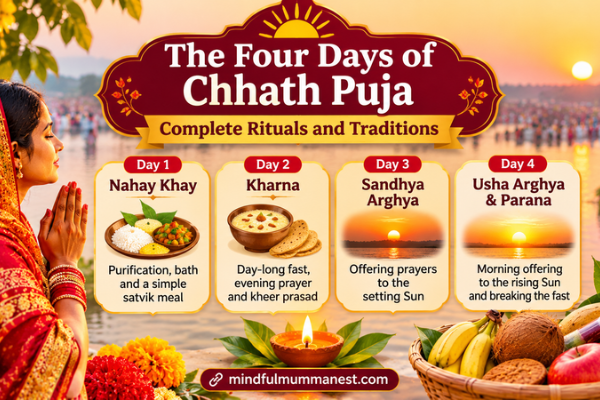
Chhath is not a one-day celebration. Preparations and rituals extend across four days.
Each day has its own purpose, food traditions and discipline.
Day 1: Nahay Khay – 13 November 2026
Nahay Khay marks the beginning of the festival.
The words themselves explain the process: bathing and eating.
Devotees take a bath, clean their homes and prepare themselves for the upcoming observance.
Traditional practices include:
- Cleaning the kitchen and cooking area.
- Bathing, sometimes in a river or another clean water source.
- Preparing a simple satvik meal.
- Avoiding onion and garlic in traditional preparations.
- Eating food prepared with special cleanliness.
A commonly prepared meal includes rice, chana dal and lauki (bottle gourd), sometimes cooked with ghee.
The purpose is to begin the festival with discipline and purity.
Day 2: Kharna – 14 November 2026
Kharna is one of the most important days.
Devotees generally observe a day-long fast and break it after sunset following their prayers.
Traditional Kharna prasad includes:
- Jaggery-based rice kheer.
- Roti or chapati.
- Bananas and other permitted fruits.
The food is prepared with great care, and the prasad is shared with family and neighbours.
After Kharna, many devotees begin the nirjala fast, which continues until the morning Arghya.
The duration is traditionally described as approximately 36 hours, although the exact duration varies with local sunrise, sunset and individual observance.
Day 3: Sandhya Arghya – 15 November 2026
This is the main evening celebration.
Families prepare bamboo baskets called soop or dala and arrange traditional offerings.
Devotees visit rivers, ponds or designated water bodies before sunset.
The offerings are placed in baskets, and prayers are made to the setting Sun.
Common activities include:
- Preparing thekua and other traditional prasad.
- Decorating bamboo baskets.
- Arranging fruits, sugarcane and coconuts.
- Carrying the offerings to the ghat.
- Standing in water and offering Arghya.
- Singing traditional Chhath folk songs.
What is Kosi Puja?
Kosi is a special ritual observed by some families, often involving a structure made with sugarcane sticks and decorated with earthen lamps and offerings.
Its exact practice and meaning vary across communities and family traditions.
It is often associated with gratitude, family well-being and the fulfilment of religious vows.
Day 4: Usha Arghya – 16 November 2026
The final day begins before sunrise.
Families return to the ghat and prepare for the morning offering.
As the first rays appear, devotees offer Arghya to the rising Sun.
After completing the prayers, the fast is broken. This is known as Parana.
Prasad is distributed among relatives, neighbours and visitors.
The festival concludes with blessings, gratitude and a sense of completion.
One thing to remember: Chhath traditions vary by household. Not every family performs every additional ritual in exactly the same way.
7. Chhath Puja 2026: Panchang, Tithi and City-Wise Timings
The correct time for Arghya is connected with the local sunset and sunrise.
There is no single sunset or sunrise time applicable to every Indian city.
According to the 2026 Drik Panchang calendar for Patna:
| Ritual | Date | Patna Panchang reference |
| Nahay Khay | 13 November | Sunrise 6:05 AM |
| Kharna | 14 November | Sunset 5:01 PM |
| Sandhya Arghya | 15 November | Sunset 5:01 PM |
| Usha Arghya | 16 November | Sunrise 6:07 AM |
Important Tithi information
For Patna, the Shashthi Tithi begins at approximately 11:23 PM on 14 November 2026 and ends at approximately 2:00 AM on 16 November 2026.
These are location-specific Panchang calculations.
City-wise Sandhya and Usha Arghya timings
The following timings are local Indian Standard Time references for 15 and 16 November 2026.
| City | Sandhya Arghya, 15 November | Usha Arghya, 16 November |
| Patna | 5:01 PM | 6:07 AM |
| Gaya | 5:03 PM | 6:06 AM |
| Muzaffarpur | 4:59 PM | 6:07 AM |
| Darbhanga | 4:57 PM | 6:05 AM |
| Bhagalpur | 4:54 PM | 5:59 AM |
| Ranchi | 5:04 PM | 6:03 AM |
| Jamshedpur | 5:01 PM | 5:59 AM |
| Varanasi | 5:10 PM | 6:15 AM |
| Gorakhpur | 5:06 PM | 6:16 AM |
| Lucknow | 5:16 PM | 6:26 AM |
| Prayagraj | 5:15 PM | 6:20 AM |
| Delhi | 5:28 PM | 6:44 AM |
| Chandigarh | 5:26 PM | 6:50 AM |
| Kolkata | 4:53 PM | 5:49 AM |
| Mumbai | 6:00 PM | 6:46 AM |
Important: These are astronomical sunset and sunrise references, not a guarantee that the Sun will be visible at that exact minute from every ghat. Buildings, hills, trees, clouds and local surroundings can affect visibility.
For the final local calculation, always select your city in Drik Panchang – Chhath Puja Calendar 2026.
You can also check Incredible India – Chhath Puja for the festival dates and traditional observance.
8. Chhath Puja Samagri: Thekua, Soop, Sugarcane and Traditional Offerings
One cannot discuss Chhath Puja without discussing its prasad.
The offerings are not merely food items. They represent agriculture, local craftsmanship, seasonal produce and the traditional kitchen of eastern India.
Thekua
Thekua is perhaps the most recognised food associated with Chhath.
It is traditionally prepared using:
- Whole wheat flour.
- Jaggery.
- Ghee.
- Fennel seeds.
- Coconut or cardamom in some recipes.
The dough is shaped using traditional wooden moulds and fried.
Thekua is valued for its taste, cultural identity and suitability for sharing as prasad.
Bamboo Soop and Dala
These baskets carry the offerings to the riverbank.
Bamboo craftsmanship is particularly important because local artisans prepare baskets and other traditional items for the festival.
Sugarcane
Sugarcane is a familiar offering during Chhath.
It represents agricultural abundance and is also used in some families’ Kosi arrangements.
Coconut and Seasonal Fruits
Common offerings include:
- Coconut.
- Banana.
- Apple.
- Sweet lime.
- Lemon.
- Pomegranate.
- Seasonal local fruits.
The exact selection varies according to region, availability and family custom.
Other Traditional Offerings
Kasar, rice laddoos, jaggery preparations, rice kheer and traditional breads are also found in different Chhath households.
The important point is that the festival uses many ingredients connected with the local agricultural economy.
For a glimpse of traditional Bihar food culture, explore Bihar Tourism.
9. The Scientific Connection: Sunlight, Water, Fasting and Human Health
Now comes a particularly interesting part.
We often hear that Chhath Puja has scientific benefits. But what exactly can science explain, and what belongs to religious belief?
Let’s understand the difference.
9.1 The Sun is essential for life
The Sun is the primary source of energy for most life on Earth.
It supports photosynthesis, which allows plants to produce food. It influences weather patterns, the water cycle and seasonal changes.
Without solar energy, our agricultural systems and ecosystems would be completely different.
So when devotees express gratitude towards the Sun, we can understand the natural importance behind this practice.
9.2 Morning sunlight and Vitamin D
Sunlight helps our skin produce Vitamin D through exposure to ultraviolet B radiation.
Vitamin D supports calcium absorption and bone health.
However, this does not mean that standing in the river during Chhath automatically provides enough Vitamin D.
The amount produced depends on:
- Time of day.
- Season.
- Cloud cover.
- Air pollution.
- Skin pigmentation.
- Clothing and exposed skin.
- Individual health factors.
There is also a difference between receiving safe daylight exposure and exposing ourselves to excessive ultraviolet radiation.
Never look directly at the Sun to obtain health benefits.
Read the NIH Vitamin D Fact Sheet for detailed scientific information.
9.3 Why is water important during Chhath?
Water has always been central to human civilisation.
Rivers and ponds support agriculture, drinking-water systems, biodiversity and community life.
Standing near a clean water body during the festival also creates a direct connection with nature.
But there is an important distinction: ritual immersion does not scientifically purify polluted water. Clean water and safe ghats are essential.
9.4 Does fasting detoxify the body?
This is where we need to be careful.
Some people believe fasting gives the digestive system a break or removes toxins. However, there is no established scientific evidence that the specific Chhath nirjala fast detoxifies the body or cures diseases.
The human body already has organs, particularly the liver and kidneys, that process and eliminate waste products.
Long periods without water can cause dehydration and may be dangerous.
Chhath is a religious observance, not a medical treatment.
People with diabetes, kidney or heart conditions, pregnant women, older adults and those taking regular medication should seek medical advice before undertaking prolonged fasting.
9.5 Why do people value discipline and cleanliness during Chhath?
There is a practical aspect to the traditional preparation.
Cleaning the house, preparing food separately, washing utensils, maintaining a clean cooking area and protecting the offerings are all practices that can support better hygiene.
However, hygiene depends on how these activities are carried out, not simply on the religious intention behind them.
9.6 What is the significance of seasonal foods?
Traditional offerings often include fruits, rice, wheat and sugarcane.
These foods are connected with regional agricultural production and seasonal availability.
Their nutritional value depends on the actual food and quantity consumed. Jaggery, for example, is still an added sugar, even though it is less refined than white sugar.
The scientific lesson is not that every traditional offering is medicinal. It is that food, agriculture, sunlight and water have always been closely connected with Indian cultural life.

10. November Weather, Seasonal Changes and Climate Change
Have you ever noticed how Chhath Puja arrives around the time when northern India starts moving from autumn towards winter?
This timing is interesting from a geographical and seasonal perspective.
Why is Chhath celebrated in Kartik?
Kartik falls around October–November in the Gregorian calendar.
In much of northern India, this period follows the main southwest monsoon season.
The weather generally starts becoming cooler, humidity often decreases and mornings can become misty in the Indo-Gangetic plains.
These are general seasonal patterns, not fixed weather conditions for every year.
The India Meteorological Department classifies October–December as the post-monsoon season for its national seasonal summaries.
How does the weather affect Chhath celebrations?
Weather has a direct effect on preparations.
Cooler mornings: Devotees may experience cold conditions while standing in water.
Fog: Morning visibility can be reduced in parts of northern India.
Air pollution: Pollution can affect breathing and visibility, particularly in urban areas.
Water levels: Rivers and ponds may have different water levels after the monsoon.
Rainfall: Unseasonal rain can affect temporary ghats and outdoor arrangements.
Is climate change changing Chhath Puja?
Climate change is not changing the religious calendar itself, but it can influence the conditions in which people observe the festival.
Changing temperatures, rainfall variability, river flows and extreme weather events can affect:
- The availability and quality of water.
- The condition of riverbanks.
- Agricultural production of fruits and sugarcane.
- The availability and price of seasonal offerings.
- The safety of devotees during outdoor rituals.
According to the India Meteorological Department’s Statement on the Climate of India during 2025, India’s annual mean land surface air temperature was 0.28°C above the 1991–2020 average. The report also recorded variations in rainfall across different seasons.
This reminds us why long-term weather and climate records deserve attention.
Read the IMD Statement on the Climate of India during 2025.
One important lesson
If we worship the Sun and offer prayers to rivers, we should also take responsibility for protecting them.
That means keeping plastic, chemical waste, synthetic decorations and other pollutants away from our water bodies.
Our traditions can remain beautiful only when the natural resources connected with them remain healthy.
11. How Different States and Districts Celebrate Chhath Puja
Chhath is strongly associated with Bihar, but its cultural journey has travelled much further.
As people migrated for education, employment and business, they carried their festivals, food, folk songs and family customs with them.
Bihar: The heart of Chhath
Bihar remains the cultural centre of the festival.
The celebrations are particularly prominent in Patna, Gaya, Muzaffarpur, Darbhanga, Bhagalpur, Bhojpur, Saran, Nalanda and other districts.
Patna: The Ganga ghats become major gathering places. Families prepare traditional baskets and offer Arghya together.
Gaya: Chhath is celebrated at rivers, ponds and traditional worship locations. The famous Deo Sun Temple in Aurangabad district is also closely associated with Sun worship.
Muzaffarpur: Families prepare traditional prasad, observe fasting rituals and gather at local water bodies.
Darbhanga and Madhubani: Maithili folk songs and regional food traditions add their own character to the celebration.
Bhojpur and Saran: Traditional Bhojpuri Chhath songs are an important part of the celebration.
Bhagalpur: Communities celebrate near local water bodies and riverbanks, with traditional offerings and family participation.
Jharkhand: A strong community tradition
Chhath is widely observed in Ranchi, Dhanbad, Jamshedpur, Bokaro, Deoghar and other parts of Jharkhand.
Families gather at ponds, rivers and community ghats.
Thekua, bamboo baskets, seasonal fruits and traditional folk songs remain central to the celebrations.
Uttar Pradesh: Purvanchal and beyond
Eastern Uttar Pradesh has a strong connection with Chhath.
Important celebrations take place in Varanasi, Gorakhpur, Ballia, Deoria, Azamgarh, Ghazipur and other districts.
In Varanasi, devotees gather near the Ganga ghats. In Gorakhpur and neighbouring districts, families use local ponds, rivers and community arrangements.
Lucknow and other urban areas also organise celebrations at designated water bodies.
Nepal: The Terai connection
Chhath is an important festival in Nepal, particularly in the Madhesh and Terai regions.
Janakpur, Birgunj and other towns observe the festival with traditional offerings, folk songs and gatherings at water bodies.
The shared cultural connections between Bihar, Mithila and Nepal make this particularly interesting.
Delhi, Mumbai and other metropolitan cities
Chhath has travelled with migrant communities.
In Delhi, community celebrations take place at designated water bodies and organised ghats.
Mumbai, Kolkata, Chandigarh, Surat and other cities also have Chhath celebrations.
Where a suitable natural river or pond is unavailable, communities may arrange authorised artificial water facilities.
Indian families living abroad
The festival is also observed by Indian communities in countries such as the United Kingdom, the United States, Mauritius and other parts of the world.
Families use locally permitted water bodies or community arrangements and follow their traditional observances.
The setting changes, but the meaning remains the same: gratitude, devotion and family connection.
For additional regional cultural information, visit Incredible India – Chhath Puja.
12. How Chhath Puja Creates Livelihoods and Helps Women Earn Money
Now, let’s connect this festival with something we discuss regularly at Mindful Mumma Nest: earning money.
Sometimes, we look at a festival only as an occasion for spending. We buy fruits, sweets, clothes, decorations and gifts.
But behind every festival market, there are people working.
There are farmers growing sugarcane, women preparing thekua, bamboo artisans making baskets, fruit sellers arranging their stalls and small business owners preparing seasonal products.
This is where Chhath becomes more than a religious celebration. It also becomes an important seasonal livelihood opportunity.
12.1 Thekua business from home
If you are good at cooking, traditional thekua can become a seasonal product.
You can start with a small quantity and take advance orders from neighbours, relatives and local community groups.
Possible products include:
- Traditional jaggery thekua.
- Coconut thekua.
- Fennel-flavoured thekua.
- Small family prasad boxes.
- Gift packs for people living away from home.
Maintain food hygiene, ingredient transparency, proper packaging and realistic pricing.
For food businesses, check the applicable registration and licensing requirements through FSSAI.
12.2 Chhath Puja fruit and prasad baskets
Many families prefer ready-to-carry festive baskets.
Women can prepare customised baskets containing:
- Bananas.
- Coconut.
- Seasonal fruits.
- Sugarcane.
- Traditional prasad.
- Decorative cloth and packaging.
You can offer different basket sizes according to customer requirements.
Start by taking advance orders instead of purchasing too much stock.
12.3 Bamboo basket and traditional craft business
Bamboo artisans are an important part of the Chhath economy.
If you do not make baskets yourself, you can collaborate with local artisans, source their products and sell them through social media or local networks.
This can also help traditional craftsmanship reach customers beyond the local market.
12.4 Festival food orders and tiffin services
Chhath creates demand for traditional meals and specific food preparations.
Women who already have cooking skills can explore:
- Pre-ordered traditional meals.
- Small family prasad packages.
- Thekua preparation.
- Festive snack boxes.
- Food orders for families travelling or hosting guests.
However, fasting food has specific household requirements. Always confirm ingredients and preparation preferences before accepting an order.
For a practical starting guide, read our earlier article:
How to Earn Money with Tiffin Service: A Home Business Opportunity for Housewives
12.5 Digital content and festival storytelling
You do not necessarily have to sell physical products.
You can also earn money by creating useful digital content around festivals.
For example:
- Chhath Puja preparation checklists.
- Printable shopping lists.
- Regional festival guides.
- Recipe videos.
- Short videos explaining traditional rituals.
- Festival-related blog posts.
- Social media content for local businesses.
You can use free or beginner-friendly tools such as Canva, CapCut and Google Docs.
If you enjoy writing or teaching, these skills can become useful starting points.
Explore our guides:
12.6 Festival photography, design and local marketing
Local sweet shops, fruit sellers, clothing stores and small businesses often need help presenting their products during festivals.
If you understand basic design and social media, you could offer:
- Festival posters.
- WhatsApp promotional designs.
- Instagram posts.
- Product photography.
- Short promotional videos.
- Basic business listing management.
These are service-based opportunities that do not necessarily require buying inventory.
12.7 A small earning plan for beginners
Here is an illustrative example of how a woman might test a seasonal thekua business.
| Particulars | Example |
| Orders | 20 boxes |
| Selling price per box | ₹250 |
| Total sales | ₹5,000 |
| Ingredients and packaging | ₹2,500 |
| Other expenses | ₹500 |
| Estimated surplus before valuing personal labour | ₹2,000 |
These are illustrative calculations, not guaranteed earnings or market quotations. Actual results depend on ingredients, labour, packaging, transport and local demand.
The idea is not to turn every religious tradition into a business. It is to recognise the skills, craftsmanship and work that already exist within our communities.
At Mindful Mumma Nest, we believe that earning money can begin with something you already know how to do.
And sometimes, that skill is sitting quietly in your own kitchen.
13. How to Celebrate an Environment-Friendly and Safe Chhath
A festival that celebrates nature should also teach us how to protect it.
Here are a few simple things every family and community can practise.
Before going to the ghat
- Check the local water conditions and official arrangements.
- Avoid entering deep or unfamiliar water.
- Keep children away from the water’s edge without supervision.
- Wear footwear suitable for wet and slippery surfaces.
- Carry warm clothing for early morning celebrations.
- Follow local administration instructions.
During the fast
A nirjala fast can be physically demanding.
People with diabetes, kidney or heart conditions, pregnant women, older adults and those taking regular medication should seek medical advice before undertaking prolonged fasting.
Never ignore dizziness, confusion, fainting, severe weakness or signs of dehydration.
Religious observance should not require someone to put their life at risk.
Protecting rivers and ponds
- Avoid plastic bags and disposable decorations.
- Do not leave food packaging at ghats.
- Use biodegradable offerings where possible.
- Dispose of flowers and organic waste responsibly.
- Keep chemical colours and other pollutants away from water bodies.
- Participate in community cleaning activities.
Our rivers are not only places of worship. They are ecosystems supporting millions of lives.

14. Guest Corner
At Mindful Mumma Nest, we always believe that knowledge becomes more beautiful when it is shared.
This Chhath Puja, I want to appreciate every mother, daughter, grandmother and homemaker who keeps our traditions alive through her patience, preparation and everyday efforts.
To our Mindful Momanis, thank you for reminding us that culture is not preserved only in books. It lives in our kitchens, our songs, our families and the little things we pass on to the next generation.
And if you have a Chhath memory, a family recipe or a traditional story, keep sharing it. Your experiences are part of India’s living heritage.
15. Frequently Asked Questions
1. When is Chhath Puja in 2026?
13–16 November 2026.
2. Why is Chhath Puja mainly celebrated in Bihar?
It developed a strong cultural identity through Bihar’s agricultural, river-based and family traditions.
3. Which God is worshipped during Chhath?
Surya Dev and Chhathi Maiya.
4. Why is the setting Sun worshipped?
It represents gratitude towards nature and the life-sustaining energy of the Sun.
5. Is Chhath Puja celebrated twice a year?
Yes. Kartik Chhath and Chaiti Chhath.
6. Can women earn money during Chhath?
Yes. Traditional food, festive baskets, crafts and digital services offer seasonal business opportunities.
16. Sources and Tools
For this article, we have prioritised government tourism information, Panchang calculations, established cultural references and scientific resources.
These are also useful links for readers who want to explore the subject further.
1. Bihar Tourism – Chhath Puja
A government resource explaining the four-day festival, its rituals, cultural traditions and celebrations across Bihar.
2. Drik Panchang – Chhath Puja Calendar 2026
Useful for festival dates, Tithi, sunrise, sunset and location-specific Panchang calculations.
3. Incredible India – Chhath Puja
A government tourism resource explaining the four-day celebration and its cultural significance.
4. Rigveda – Book 1, Hymn 115
An accessible English translation of an ancient hymn dedicated to Surya, useful for understanding India’s historical tradition of solar worship.
5. NIH – Vitamin D Fact Sheet
Scientific information about Vitamin D, sunlight exposure, its role in the body and factors affecting its production.
6. India Meteorological Department – Climate of India 2025
Official climate information about India’s annual temperature, rainfall patterns, seasonal variations and extreme weather events.
17. Final Thoughts: A Tradition That Connects Our Past and Future
As I understand Chhath Puja, its beauty is not limited to four days of fasting and prayers. It is about remembering the Sun, respecting water, appreciating food and staying connected with our roots.
And perhaps the most beautiful lesson is this: we should not wait for something new to arrive before expressing gratitude. Even the setting Sun deserves our prayers.
At Mindful Mumma Nest, I hope we continue learning from our traditions while building confidence, knowledge and opportunities to earn money. Because our roots give us identity, and our skills help us build our future.